Piano Lessons for Kids Bay Area 2026 — Studios, Prices & Readiness Guide
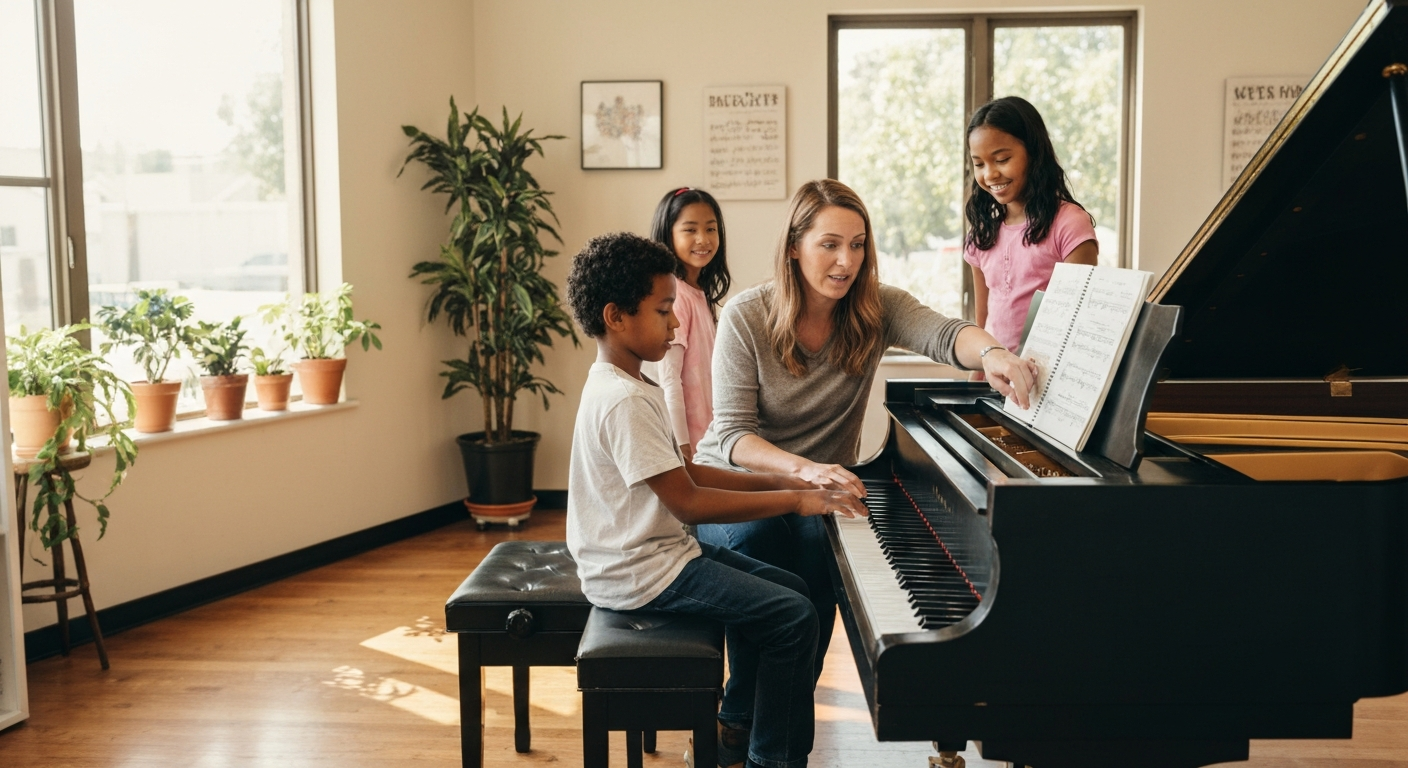
Your 6-year-old wants to play piano. Do you start with group classes or private lessons? Suzuki or traditional method? And how do you know if your child is actually ready?
Quick Answer: Most Bay Area kids start piano lessons between ages 5-7. Group classes run $25-$40/month (30-45 min sessions); private lessons range $50-$70/hour in South Bay and East Bay, $80-$150/hour on the Peninsula. Look for teachers with college music degrees or certification. Trial lessons cost $25-$40. Your child is ready when they can focus for 30 minutes, recognize numbers 1-5, and show genuine interest in music.
Every Bay Area parent I talk to wants their kid to learn piano. But most hit the same walls: "Is my 5-year-old too young?" "Do we need a real piano or will a keyboard work?" "How do I tell if a teacher is any good?"
Here's what you need to know before booking that first trial lesson.
Is Your Child Ready for Piano Lessons?
Build your summer plan
Map every week of summer in 3 minutes
KidPlanr lays out every week with camps that match each kid's age and interests — and tracks which weeks still have spots.
Build my calendar →Forget the birthday rule. Readiness beats age every time.
The 5 Signs Your Child Is Ready
Your child can handle formal piano lessons when they can:
- Focus for 30 minutes — Sit still and follow instructions for a full lesson
- Span five keys comfortably — Their hand fits the keyboard without strain
- Recognize numbers 1–5 and basic letters — Piano uses finger numbers and note names
- Show genuine interest — They ask about the piano, sing along, explore sounds
- Handle gentle correction — Music lessons involve a lot of "try again"
What this means for your family: If your 4-year-old can do all five, great. If your 7-year-old can't focus yet, wait. Individual readiness always beats calendar age.
How common is it to start early: Most Bay Area piano teachers recommend ages 5-7 as the sweet spot. About 30% of their students start at age 5, 50% at ages 6-7, and 20% at age 8 or older.
What you can do now: Test readiness with a trial lesson. Most Bay Area studios offer $25-$40 trials. Your child will know within 15 minutes if they're into it.
What NOT to over-interpret: If your child isn't ready at 5, that doesn't mean they won't love piano at 7. Interest develops. Physical readiness develops. Starting "late" at age 8 is totally fine.
Ages 3-4: Music Exploration (Not Formal Lessons Yet)
If your toddler loves music but isn't quite ready for lessons, try:
- Music Together classes — Parent-child music play (available at many Bay Area community centers)
- Musikgarten — Early childhood music programs (ages 0-4)
- Just playing — Let them bang on keys, sing songs, explore sounds
The only risk with formal lessons before age 5 is frustration on both sides if your child isn't developmentally ready yet.
Group Classes vs. Private Lessons: Which Format to Choose
This is the first real decision. And it matters.
| Format | Best For | Typical Cost (Bay Area) | Session Length | Ages |
|---|---|---|---|---|
| Group classes | Beginners ages 4.5–7; budget-conscious families; kids who like peer energy | $25-$40/month (4-6 kids per class) | 30-45 min/week | 4.5-7 |
| Private lessons | Kids with prior experience; ages 7+; serious students; flexible scheduling needs | $50-$70/hour (South Bay, East Bay); $80-$150/hour (Peninsula) | 30-60 min/week | 5+ |
| Hybrid | Kids transitioning from group to private; families wanting both social + focused instruction | Group: $30/month + Private: $200-$280/month (4 lessons) | 30 min group + 30 min private | 6+ |
When Group Classes Work Best
Ages 4.5-6: Group piano classes are often the perfect entry point. Kids learn together, stay engaged through peer energy, and parents pay less while figuring out if their child will stick with it.
Ensemble Schools (Fremont, Palo Alto, San Jose locations) runs beginner group classes for ages 4.5-6. As of 2026, their 45-minute classes cost $210 for a semester with 3-6 kids per class. Materials are about $21 additional.
Masako's Music Studio (Fremont/Newark) offers group piano for young beginners. Check their current pricing directly.
What changes: After 6-12 months of group classes, most kids either lose interest (and you're glad you didn't commit to $200/month private lessons) or they want more — and that's when you transition to private.
When Private Lessons Are Worth It
Ages 7+, or any age if your child:
- Already plays and needs focused instruction
- Wants to progress faster
- Has specific goals (recitals, competitions, exams)
- Learns better one-on-one
Private lessons give your child the teacher's full attention. Progress is faster. But it's also more expensive and requires more parental involvement (practice supervision, weekly commitment).
10 Bay Area Piano Studios & Programs (2026)
Here's where Bay Area parents actually go for piano lessons. Prices are verified from studio websites as of May 2026. Always confirm current pricing and availability when you contact them.
Peninsula & South Bay
1. The California Conservatory of Music
Locations: Redwood City, Sunnyvale, Fremont
Formats: Private lessons, group classes, Suzuki program
Ages: 4+
Price range: $70-$120/hour for private lessons (varies by teacher experience and location)
What parents like: Multiple Bay Area locations, Suzuki-certified teachers, performance opportunities
Trial lesson: Contact for pricing
Website: thecaliforniaconservatory.com
2. New Mozart School
Location: Palo Alto, Menlo Park, Redwood City, Los Altos, Mountain View
Formats: Private lessons
Ages: 5+
Price range: Contact for current rates; trial lessons $30 for 30 minutes
What parents like: Discounted trial lessons, experienced teachers, convenient Peninsula locations
Website: newmozartschool.com
3. Opus 1 Music Studio
Locations: Palo Alto, Mountain View
Formats: Private lessons for piano, violin, cello, guitar
Ages: All ages
Price range: $80-$120/hour (Peninsula pricing)
What parents like: Experienced instructors, recital opportunities
Website: musicopus1.com
4. Ensemble Schools
Locations: Fremont, Palo Alto, San Jose
Formats: Group classes (ages 4.5-6), private lessons
Ages: 4.5+
Price range: Group classes ~$210/semester; private lessons contact for pricing
What parents like: Beginner-friendly group classes, multiple South Bay locations
Trial lesson: Contact for current offerings
Website: ensembleschools.com
San Francisco
5. The Music Room SF
Location: San Francisco
Formats: Private lessons, group classes
Ages: 3+
Price range: Contact for current rates
What parents like: Non-competitive environment, focus on musicianship and creativity
Website: musicroomsf.com
6. Little Mission Studio
Location: San Francisco
Formats: Private lessons
Ages: 5+
Price range: $80-$100/hour (San Francisco pricing)
What parents like: Tailored approach, welcoming environment
Website: littlemissionstudio.com
7. McAllister Music Studio
Location: San Francisco
Formats: In-person and online private lessons
Ages: Children and adults
Price range: Contact for current rates
What parents like: Online lesson option, voice and songwriting available too
Website: mcallistermusicstudiosf.com
East Bay
8. Starland School of Music
Location: Alameda
Formats: Private lessons
Ages: All ages and skill levels
Price range: $50-$70/hour (East Bay pricing)
What parents like: 30+ years in the Bay Area, experienced teachers
Website: starlandmusic.com
9. Masako's Music Studio
Locations: Fremont, Newark
Formats: Private and group classes
Ages: All ages
Price range: Contact for current rates
What parents like: Both private and group options, East Bay convenience
Website: masakomusic.net
10. Soundwise Piano Studio
Location: Berkeley
Formats: Private lessons, group classes
Ages: Kids and adults
Price range: $60-$80/hour (Berkeley pricing)
What parents like: Berkeley location, experienced instructor
Website: soundwisestudio.com
Marin County
Marin Piano Studio (Corte Madera) offers lessons for children and adults. Contact them directly for current pricing and availability. marinpianostudio.com
Suzuki vs. Traditional Method: What's the Difference?
You'll hear "Suzuki" a lot. Here's what it actually means.
Suzuki Method
The approach: Kids learn by ear first (like learning to speak before reading). Parents attend every lesson and become the "home teacher." Emphasis on listening to recordings, playing by ear, group classes alongside private lessons.
Best for: Ages 3-6, kids who love imitating, families who can commit to high parental involvement
Bay Area Suzuki programs: The California Conservatory (Redwood City, Sunnyvale, Fremont) offers Suzuki-certified piano instruction.
What parents like: Younger kids can start before they can read. Lots of peer support through group classes. Strong foundation in listening and ear training.
What parents find hard: Requires parents to attend every lesson and supervise daily practice. More time commitment than traditional.
Traditional Method
The approach: Start with reading music notation from day one. Focus on technique, theory, and note-reading. Less parent involvement required (drop-off lessons are fine).
Best for: Ages 6+, kids who like reading and puzzles, families who can't attend every lesson
Bay Area traditional programs: Most of the studios listed above use traditional method or a mix of both.
What parents like: Kids become independent faster. Less parental time commitment. Straightforward progression through method books.
Hybrid (Most Common)
Many Bay Area teachers blend both: start with some ear training and fun songs (Suzuki-inspired) but introduce note-reading earlier than pure Suzuki. This is often the best of both worlds.
What you can do now: Ask teachers during trial lessons: "Do you teach Suzuki, traditional, or a mix?" There's no wrong answer — just what fits your family.
What Piano Lessons Actually Cost in the Bay Area (2026)
Let's talk real numbers.
Group Classes
- $25-$40/month for 30-45 minute weekly classes
- 3-6 kids per class
- Best value for ages 4.5-6 testing interest
Private Lessons (South Bay & East Bay)
- $50-$70/hour — Most common range in San Jose, Fremont, Alameda, Oakland
- $200-$280/month for weekly 30-minute lessons
- $400-$560/month for weekly 60-minute lessons
Private Lessons (Peninsula & San Francisco)
- $80-$150/hour — Palo Alto, Menlo Park, Los Altos, Mountain View, San Francisco
- $320-$600/month for weekly 30-minute lessons
- $640-$1,200/month for weekly 60-minute lessons
Hidden Costs
- Method books & sheet music: $20-$50/year
- Piano or keyboard: $200-$500 for starter digital keyboard; $3,000+ for acoustic piano
- Recital fees: $0-$50/year (varies by studio)
- Performance attire: $30-$60 if recitals require specific dress
Year 1 total investment: Expect $2,500-$7,000 depending on lesson frequency, instrument purchase, and location.
Scary content (Peninsula pricing): Private piano lessons in Palo Alto/Los Altos range $80-$150/hour. At $120/hour weekly, that's $480/month or $5,760/year before buying a piano.
Anti-anxiety plan: Group classes start at $25-$40/month. Many studios offer trial periods. South Bay and East Bay options average $50-$70/hour for private lessons. Community centers (Palo Alto Community Services, San Jose Parks & Rec) sometimes offer subsidized music classes. Start with a $200 digital keyboard — you don't need an acoustic piano for the first year.
Do You Need to Buy a Piano?
Short answer: not yet.
Year 1: Digital Keyboard Is Fine
For the first 6-12 months, a basic digital keyboard works perfectly. Look for:
- 61 or 88 keys (88 is better long-term)
- Touch-sensitive keys (volume changes when you press harder)
- Sustain pedal jack (you'll need it by month 6)
Budget pick: Yamaha P-45 or similar ($200-$400)
Mid-range: Casio Privia PX-160 ($400-$600)
Year 2+: Consider an Acoustic Piano
If your child is still playing after a year and progressing, an acoustic piano becomes worth it. The touch, tone, and feel are different. Most serious students need one by year 2-3.
What you can do now: Rent before buying. Bay Area piano stores (Piedmont Piano Company, Truesdell Piano) offer rent-to-own programs. Test for 6 months before committing $3,000-$8,000.
How to Evaluate a Piano Teacher (5-Question Checklist)
Not all piano teachers are created equal. Here's what to ask in trial lessons:
1. What's your teaching background?
What to listen for: College music degree, performance experience, or teaching certification. Years teaching kids specifically (not just "I've been playing since age 5").
Red flag: No formal training, no references, vague about credentials.
2. How do you handle a beginner who's struggling?
What to listen for: Specific examples ("I break it into smaller sections," "I find a different song they like," "I adjust the pace"). Patience and problem-solving.
Red flag: "They just need to practice more." That's not teaching.
3. Do you teach reading music or playing by ear?
What to listen for: Clear answer about their method (Suzuki, traditional, hybrid). Matches what your family wants.
Red flag: Dismissive of other methods. Good teachers respect multiple approaches.
4. What's your policy on missed lessons and makeup classes?
What to listen for: Clear written policy. Reasonable flexibility (illness, emergencies).
Red flag: No makeups ever, or unclear/changing policies.
5. Can I observe lessons or get progress updates?
What to listen for: Yes for young kids (parent observation is normal). Regular check-ins about progress.
Red flag: "Parents just drop off." For kids under 10, you need visibility.
Utility test: Would a parent actually use this in the next 7-14 days when shopping for teachers? YES — parents will book 2-3 trial lessons and use this checklist to compare.
Integration test: Does the post naturally build toward this checklist? YES — the entire post explains what good piano teaching looks like, so asking these 5 questions is the logical next step.
What to Expect: Month-by-Month First Year
Months 1-2: Getting Comfortable
Your child learns finger numbers (1-5), hand position, and plays simple one-handed melodies. Practice is 10-15 minutes daily. Expect some resistance — that's normal.
Months 3-4: Reading Music Starts
Basic note-reading (treble clef for right hand). Two hands together on easy songs. Practice increases to 15-20 minutes. You'll hear the same song 100 times.
Months 5-6: First Milestone
Your child can play simple songs with both hands. They recognize quarter notes, half notes, whole notes. First mini-recital or performance for family.
Months 7-9: Building Repertoire
Learning 3-5 new songs. Introduction to dynamics (loud/soft) and phrasing. Practice time 20-25 minutes most days. More independence.
Months 10-12: Year-End Progress
Can play 10-15 songs from memory. Reads music fluently in both clefs (treble and bass). Ready for intermediate books. First formal recital.
What changes: By month 6, you'll know if your child is serious. That's when parents typically upgrade from keyboard to acoustic piano and commit to year 2.
Finding Free & Low-Cost Piano Options in the Bay Area
Not everyone can afford $200-$600/month for private lessons. Here are alternatives:
Community Centers
- Palo Alto Community Services — Subsidized music classes for residents
- San Jose Parks & Recreation — Group music classes at discounted rates
- Oakland Parks & Rec — Music programs for kids
Music Schools with Financial Aid
Some Bay Area music schools offer sliding-scale tuition or scholarship programs. Ask directly:
- The California Conservatory
- Community Music Center (San Francisco)
YouTube + Self-Teaching (Ages 10+)
For families on tight budgets, older kids (10+) can learn basics through free YouTube lessons (Hoffman Academy, Piano with Beth) and then invest in formal lessons once they've proven commitment.
What you can do now: Check your city's recreation department for subsidized music classes. Call studios on this list and ask if they offer financial aid or sliding scale tuition.
Cross-Track Link: Planning Summer Camps Too?
If you're mapping out your child's year-round activities, don't forget summer. Many kids continue piano through summer or take a break for camp.
Planning summer camps too? Search 3,000+ Bay Area camps →
Internal Links
Related activities and decision guides:
- Best Afterschool Activities for Kids in Bay Area 2026
- Music Lessons for Kids in Bay Area 2026
- How to Choose Afterschool Activities for Your Child
- Gymnastics Classes for Kids in Bay Area 2026
- Swimming Lessons for Kids in Bay Area 2026
Frequently Asked Questions
Q: What's the best age to start piano lessons?
A: Most kids are ready between ages 5-7, but readiness matters more than age. Look for these signs: can focus for 30 minutes, span five keys, recognize numbers 1-5, and show genuine interest in music.
Q: How much do piano lessons cost in the Bay Area?
A: Group classes run $25-$40/month. Private lessons are $50-$70/hour in South Bay and East Bay, $80-$150/hour on the Peninsula and San Francisco. Expect $200-$600/month for weekly lessons depending on location and lesson length.
Q: Do I need to buy a piano right away?
A: No. A digital keyboard ($200-$400) works great for the first year. Upgrade to an acoustic piano if your child is still playing and progressing after 12 months.
Q: Group classes or private lessons for beginners?
A: Group classes work well for ages 4.5-7 testing interest. They're more affordable ($25-$40/month) and kids enjoy learning with peers. Transition to private lessons after 6-12 months if your child wants to progress faster.
Q: What's the difference between Suzuki and traditional piano methods?
A: Suzuki teaches by ear first (no reading music initially) and requires parents to attend every lesson. Traditional starts with reading music from day one and needs less parent involvement. Many teachers blend both approaches.
Q: How long are piano lessons for kids?
A: Beginners (ages 5-7) start with 30-minute lessons. Ages 8+ often do 45-60 minute lessons as they advance. Weekly lessons are standard.
Q: Can my child learn piano on a keyboard?
A: Yes for the first year. Look for 88 keys, touch-sensitive (velocity-sensitive) keys, and a sustain pedal jack. After a year of consistent practice, consider upgrading to an acoustic piano for better touch and tone.
Final Checklist: Before You Book That First Lesson
- [ ] My child shows at least 3 of the 5 readiness signs
- [ ] I've decided on group classes or private lessons based on age and budget
- [ ] I've researched 2-3 studios in my area
- [ ] I've contacted studios for trial lesson pricing and availability
- [ ] I have the 5-question teacher evaluation checklist ready
- [ ] I have a digital keyboard or plan to buy one before lessons start
- [ ] I understand the monthly cost and have budgeted for it
- [ ] I've talked to my child about consistent practice (10-20 min/day)
Ready to explore other afterschool activities? Track your child's year-round activities — join the waitlist for KidPlanr's activity tracker →
Last updated: May 15, 2026 | All studio information and pricing verified from official websites as of publication date. Contact studios directly for current availability and rates.
Sources:
- The California Conservatory of Music
- Little Mission Studio
- Berkeley Parents Network: Piano Lessons for Children
- McAllister Music Studio
- Marin Piano Studio
- The Music Room SF
- Starland School of Music
- Lessons.com: Piano Lessons Cost in Palo Alto
- Lessons.com: Piano Lessons Cost in San Jose
- Ensemble Schools: Music Classes & Group Lessons
- New Mozart School: Piano Lessons
- Opus 1 Music Studio
- Chambers Music Studio: Best Age to Start Piano Lessons
- iPianoLab: Is Your Child Too Young for Piano Lessons?
- Charadance: When to Start Piano Lessons
- Masako's Music Studio
- Soundwise Piano Studio
Build your summer plan
Map every week of summer in 3 minutes
KidPlanr lays out every week with camps that match each kid's age and interests — and tracks which weeks still have spots.
Build my calendar