Bay Area Private School Application Timeline 2026-27
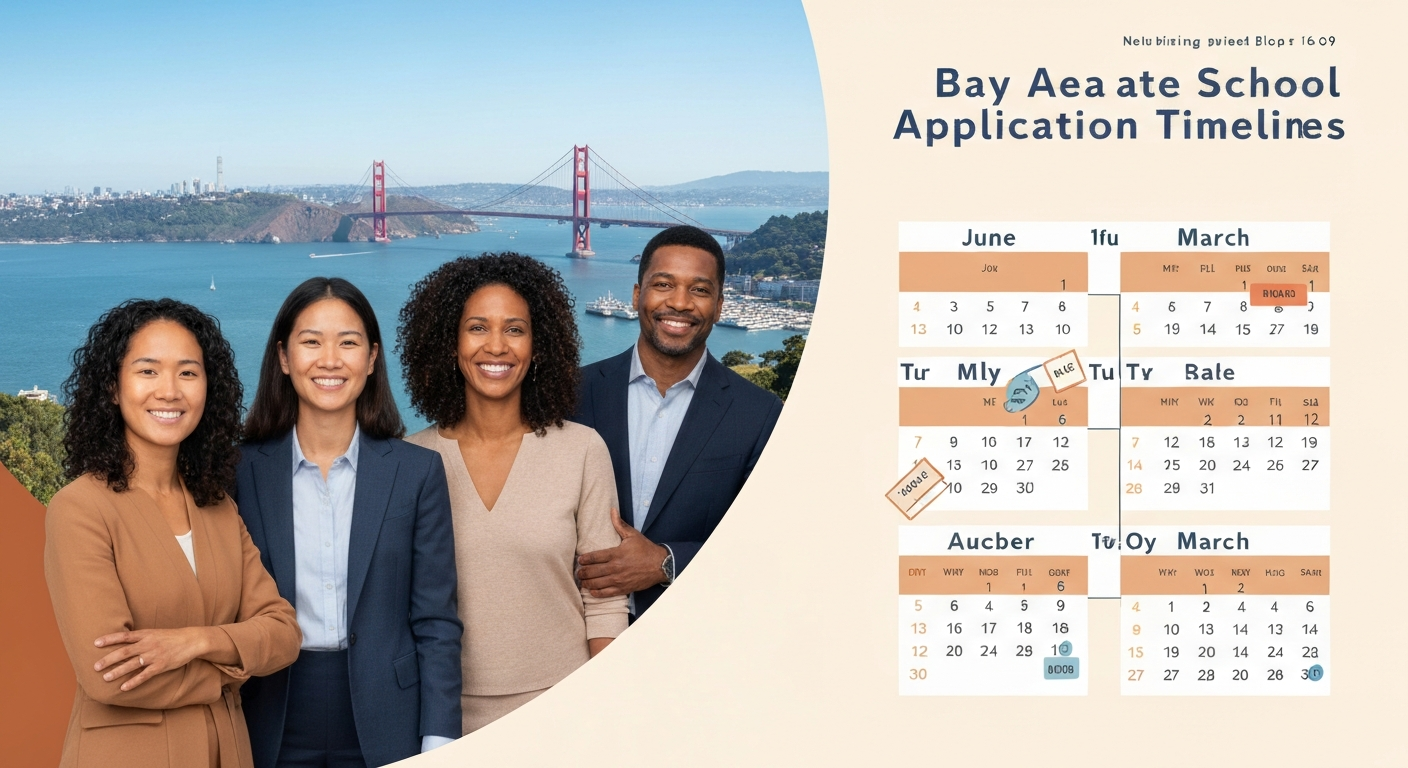
Most Bay Area parents think private school applications start in September. By then, you're already behind. The real work begins in June — a full six months before most application deadlines.
Quick Answer: Bay Area private school applications for 2026-27 follow a June-to-March cycle. Tours start June-September, assessments happen October-February, applications are due in January (most schools by Jan 15-23), and decisions come out mid-March. Start researching schools now if you're applying this fall — October tour slots fill by August at many top schools.
If you're reading this in May 2026 and planning to apply for Fall 2027 kindergarten or elementary entry, you're right on time. This guide walks you through exactly what to do each month, so you never panic about being late or unprepared.
Why the Timeline Matters
Bay Area parents plan ahead with KidPlanr
Free, week-by-week summer plans for your kids
Plan summer between school years — match camps to each kid's age, interests, and your work calendar. Free to use.
Plan my summer →Bay Area private schools — from Harker to Nueva to Head-Royce — run on a coordinated admissions calendar. Miss the October tour window at most schools, and you'll struggle to get an interview slot. Submit your application late, and you're automatically moved to the waitlist pool, even if your child is qualified.
The Bay Area has over 400 private schools, but only about 15-20% accept applications after their January deadlines. And among those, spots are limited to waitlist movement.
The stakes are real: Applications are due in mid-January. Parent interviews happen December through early February. Kindergarten assessments run January through early March. Decisions come out March 18-19, 2026. You have 7 days to accept — by March 25-26.
What this means: You need at least 6-8 months of lead time. For families applying for Fall 2027 entry, that means starting research and tours no later than Summer 2026.
How common is it to miss deadlines? Admissions directors report that 20-30% of inquiries come after the tour window closes. Those families are almost always waitlisted, regardless of qualifications. It's a hard filter.
What you can do now: If you're starting in May-June 2026, you're on track. Read this timeline, pick your top 5-8 schools, and mark tour request dates on your calendar. If you're starting later, you can still apply — but expect a narrower range of schools willing to accommodate late tours.
What NOT to over-interpret: Starting in July instead of June won't ruin your chances. Most schools accept tour requests through September. But waiting until October does limit options — that's when slots genuinely fill up. The timeline is firm, but there's flexibility within the windows.
June 2026: Research & School List (3-4 Months Before Tours)
What's happening this month: Admissions offices reopen after summer planning. School websites publish 2026-27 tour dates. Consultants start taking new clients.
Your job: Build your school list. Narrow from "all Bay Area private schools" (400+) to a realistic target list of 8-12 schools you'll actually tour.
How to Build Your School List
Start broad, then filter:
-
Geography: Which cities can you realistically drive to for daily drop-off? Most families draw a 20-25 minute radius from home or work.
-
Philosophy: Progressive vs. traditional? Montessori? Waldorf? Reggio Emilia? Match your parenting style.
-
Budget: Tuition ranges from $15,000/year (smaller schools) to $55,000/year (top-tier). Add 15-20% for fees, uniforms, activities, and fundraising expectations.
-
Selectivity: Schools like Nueva, Harker, and Kehillah accept 8-15% of applicants. Others accept 40-60%. Apply to a mix.
Target: By end of June, you should have 8-12 schools on your list. For each school, note:
- Tuition (verify 2026-27 rates on their website)
- Tour request deadline (most schools open tour signups July-August)
- Application deadline (usually mid-January)
- Admissions contact email
Common mistake: Applying to only highly selective schools. Experienced admissions consultants recommend the "2-4-2 rule": 2 reach schools, 4 target schools, 2 safety schools. This prevents March panic when all reach schools send rejections.
July-August 2026: Request Tours (2-3 Months Before Tours)
What's happening: Schools open tour registration. Slots fill within 2-4 weeks at popular schools.
Your job: Request tours at all 8-12 schools on your list. Do this the day schools open tour registration. Don't wait.
How to Request Tours
Most schools use online forms or email. Include:
- Parent names
- Child's name and birthdate
- Current school/preschool
- Preferred tour dates (give 3-4 options)
- Brief note: "We're excited to learn more about [School Name] for our daughter's kindergarten year."
Timeline for tour requests:
- Early July: Most schools open registration for September-October tours
- By mid-August: First-choice slots are 60-80% full at selective schools
- Late August/Early September: Waitlist-only for prime tour times (Tuesday-Thursday mornings)
What this means: If you request a tour in early July, you'll likely get your preferred date. If you wait until late August, expect limited availability or November dates (which are still fine but cut it close for application prep).
How common is it to miss tour windows? Very common. About 40% of families miss the July-August tour request window and end up with November dates or no tour at all. Schools that require tours (most do) won't process your application without one.
What you can do now: Set calendar reminders for July 1, 2026. Check each school's website for tour registration links. Some schools email their mailing lists; others post on their admissions page only.
What NOT to over-interpret: Getting a November tour instead of September doesn't mean you're doomed. It's not ideal, but schools understand that life happens. The real cutoff is December — by then, most schools won't accommodate new tours because they're deep into assessment season.
September-October 2026: Attend Tours & Start Applications (Application Deadlines 3-4 Months Away)
What's happening: Tours run Tuesday-Thursday mornings. You'll see classrooms, meet teachers, hear from the head of school, and talk to current parents.
Your job: Tour all 8-12 schools. Take notes. Narrow your list to 4-6 schools where you'll actually apply.
What to Look For During Tours
Beyond the marketing presentation, observe:
-
Classroom environment: Are kids engaged? Are there diverse teaching styles, or is every classroom identical?
-
Teacher-student interaction: Do teachers speak to kids respectfully? Do they ask questions, or just give instructions?
-
Student body diversity: Does the school reflect the Bay Area's diversity (race, income, family structure), or is it homogeneous?
-
Your child's fit: Can you imagine your specific kid thriving here? Not a generic child — your child.
Tour mistakes parents make: Falling in love with the prettiest campus or the most charismatic head of school. Those matter, but they don't predict your child's daily experience. Watch the kids, not the adults.
Start Applications (Due in 3 Months)
Most schools use their own application portals. A few use common application systems like Ravenna or SchoolAdmin.
What you need to start an application:
- Child's birth certificate
- Immunization records
- Current preschool contact info (for teacher recommendations)
- Parent essays (1-2 pages): "Why this school?" and "Tell us about your child"
- Application fee: $100-$150 per school
Start writing parent essays now. They take longer than you think. Most parents report spending 4-6 hours per school on essays.
By end of October: You should have narrowed from 8-12 schools to 4-6 where you'll apply. You should have started (not finished) all applications.
November 2026: Complete Applications & Schedule Assessments (2 Months to Deadline)
What's happening: Application portals close for submissions in mid-January. Schools start scheduling parent interviews and kindergarten assessments.
Your job: Finish applications. Request teacher recommendations. Confirm assessment dates.
Teacher Recommendations
Most schools require a Confidential Student Evaluation from your child's current preschool or Pre-K teacher. This is the ISSFBA Common Form — one form sent to multiple schools.
How to request it:
1. Email your child's teacher in early November (give 4-6 weeks of lead time)
2. Provide a list of schools where you're applying
3. Include submission deadlines (January 15-23 for most schools)
4. Offer to meet if the teacher has questions about your child
Common issue: Some preschools charge $25-$50 per recommendation. Budget accordingly.
Kindergarten Assessments
Schools assess kindergarten applicants to gauge developmental readiness, not IQ. Assessments typically include:
- Following directions in a small group (4-6 kids)
- Fine motor skills (drawing, cutting, puzzles)
- Language skills (answering questions, retelling a story)
- Social skills (sharing, turn-taking)
When assessments happen: Most schools schedule assessments January-February 2026. Some schools (like San Francisco School) hold group assessments on a single day — March 4, 2026 in their case.
Do you need to prep your child? Not intensely. Experienced admissions directors say the best prep is regular preschool attendance, reading together daily, and basic social skills practice (waiting your turn, using words to express feelings). Formal test prep for kindergarten is overkill unless your child has developmental delays.
What this means: If your child is developmentally typical — can follow 2-step directions, uses 4-5 word sentences, plays cooperatively — they'll be fine. If they're significantly behind, the assessment will surface that, and the school may suggest waiting a year.
By end of November: Applications should be 90% done. Teacher recommendations should be requested. You should have received assessment scheduling info from schools.
December 2026: Submit Applications & Parent Interviews (1 Month to Deadline)
What's happening: Final application push. Schools conduct parent interviews.
Your job: Submit applications by individual school deadlines (most are January 15-23, but verify each school). Complete parent interviews.
Application Submission Deadlines
Here are verified deadlines for major Bay Area private schools applying for Fall 2027 entry:
- La Scuola (San Francisco): January 15, 2027
- San Francisco School: January 23, 2027
- Most ISSFBA schools: January 15-20, 2027
What this means: You have a 5-8 day window across most schools. Do NOT wait until January 22 to submit. Aim for January 10-15 to avoid technical issues.
How common is it to miss deadlines? About 10% of applicants submit late or incomplete applications. Most schools will not accept late applications unless there's a documented emergency. And even then, you're automatically in the waitlist pool.
Parent Interviews
Parent interviews typically last 45-60 minutes. You'll meet with an admissions officer or the head of school. Common questions:
- Why are you interested in our school?
- Tell us about your child. What are their strengths? What do they struggle with?
- How do you handle discipline at home?
- What does your family value most in education?
- How involved do you expect to be in school life?
Interview advice from admissions directors: Be honest. Don't oversell your child or claim they're gifted if they're not. Schools value authenticity over perfection. They're assessing family-school fit, not your parenting credentials.
By end of December: All applications should be submitted. Parent interviews should be scheduled or completed.
January 2027: Final Submissions & Assessment Season (Deadline Month)
What's happening: Application deadlines hit mid-month. Kindergarten assessments ramp up. Schools begin internal review of files.
Your job: Ensure all materials are submitted. Attend scheduled assessments. Wait.
Final Checklist Before Deadlines
Before January 15-23 (depending on school):
- [ ] Application submitted through school portal
- [ ] Application fee paid
- [ ] Parent essays finalized
- [ ] Teacher recommendation received by school (confirm via email)
- [ ] Transcripts/report cards uploaded (if applicable for older grades)
- [ ] Parent interview completed
What if something is missing? Contact the admissions office immediately. Most schools are flexible about teacher recommendations arriving a few days late (teachers are busy). But you cannot be late with your application or essays.
Assessment Season
Most kindergarten assessments happen January-February. Some schools hold group assessments on specific dates; others do rolling individual assessments.
Example: San Francisco School holds parent interviews and kindergarten assessments on the afternoon of March 4, 2026 (for applicants who passed the initial review).
What your child will experience: A 1-2 hour session with 4-6 other kids. They'll do puzzles, draw, listen to a story and answer questions, play with blocks, and interact with each other. Teachers observe and take notes.
What you should do the night before: Normal bedtime. Normal breakfast. Tell your child they're going to visit a new school and play with other kids. That's it. Don't say "this is a test" or "you need to do well." Kindergarteners don't handle performance pressure well.
By end of January: All applications submitted. Assessment scheduled or completed.
February 2027: Waiting Period (Decisions 1 Month Away)
What's happening: Schools review files. Admissions committees meet weekly to discuss applicants. You wait.
Your job: Follow up if you haven't heard about assessment scheduling. Otherwise, do nothing. Seriously — resist the urge to email admissions asking for updates.
Should You Send Additional Materials?
Short answer: Only if something significant changed (major award, new sibling, change in family circumstances that affects tuition needs).
Don't send: Photos of your child's artwork. Additional parent letters. Thank-you notes to admissions officers. These don't help and may be seen as pushy.
The "Legacy" Question
Many Bay Area private schools have legacy admissions (children of alumni get preference). Legacy doesn't guarantee admission, but it does bump your child to the top of the waitlist if they're on the borderline.
If you or your partner attended a Bay Area private school, mention it in your application. It matters more than most families realize, especially at schools with active alumni networks.
March 2027: Decision Notifications & Enrollment Contracts (Decision Month)
What's happening: Schools release decisions mid-March. You have 7-10 days to accept.
Your job: Open decision letters (email or mail). Make your final decision. Submit enrollment contracts.
Key Dates (2027 Cycle)
For schools using the ISSFBA system (most Bay Area independent schools):
- Notifications mailed: Wednesday, March 18, 2027
- Electronic notification: Thursday, March 19, 2027
- Family responses due: Thursday, March 26, 2027
For San Francisco School specifically:
- Decisions posted: March 19, 2027
- Families must respond by: 5:00 PM on March 25, 2027
What this means: You have exactly 7 days to decide. Use this week to revisit schools (if you're torn between two), talk to current parents, and review financial aid offers (if applicable).
What If You're Waitlisted?
Waitlists are common. Typical acceptance rates at selective schools range from 10-20%, meaning 80-90% of applicants are either rejected or waitlisted.
If you're waitlisted:
1. Accept your spot on the waitlist (do this immediately if you're still interested)
2. Confirm your interest in writing (email the admissions office: "We remain very interested and would accept an offer if a spot opens.")
3. Consider backup plans (accept an offer from your safety school by the deadline, even if you're waitlisted elsewhere)
Waitlist movement: It varies by year, but admissions directors report that 10-30% of waitlisted families eventually get offers, usually in April-May as accepted families decline.
By end of March: You should have accepted an offer at one school and declined others. Deposit paid (typically $1,000-$5,000).
What If You're Starting Late?
If it's already September 2026 or later and you haven't toured:
Not ideal, but here's the realistic path:
-
Tour immediately — Request tours at 4-6 schools that still have availability (often less selective schools or newer schools).
-
Apply to schools that accept rolling admissions — About 20% of Bay Area private schools accept applications beyond January. These tend to be smaller, faith-based, or newer schools. Check AAAIS (Asian American Association of Independent Schools) and BAISN (Bay Area Independent School Network) for lists.
-
Expect limited financial aid — Financial aid is often exhausted by March. Late applicants rarely get aid, even if qualified.
-
Plan for next year — If you're applying for kindergarten and it's too late, consider waiting a year. Your child will be older and more developmentally ready, and you'll have the full timeline to work with.
Cost Reality Check
Bay Area private school tuition for 2026-27 ranges from $20,000 to $55,000/year for K-8. Add:
- Application fees: $100-$150 per school × 4-6 schools = $400-$900
- Testing/assessment fees: $0-$200 (some schools charge)
- Enrollment deposit: $1,000-$5,000 (due in March)
- First year extras: Uniforms ($200-$500), school supplies ($100-$200), fundraising expectations ($500-$2,000), after-school care ($5,000-$12,000/year if needed)
Total first-year cost for a middle-tier private school: $25,000-$35,000. For top-tier: $55,000-$70,000.
Financial aid is available at most schools. Typical aid covers 20-50% of tuition for families earning under $150,000. Schools use SSS (School and Student Services) forms to assess need. Apply by the financial aid deadline (usually January 15, same as applications).
Your Next 30 Days: Action Checklist
If it's May-June 2026 (right now):
- [ ] Research 20-30 Bay Area private schools (websites, reviews, tuition)
- [ ] Create a shortlist of 8-12 schools you'd realistically send your child to
- [ ] Mark calendar: July 1, 2026 — Tour request day
- [ ] Budget: Estimate total costs (tuition + fees + extras)
- [ ] Join a parent group: Search Facebook for "Bay Area Private School Admissions" or similar
If it's July-August 2026:
- [ ] Request tours at all 8-12 schools immediately
- [ ] Set up a spreadsheet: School name, tour date, application deadline, tuition, notes
- [ ] Order your child's immunization records from their pediatrician
- [ ] Start brainstorming parent essays
If it's September-October 2026:
- [ ] Attend all scheduled tours
- [ ] Narrow list to 4-6 schools where you'll apply
- [ ] Start applications (most open September 1)
- [ ] Request teacher recommendations (give 6 weeks of lead time)
If it's November-December 2026:
- [ ] Finish applications
- [ ] Complete parent interviews
- [ ] Confirm teacher recommendations were submitted
- [ ] Submit applications by January 15-23
If it's January-March 2027:
- [ ] Attend kindergarten assessments
- [ ] Wait (February)
- [ ] Open decision letters mid-March
- [ ] Accept offer and pay deposit by March 25-26
Frequently Asked Questions
Q: Do I need to hire an admissions consultant?
Not required, but common for families applying to highly selective schools (acceptance rates under 20%). Consultants cost $2,000-$10,000 depending on services. They help with school selection, essay editing, interview prep, and waitlist strategy. If you're organized and comfortable with research, you don't need one. If you're overwhelmed or have a complex situation (child with learning differences, challenging family circumstances), a consultant can help.
Q: Can I apply to more than 6 schools?
Yes, but most admissions consultants recommend 4-6. Applying to 10+ schools is exhausting (tours, essays, interviews), expensive (fees add up), and doesn't improve your odds. Focus on fit, not quantity.
Q: What if my child has a late birthday (summer/fall)?
Many Bay Area schools have strict age cutoffs (child must turn 5 by September 1 for kindergarten). If your child has a late August or September birthday, check each school's cutoff policy. Some allow younger kids; others don't. If your child misses the cutoff, you'll apply for the following year.
Q: How important are preschool recommendations?
Very. Teacher recommendations carry 20-30% weight in admissions decisions. A glowing letter from a teacher who knows your child well can make the difference. Make sure your child's current teacher actually likes them and has positive observations to share.
Q: What if we can't afford tuition even with financial aid?
Consider public school alternatives. Bay Area has excellent public schools in many districts (Palo Alto Unified, Piedmont Unified, Mill Valley). If you're set on private but cost is prohibitive, look into:
- Catholic schools (often $8,000-$15,000/year, significantly cheaper)
- Smaller independent schools outside the elite tier
- Schools with generous aid policies (Menlo School, Phillips Brooks School, Marin Country Day give aid to 30-40% of families)
Q: Do siblings get preference?
Almost always. If you have an older child enrolled, your younger child has a 70-90% chance of admission (assuming developmental readiness). But sibling preference doesn't mean automatic — some siblings are still waitlisted if there are concerns about fit or space constraints.
Q: Can I reapply if we're rejected?
Yes. Families can reapply the following year. Schools generally view reapplications positively — it shows commitment. But address whatever weaknesses were in your first application (child's readiness, parent essays, school fit).
Q: What if I need to switch schools mid-year?
Private schools rarely accept mid-year transfers unless there's a spot opening (another family leaves). If you need to switch, contact schools directly in November-December (when families give notice for the next year). Expect limited options.
Related Resources
Explore other school planning guides:
- How to Choose the Right Elementary School for Your Family in the Bay Area
- Bay Area Private School Financial Aid Guide — How to Afford Tuition
- School Tour Checklist — 20 Questions to Ask
- Kindergarten Assessment Prep Guide — What Your Child Needs to Know
Want to track your school research and application progress? KidPlanr helps Bay Area families organize school tours, deadlines, and decision factors in one place. Join the waitlist for early access — launching Fall 2026.
Sources:
- ISSFBA Admission Process
- San Francisco School Admissions
- La Scuola Admissions
- Independent School Admissions Timeline — Test Innovators
- Timeline for Applying to Private School — Parents Press
Bay Area parents plan ahead with KidPlanr
Free, week-by-week summer plans for your kids
Plan summer between school years — match camps to each kid's age, interests, and your work calendar. Free to use.
Plan my summer