Music Lessons for Kids Bay Area 2026 | Piano, Guitar, Violin Guide
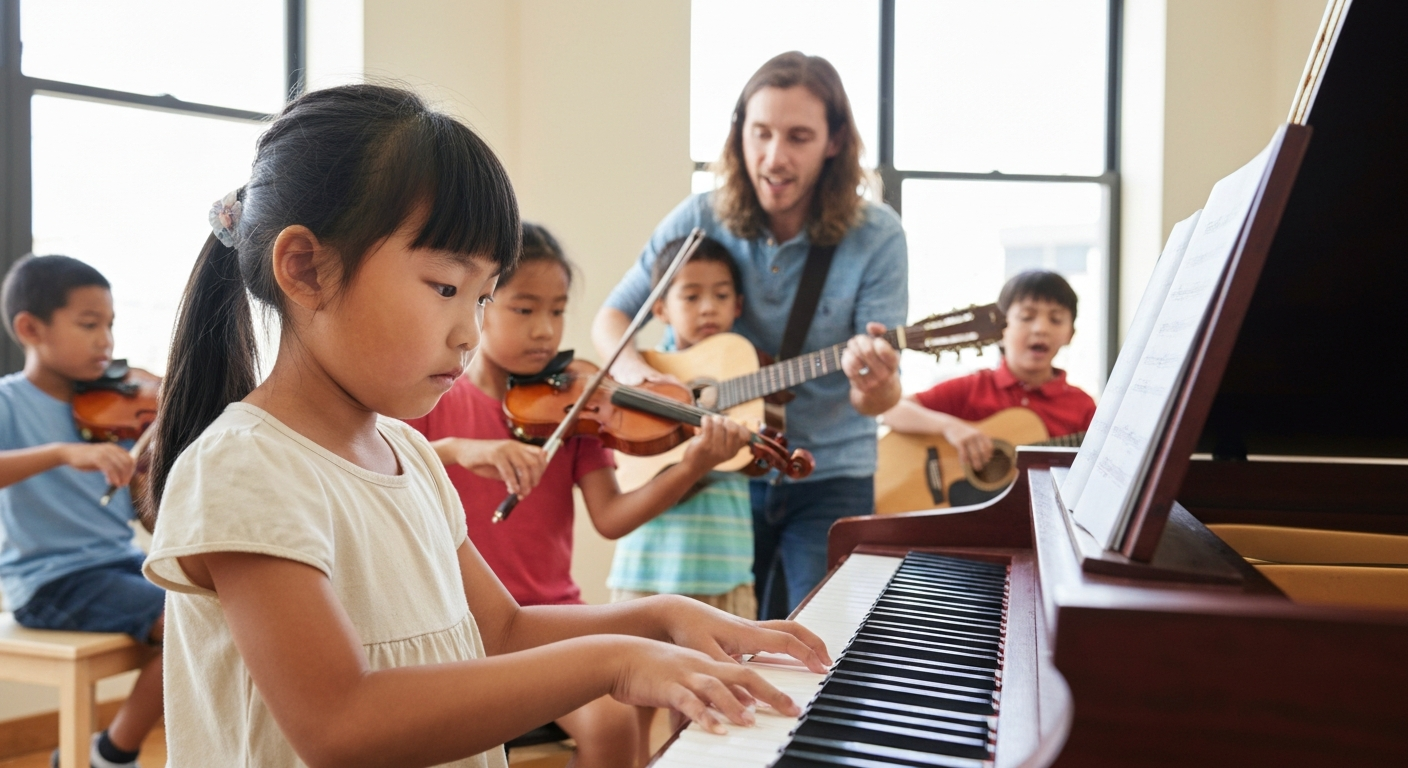
Your five-year-old announces at breakfast: "I want to learn piano." Or guitar. Or violin. The request sounds simple until you realize you're staring at hundreds of Bay Area music schools, programs that range from $25 group classes to $120 private lessons, and a decision tree you never knew existed: Which instrument? What age? Group or private? Month-to-month or semester commitment?
You're not alone. Music lessons are one of the top three afterschool activities parents choose, but the entry point is surprisingly confusing.
Quick Answer: Start with your child's age and attention span. Kids 4-6 do well in 30-minute group classes ($25-35/class) focused on rhythm and basics. Ages 7-9 can handle 30-minute private lessons ($35-50/lesson) on piano, violin, or guitar. Ages 10+ benefit from 60-minute privates ($70-100/lesson) if they're committed. Most Bay Area studios offer trial classes — use them to test teacher rapport and format before committing. Expect to try 2-3 studios before finding the right fit.
This guide walks through the real decision points: which instrument fits your child's age and personality, group vs. private format, how to evaluate a music teacher, and what you'll actually pay in the Bay Area. At the end, you'll have a trial class checklist and a shortlist of 15+ local studios to call.
Part 1: Which Instrument? (Age and Personality Matter More Than You Think)
Build your summer plan
Map every week of summer in 3 minutes
KidPlanr lays out every week with camps that match each kid's age and interests — and tracks which weeks still have spots.
Build my calendar →The "right" instrument isn't just about what your kid hears on Spotify. Age, motor development, and personality type all constrain the options.
Ages 4-6: Rhythm First, Melody Later
At this age, most kids don't have the fine motor control for violin fingering or the hand span for piano chords. Music educators typically recommend starting with rhythm-based exploration before committing to a specific instrument.
What works at this age:
- Group music classes (Kindermusik-style) — singing, percussion, movement
- Piano (with caveats) — if your child can sit for 20-30 minutes and has decent finger independence
- Ukulele — smaller than guitar, easier to fret, immediate gratification
- Percussion — drums, xylophones, rhythm sticks (high engagement)
What usually doesn't work yet:
- Violin — requires precise finger placement and bow control (most teachers recommend starting at age 6-7)
- Trumpet/brass — embouchure (lip technique) is too advanced for this age
- Guitar (full-size) — hand span too small (though 1/2-size guitars can work for some kids)
What this means: If your 5-year-old wants violin because their friend plays, many Bay Area teachers will recommend starting with a year of general music class first, then transitioning to violin at age 6. This isn't gatekeeping — it's matching the instrument to developmental readiness.
How common: About 60% of music studios in the Bay Area offer group classes for ages 4-6 focused on musical fundamentals rather than instrument-specific training. Studios like Opus 1 Music Studio and San Francisco Community Music Center have dedicated early-childhood music programs.
What you can do now: Ask potential studios: "Do you recommend starting with group music class before private lessons?" Studios that push 4-year-olds into private piano without assessing readiness may not be prioritizing developmental fit.
Ages 7-9: The Sweet Spot for Most Instruments
By age 7, most kids have the motor control for piano, violin, guitar (3/4-size), and basic woodwinds. This is when private lessons start making sense.
Experienced music teachers often note that kids in this range benefit from one-on-one instruction because they're past the "just exploring" phase and ready for structured skill-building.
Instrument fit by personality:
- Piano — Works for kids who like structure, can sit still, enjoy immediate feedback (press key → sound)
- Guitar — Appeals to kids who want to play songs they recognize quickly, social learners
- Violin — Best for detail-oriented kids who tolerate delayed gratification (it takes months to sound good)
- Drums — High-energy kids, kinesthetic learners, kids who need to move
Format choice: Most 7-9 year olds do well in 30-minute private lessons once a week. Group lessons can work if your child is socially motivated, but progress is usually slower.
What NOT to over-interpret: If your 8-year-old tries piano and quits after 3 months, it doesn't mean they're "not musical." Many kids need to try 2-3 instruments before finding the one that clicks. Studios with flexible month-to-month enrollment (like Bay Area Academy of Music) make this experimentation less costly.
Ages 10+: Ready for Commitment and Complexity
By age 10, kids who are genuinely interested can handle 60-minute lessons, practice expectations, and technique refinement. This is also the age where choosing the wrong format can kill motivation.
A common experience parents report: their 11-year-old loves music but hates classical piano drills. Many Bay Area studios now offer rock/pop tracks (School of Rock Palo Alto) or jazz improvisation alongside classical training. If your kid is motivated by playing songs they know, find a teacher who accommodates that.
What this does NOT mean: "Pop music teachers are less rigorous" or "classical is the only serious path." The Bay Area has excellent teachers across all genres. What matters is matching teaching style to your kid's learning motivation.
Part 2: Group Classes vs. Private Lessons (It's Not Just About Cost)
Price is part of the calculation, but format affects learning speed, social experience, and dropout risk.
Group Classes: $25-35 per class (4-8 kids per group)
Pros:
- Lower cost (typically $100-140/month for weekly classes)
- Social learning (kids motivate each other)
- Less performance pressure (everyone's a beginner)
Cons:
- Slower individual progress (teacher can't customize pace)
- Scheduling inflexibility (group meets at set time)
- Distraction risk (some kids zone out in groups)
Best for: Ages 4-7, social learners, kids exploring before committing
Bay Area examples offering group classes:
- San Francisco Community Music Center (group programs for toddlers through elementary)
- Opus 1 Music Studio (group classes starting age 3)
- Blue Bear School of Music (infant/toddler music classes)
Private Lessons: $35-50 (30 min) or $70-100 (60 min)
Pros:
- Faster progress (customized to your kid's pace)
- Flexible scheduling (easier to reschedule around camps, vacations)
- One-on-one teacher rapport (teacher learns your kid's learning style)
Cons:
- Higher cost ($140-200/month for weekly 30-min, $280-400/month for 60-min)
- More pressure (all eyes on your kid)
- Less peer motivation (no classmates to "compete" with)
Best for: Ages 7+, goal-oriented kids, kids who've already committed to an instrument
Scary content balance: Yes, private lessons cost $140-400/month — but most Bay Area studios offer month-to-month enrollment with no upfront semester commitment. If your kid wants to try violin, you're not locked into a $2,000 fall semester before knowing if they'll stick with it. Opus 1 Music Studio, Bay Area Academy of Music, and Legato Music School all offer flexible monthly plans.
What you can do now: Ask during your trial class: "What's your cancellation policy?" and "Can I switch between 30-minute and 60-minute lessons if my kid's ready?" Studios with rigid semester-only enrollment may not be the best fit for beginners.
Part 3: Evaluating Music Teachers (The Checklist You Actually Use)
Credentials matter, but teacher-student rapport matters more. A conservatory-trained pianist who can't connect with 8-year-olds will produce less progress than a music-ed major who gets kids excited.
The Trial Class Evaluation Checklist
Most Bay Area studios offer one free or discounted trial lesson. Bring this checklist and score each criterion (1-5 scale). Compare across 2-3 studios before committing.
1. Teacher Rapport (Most Important)
- [ ] Does the teacher greet your child warmly and learn their name?
- [ ] Does the teacher ask what songs/music your kid likes?
- [ ] Does the teacher adjust explanation style when your kid looks confused?
- [ ] Does your kid smile or engage naturally (vs. looking scared/bored)?
Why this matters: A technically excellent teacher who talks over your kid's head will cause dropout. Watch for teachers who get down to eye level, use kid-friendly metaphors ("this note sounds like a sleepy giant"), and check in frequently ("Does that make sense? Want to try it?").
2. Class Size and Attention (for Group Classes)
- [ ] Is the class size manageable? (4-8 kids is ideal; 12+ is too many for beginners)
- [ ] Does every child get individual feedback during class?
- [ ] Are materials age-appropriate? (No sheet music for 5-year-olds who can't read yet)
3. Student Engagement Level
- [ ] Are kids actively playing instruments (vs. listening to teacher talk)?
- [ ] Do kids look focused or are they staring out the window?
- [ ] Does the teacher use games, call-and-response, or movement (for younger kids)?
4. Facility and Equipment
- [ ] Are instruments in good condition? (Out-of-tune pianos, broken guitar strings = red flag)
- [ ] Is the space clean, well-lit, and safe?
- [ ] Is there a waiting area for parents (if you're staying)?
5. Pricing Transparency
- [ ] Does the studio provide written tuition rates upfront (not "call for pricing")?
- [ ] Are there hidden fees? (Registration fees, recital fees, book costs)
- [ ] Is monthly tuition the same every month, or does it vary by number of weeks?
How common: About 40% of Bay Area music studios have flexible month-to-month policies. The rest require semester or 3-month minimum commitments. Ask explicitly: "What happens if my kid wants to quit after 6 weeks?"
6. Commitment Flexibility
- [ ] Can you start mid-month or mid-semester?
- [ ] Is there a trial period (first month) before committing?
- [ ] Can you pause lessons for summer camps or vacations?
7. Progress Tracking
- [ ] Does the teacher provide written feedback after lessons?
- [ ] Are there periodic assessments or recitals (so kids have goals)?
- [ ] Does the studio communicate progress to parents (especially for younger kids who can't self-report)?
8. Parent Communication
- [ ] Can you observe lessons (or is there a one-way window)?
- [ ] Does the teacher give practice guidance for home ("15 minutes/day on these 3 exercises")?
- [ ] Is the teacher responsive to emails or texts about scheduling?
What this checklist does NOT mean: You need a perfect 5/5 score on all 8 criteria. Most great studios will score 4-5 on teacher rapport, engagement, and pricing transparency. The purpose is to compare across studios so you're not choosing blind.
Part 4: What You'll Actually Pay in Bay Area (2026 Pricing)
Music lessons in the Bay Area are more expensive than national averages, but there's a wide range.
Group Classes
- $25-35 per class (ages 3-7, 45-60 minute sessions)
- $100-140/month for weekly group classes
- Example: Blue Bear School of Music (San Francisco) offers toddler music classes; San Francisco Community Music Center has sliding-scale tuition for group programs
Private Lessons (30 minutes)
- $35-50 per lesson (beginner/intermediate students)
- $140-200/month for weekly 30-minute lessons
- Example: National average is $35-50/lesson in 2026; Bay Area skews toward the higher end ($45-50 typical)
Private Lessons (60 minutes)
- $70-100 per lesson (advanced students, older kids)
- $280-400/month for weekly 60-minute lessons
Additional Costs to Expect
- Instrument rental (if you don't own): $30-60/month for violin or guitar, $50-100/month for piano rental
- Books and materials: $20-40 per semester
- Recital fees: $0-50/year (some studios charge, others include it)
- Registration fees: $0-100 (many Bay Area studios don't charge this if you stay enrolled)
Scary content balance: Yes, private lessons can run $280-400/month at the high end — but that's for 60-minute advanced lessons. Most Bay Area families with elementary-age beginners pay $140-200/month for 30-minute weekly lessons. If that's still a stretch, look for studios with sliding-scale tuition (San Francisco Community Music Center), group classes ($100-140/month), or community programs through city parks and recreation (often under $200 for a full semester).
What you can do now: Budget for the first 3 months at $140-200/month (30-min private) or $100-140/month (group). If your kid sticks with it, that's the real cost. Many kids drop within the first 2-3 months — flexible enrollment protects you from sinking $1,200 into a semester your kid quits halfway through.
Part 5: 15+ Bay Area Music Studios to Evaluate (Verified for 2026)
Here's a starting shortlist organized by region. All studios were confirmed operating as of April 2026. Use the trial class checklist above to evaluate 2-3 before committing.
Peninsula (Palo Alto, Mountain View, Sunnyvale, Los Altos, Menlo Park)
Opus 1 Music Studio (Mountain View, Palo Alto)
- Instruments: Piano, violin, cello, guitar, voice
- Ages: Group classes start age 3, private lessons age 5+
- Format: Private and group classes available
- Locations: 3 campuses (1350 Grant Rd Mountain View, 3401 El Camino Real Palo Alto, 284 Moffett Blvd Mountain View)
- Notes: Month-to-month tuition, no enrollment fees for current members
- Website: musicopus1.com
The California Conservatory of Music (Sunnyvale, Redwood City, Fremont)
- Instruments: Guitar, piano, violin, voice
- Ages: 4+ (private lessons for all ages)
- Format: Private lessons (30 min, 45 min, 60 min options)
- Location: Sunnyvale campus serves Peninsula families
- Website: thecaliforniaconservatory.com
New Mozart School of Music (Palo Alto, Menlo Park, Redwood City, Los Altos, Mountain View)
- Instruments: Multiple instruments including piano, violin
- Ages: Group classes ages 3-7 (Harmony Road program), private lessons ages 5+
- Format: Private and group
- Website: newmozartschool.com
Serina Music Academy (Palo Alto, Mountain View, Los Altos)
- Instruments: Multiple instruments (piano, violin, guitar, voice)
- Ages: Children and adults
- Format: Private lessons
- Website: serinamusic.com
School of Rock Palo Alto
- Instruments: Guitar, bass, drums, keyboard, vocals
- Ages: Elementary through high school (rock/pop focus)
- Format: Private lessons + group band rehearsals
- Notes: Best for kids motivated by playing rock/pop songs (not classical)
- Website: schoolofrock.com/locations/paloalto
East Bay (Oakland, Berkeley, Pleasanton, Livermore, Fremont, Milpitas)
Bay Area Academy of Music (Pleasanton, serving Livermore, Dublin, Fremont, Castro Valley)
- Instruments: Guitar, voice, piano, drums, violin, cello, ukulele
- Ages: Children and adults (lessons start as young as age 4)
- Format: Private lessons only
- Location: 5460 Sunol Blvd, Suite 1, Pleasanton (Raley's-Oak Hills Shopping Center)
- Notes: Month-to-month enrollment, no semester minimum, flexible scheduling 7 days/week
- Website: bayareaacademyofmusic.com
Pleasanton Academy of Music (Pleasanton)
- Instruments: Piano, guitar, violin
- Ages: Children and adults
- Format: Private lessons
- Website: pleasantonacademyofmusic.com
South Bay School of Music & Arts (Milpitas, North San Jose, Newark, Fremont)
- Instruments: Multiple instruments
- Ages: 40+ years serving southern Bay Area
- Format: Private and group lessons
- Location: Serves Milpitas, San Jose, Fremont, Santa Clara
- Website: sbsma.com
San Francisco and North Bay
San Francisco Community Music Center (Mission District, San Francisco)
- Instruments: Wide variety (piano, violin, guitar, voice, woodwinds, brass)
- Ages: Toddlers through adults
- Format: Private and group classes, sliding-scale tuition available
- Notes: One of the oldest community arts organizations on West Coast (founded 1921), serves 2,400+ students annually
- Location: Mission District branch
- Website: sfcmc.org
Little Mission Studio (San Francisco)
- Instruments: Multiple instruments
- Ages: Children (focus on early music education)
- Format: Group music classes ($249-499 depending on duration), workshops ($25-100)
- Website: littlemissionstudio.com
Blue Bear School of Music (San Francisco)
- Instruments: Multiple instruments
- Ages: Infants, toddlers, children, adults
- Format: Music classes for infants/toddlers (early childhood music exploration)
- Website: bluebearmusic.org
Arabesque Conservatory of Music (San Francisco)
- Instruments: Piano, guitar, voice, drums, violin
- Ages: Kids, teens, adults (beginner to advanced)
- Format: Private lessons
- Website: arabesqueconservatory.com
South Bay (San Jose, Willow Glen, Santa Clara, Cupertino)
Legato Music School (San Jose/Willow Glen)
- Instruments: Piano, guitar, violin
- Ages: Children and adults
- Format: Private lessons (personalized instruction since 2009)
- Location: San Jose/Willow Glen area
- Website: legatomusicschool.com
How to Use This List
- Narrow by location: Start with 3-5 studios within 15 minutes of your home or kid's school (commute matters for weekly lessons)
- Check instrument availability: Not every studio teaches every instrument — confirm your target instrument before calling
- Schedule 2-3 trial classes: Most studios offer one free or discounted trial lesson — use the checklist above
- Ask the commitment question: "Can I start month-to-month or do you require a semester minimum?"
- Check teacher-student fit: The credential on paper matters less than whether your kid connects with the teacher
What NOT to do: Don't choose based solely on price or proximity. A $35/lesson teacher your kid hates will produce zero progress. A $50/lesson teacher your kid loves will keep them engaged for years.
Part 6: What Changes After You Start Lessons (Expectations vs. Reality)
Month 1-2: The Honeymoon Phase
Your kid is excited. They practice without nagging. Progress feels fast (because they're starting from zero).
What's actually happening: Novelty is high. But this isn't sustainable motivation yet.
What you can do: Establish a practice routine NOW (same time every day, 10-15 minutes for beginners). Don't rely on excitement to drive practice once the novelty wears off.
Month 3-4: The "This Is Harder Than I Thought" Phase
Many kids hit a plateau around month 3. Progress slows. They resist practice. You start wondering if you wasted money.
This is normal. Music educators often note that months 3-5 are when most dropouts happen — not because kids lack talent, but because initial excitement fades before skill-building produces intrinsic reward.
How common: Experienced parents report that about 40-50% of kids drop their first instrument within 6 months. This doesn't mean music isn't for them — it often means the instrument or teacher wasn't the right fit.
What you can do now: At month 3, ask your kid: "Do you want to keep going, try a different instrument, or take a break?" Forcing a kid to stick with violin they hate breeds resentment. But letting them quit without any conversation sends the message "quitting is fine when things get hard."
What NOT to over-interpret: If your kid quits piano at month 4, it doesn't mean they're "not a musician" or "lack grit." Many successful musicians tried 2-3 instruments before finding the one that clicked. The key is distinguishing "normal learning curve resistance" from "genuinely wrong instrument."
Month 6+: If They're Still Going, Motivation Is Real
By month 6, if your kid is still showing up to lessons and practicing (even with occasional reminders), they've crossed the dropout hump. Motivation is transitioning from external (you) to internal (they want to get better).
What changes now:
- They start asking when the next lesson is (vs. you having to remind them)
- They bring home songs they learned and want to play for family
- They ask about recitals or performance opportunities
- They compare progress with friends or siblings ("I can play this song now!")
What this means: This is the signal to invest more — not necessarily more money, but more support. Help them find performance opportunities (school talent show, family gatherings), connect with other kid musicians, or explore music camps in summer.
Cross-Track Linking: Planning Summer Too?
If you're figuring out afterschool activities, you're probably also thinking about summer. Music and camps don't have to be separate decisions — many Bay Area summer camps offer music tracks.
Planning summer camps? Search 3,000+ Bay Area summer camps →
The One Decision That Actually Matters
You've now seen the instruments, formats, pricing, studio options, and reality check. But here's the truth: the "right" choice is the one your kid will actually show up for.
A $120/hour conservatory-trained teacher is wasted if your 7-year-old dreads lessons. A $35 group class with an enthusiastic teacher who makes music feel like play will produce more long-term musical engagement than drilling scales with a credentials-heavy instructor.
Use the trial class checklist. Try 2-3 studios. Watch your kid's face when they interact with the teacher.
That's the signal. Not the studio's website. Not the Yelp reviews. Your kid's genuine engagement.
What to Do This Week
Here's your 3-step action plan:
- Pick 3-5 studios from the list above (within 15 minutes of home)
- Call and schedule trial classes (most studios offer one free or discounted trial)
- Bring the trial class evaluation checklist and score each studio on teacher rapport, engagement, pricing transparency, and commitment flexibility
After trying 2-3 studios, you'll know which one feels right. And if your kid drops after 3 months? You're not locked into a multi-thousand-dollar semester. Most Bay Area studios with month-to-month enrollment let you pause or stop without penalty.
Track your child's year-round activities — including music lessons — with KidPlanr's activity tracker. Join the waitlist →
Trial Class Evaluation Checklist (Print This)
Use this scorecard when visiting studios. Score each dimension 1-5 (5 = excellent). Compare across 2-3 studios before committing.
Studio Name: ____ | Date: __
1. Teacher Rapport (Does the teacher connect with your kid?)
- Score: ☐ 1 ☐ 2 ☐ 3 ☐ 4 ☐ 5
- Notes: ________
2. Class Size & Individual Attention (For group classes: does each kid get feedback?)
- Score: ☐ 1 ☐ 2 ☐ 3 ☐ 4 ☐ 5
- Notes: ________
3. Student Engagement Level (Are kids actively playing or zoning out?)
- Score: ☐ 1 ☐ 2 ☐ 3 ☐ 4 ☐ 5
- Notes: ________
4. Facility & Equipment Quality (Instruments in good condition? Clean, safe space?)
- Score: ☐ 1 ☐ 2 ☐ 3 ☐ 4 ☐ 5
- Notes: ________
5. Pricing Transparency (Upfront rates? Hidden fees?)
- Score: ☐ 1 ☐ 2 ☐ 3 ☐ 4 ☐ 5
- Monthly tuition: $__ | Registration fee: $_ | Other costs: ___
6. Commitment Flexibility (Month-to-month or semester minimum?)
- Score: ☐ 1 ☐ 2 ☐ 3 ☐ 4 ☐ 5
- Policy: ☐ Month-to-month ☐ 3-month minimum ☐ Semester minimum
- Can you pause for vacations? ☐ Yes ☐ No
7. Progress Tracking (Written feedback? Periodic assessments? Recitals?)
- Score: ☐ 1 ☐ 2 ☐ 3 ☐ 4 ☐ 5
- Notes: ________
8. Parent Communication (Can you observe? Practice guidance? Responsive?)
- Score: ☐ 1 ☐ 2 ☐ 3 ☐ 4 ☐ 5
- Notes: ________
Total Score: ____ / 40
Decision:
☐ Top choice — enroll here
☐ Strong backup — keep on list
☐ Not the right fit — keep looking
Kid's Reaction: (Circle one)
Excited / Neutral / Hesitant / Resistant
Compare all trial classes and choose the studio with the highest score AND positive kid reaction.
Frequently Asked Questions
How do I know which instrument is right for my child?
At ages 4-6, start with rhythm-based group music classes or piano (if your child can sit for 20-30 minutes). At ages 7-9, let your child try 2-3 instruments through trial lessons before committing. Piano, guitar, and violin are the most common starter instruments. Personality matters: structure-loving kids often prefer piano, social kids gravitate toward guitar, detail-oriented kids do well with violin.
Should I buy an instrument before the first lesson?
No. Most Bay Area studios recommend starting with rentals ($30-60/month for violin or guitar) or borrowing until your child commits. Many studios have loaner instruments for the first month. For piano, you can start with a keyboard ($200-400) before investing in an acoustic or digital piano ($1,000-5,000).
How much practice should my child do per week?
Music teachers typically recommend 10-15 minutes per day (5-6 days/week) for beginners ages 4-7. Ages 8-10 can handle 15-30 minutes per day. Ages 11+ who are serious about an instrument should practice 30-60 minutes per day. Consistency matters more than duration — daily 15-minute sessions produce better results than one 90-minute marathon on Sunday.
What if my child wants to quit after 2 months?
Ask: "Is this hard, or is this boring?" Hard means the learning curve is normal — encourage pushing through. Boring means wrong teacher or wrong instrument — consider switching. Many kids drop their first instrument but succeed with their second. Studios with month-to-month enrollment (like Bay Area Academy of Music, Opus 1 Music Studio) make experimentation less costly.
How long until my child can play a recognizable song?
Piano and guitar students can often play simple melodies within 4-8 weeks. Violin takes longer (3-6 months) due to bow control and intonation challenges. Drums and ukulele offer the fastest gratification (2-4 weeks for basic rhythm). This varies by age, practice frequency, and teacher approach.
Are group classes worth it or should I just start with private lessons?
Group classes work well for ages 4-7 who are exploring music for the first time. They're lower cost ($25-35/class vs. $35-50 for private) and provide peer motivation. Private lessons are better for ages 7+ who've committed to an instrument and want faster progress. If budget allows, try both: group class for 6 months, then transition to private.
What credentials should I look for in a music teacher?
Music education degree or conservatory training is a plus, but teacher-student rapport matters more. A teacher with a master's degree who can't connect with kids will produce less progress than an undergraduate music major who makes lessons fun. Use the trial class checklist (above) to evaluate rapport, engagement, and communication style. Ask: "How long have you been teaching kids this age?"
Can my child take lessons online or do they need in-person?
Ages 4-8 usually need in-person lessons (harder to maintain focus on screen, hands-on guidance needed). Ages 9+ can do well with online lessons if they're self-motivated and you can help set up equipment. Many Bay Area studios (Opus 1, California Conservatory) offer both formats. Start in-person for the first 2-3 months to build foundation, then consider online for scheduling flexibility.
Looking for summer camps too? Search 3,000+ Bay Area camps by age, interest, and budget →
Track your child's year-round activities including music lessons. Join the KidPlanr activity tracker waitlist →
Build your summer plan
Map every week of summer in 3 minutes
KidPlanr lays out every week with camps that match each kid's age and interests — and tracks which weeks still have spots.
Build my calendar