
School Tour Questions Bay Area | Elementary School Checklist 2026
Last updated: April 2026
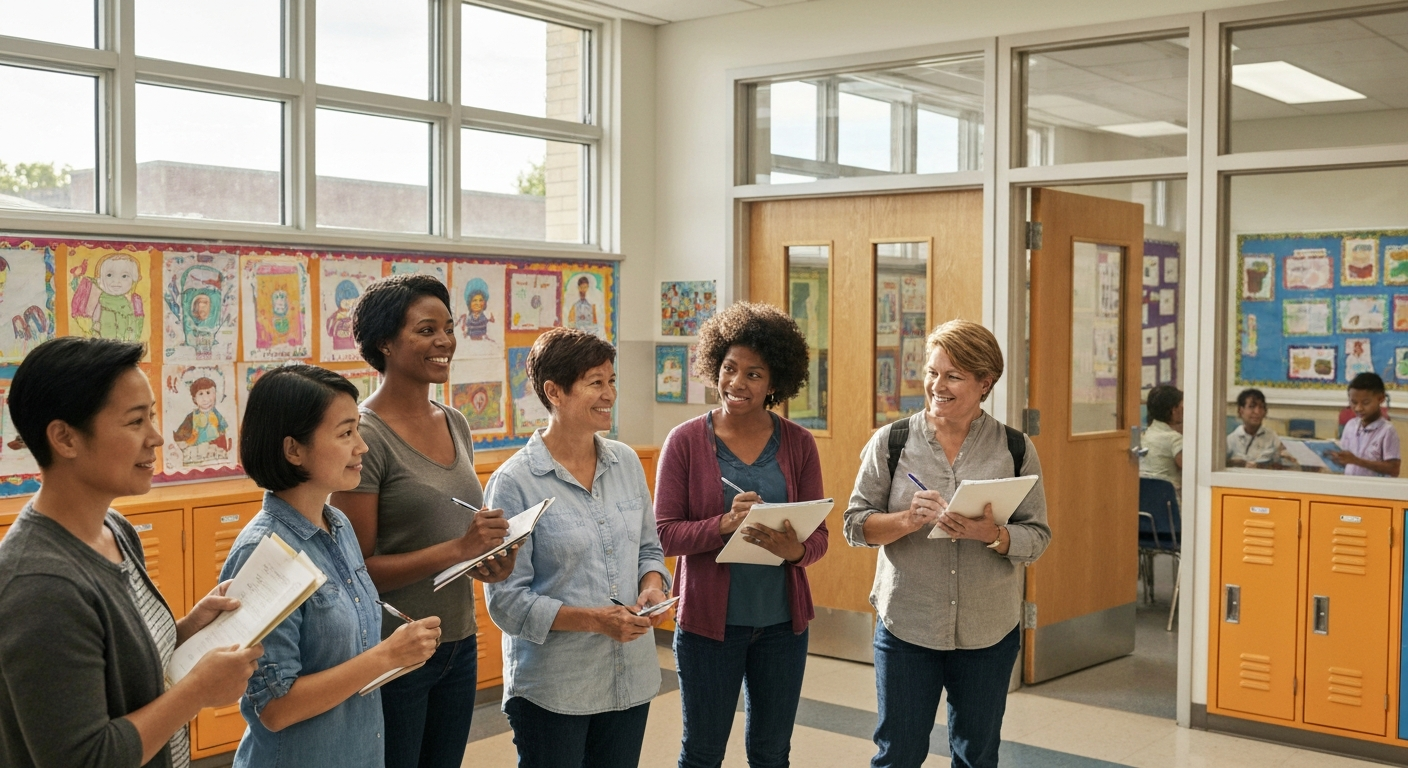
You've scheduled tours at 3-5 elementary schools across the Bay Area. You'll spend 60-90 minutes at each school observing classrooms, meeting teachers, and hearing the principal's pitch.
Most parents walk away with glossy brochures and vague impressions. You'll walk away with data.
Quick Answer: The most revealing school tour questions focus on teacher retention rate (under 15% annually is excellent), class size beyond K-1 (18-22 is ideal for elementary), and how the school handles behavioral issues (restorative vs punitive). Ask "Can I observe a typical classroom for 15 minutes?" and "What percentage of your teachers return each year?"—schools that hesitate to answer are hiding problems.
Before You Tour: Set Your Evaluation Criteria
Bay Area parents plan ahead with KidPlanr
Free, week-by-week summer plans for your kids
Plan summer between school years — match camps to each kid's age, interests, and your work calendar. Free to use.
Plan my summer →School tours are marketing events. Principals show you their best classrooms. You'll see bulletin boards covered in student work, meet the warmest teachers, and hear about the robotics program.
Your job is to see past the marketing.
Pre-tour prep (20 minutes):
1. Check GreatSchools.org for basic stats (enrollment, demographics, test scores)
2. Google "[school name] parent reviews" — read Yelp, Niche, and local parent forums
3. Define your 3 non-negotiables (e.g., "under 20 students per class," "Mandarin immersion," "strong special ed support")
4. Print this checklist or save to your phone
For general guidance on choosing schools, see our complete guide to selecting elementary schools in the Bay Area.
Part 1: Questions About Academics & Curriculum
1. "What curriculum do you use for reading and math?"
Why it matters: Cookie-cutter curriculum isn't bad—it shows consistency. The answer reveals whether teachers have autonomy or follow a structured program.
Red flags:
- "Each teacher chooses their own" (can mean inconsistent quality)
- Principal doesn't know or is vague
- Curriculum is very outdated (e.g., still using 1990s textbooks)
Green flags:
- Specific answer (e.g., "We use Fountas & Pinnell for literacy, Eureka Math for math")
- "Teachers adapt the curriculum to student needs"
- Recent adoption (curriculum updated in last 5 years)
2. "How do you differentiate for advanced learners and struggling students?"
Why it matters: Most classrooms have a 3-4 grade level spread. Schools without differentiation leave both ends bored or lost.
Listen for:
- Specific strategies (e.g., "We use guided reading groups," "Math specialists pull small groups")
- Evidence they actually do it (ask to see a lesson plan or observe)
Red flags:
- "All students move at the same pace"
- "We don't have resources for gifted students" (in a well-funded district, this is a choice)
- Vague answer like "teachers differentiate as needed"
3. "Do you have full-time specialists for art, music, PE, and library?"
Why it matters: Specialists = well-rounded education. If the homeroom teacher is doing art and music, your child is getting less depth.
Bay Area reality check: Public schools in lower-income districts often lack specialists due to budget cuts. Private schools almost always have them.
Ask specifically: "How many minutes per week does my child get art? Music? PE?"
Common in well-resourced Bay Area schools: 60 minutes art/week, 60 minutes music/week, 90 minutes PE/week
4. "What's your homework policy for K-2 and 3-5?"
Why it matters: Excessive homework in elementary school is linked to stress and no academic benefit. Schools that pile on homework in 1st grade are misaligned with child development research.
Research-backed guideline: 10 minutes per grade level per night (1st grade = 10 min, 5th grade = 50 min)
Red flags:
- K-1 has nightly homework packets
- 3rd-4th grade has 90+ minutes of homework
- School says "homework builds character"
Green flags:
- "K-2 homework is optional and reading-focused"
- "We limit homework to reinforce skills, not busy work"
5. "How much screen time do students get per day?"
Why it matters: Some Bay Area schools are 1:1 device schools (every student has an iPad or Chromebook). Others limit screen time. Neither is inherently better—but you should know.
Follow-up if 1:1 devices: "How do you teach digital citizenship and manage screen addiction?"
Follow-up if low-tech: "Do students learn basic computer skills?"
For Bay Area families balancing tech exposure with traditional learning, understanding each school's philosophy helps. If you're also planning summer camps or afterschool activities, consider how your child's year-round tech balance looks holistically.
Part 2: Questions About Teachers & Staff
6. "What's your teacher retention rate?"
This is the single most revealing question.
Why it matters: High teacher turnover = systemic problems (low pay, bad admin, burnout culture). Kids thrive with stable, experienced teachers.
Benchmark:
- Excellent: Under 10% annual turnover
- Good: 10-15%
- Concerning: 15-25%
- Red flag: Over 25%
If they won't give a number: "Can you tell me how many teachers left last year?" (Do the math yourself: 3 teachers left out of 20 = 15% turnover)
7. "What percentage of your teachers have more than 5 years of experience?"
Why it matters: New teachers are learning. Experienced teachers are masters. A healthy school has a mix—but if everyone is brand new, there's no institutional knowledge.
Ideal: 60%+ of teachers with 5+ years experience
Red flag: "Most of our teachers are in their first 3 years"
8. "How do you support new teachers?"
Why it matters: Even great new teachers need mentorship. Schools that pair new teachers with veterans produce better outcomes.
Listen for: Formal mentorship programs, peer observation, regular feedback
9. "What's your average class size for each grade?"
Why it matters: Class size directly impacts instruction quality.
Bay Area benchmarks:
- K-1: Under 20 students (California class size reduction mandate)
- 2nd-3rd: 20-24 students
- 4th-5th: 24-28 students
Red flags:
- 30+ students in any elementary grade
- "We combine grades" (without a pedagogical reason like Montessori)
Follow-up: "Do you have aides or co-teachers in larger classes?"
Part 3: Questions About School Culture & Safety
10. "How do you handle bullying and behavioral issues?"
Why it matters: Every school has behavior problems. What matters is how they're addressed.
Red flags:
- "We don't have bullying here" (denial)
- Punitive-only approach (e.g., "We have zero tolerance and suspend immediately")
- Vague answer
Green flags:
- Specific process (e.g., "We use restorative circles," "Counselor mediates peer conflicts")
- Evidence of social-emotional learning (SEL curriculum, regular class meetings)
- Principal acknowledges conflict happens and describes resolution
11. "Do you have a full-time counselor or social worker?"
Why it matters: Kids face anxiety, peer conflict, family stress. Schools with mental health support can intervene early.
Bay Area reality check: Well-funded districts (Palo Alto, Piedmont) often have full-time counselors. Under-resourced schools share a counselor across multiple sites.
Minimum standard: At least 1 counselor for every 500 students
12. "What's your suspension and expulsion rate?"
Why it matters: High suspension rates = punitive discipline culture. Disproportionate suspension of Black and Latino students = racial bias problem.
Ask: "What percentage of students were suspended last year? How does that break down by race and disability status?"
Red flag: School won't share this data (it's public record—they should know it)
13. "How do you communicate with parents?"
Why it matters: Schools with strong parent-teacher communication catch problems early.
Listen for:
- Regular communication (weekly emails, monthly newsletters)
- Multiple channels (email, text, app, website)
- Two-way communication (not just school-to-parent broadcasts)
Ask: "How quickly can I expect a response if I email my child's teacher?"
In well-run schools: Parents can expect responses within 24-48 hours
14. "What's your emergency lockdown procedure?"
Why it matters: Bay Area schools practice lockdown drills. You should know how the school keeps kids safe.
Ask: "How many lockdown drills do you conduct per year? How do you communicate with parents during an emergency?"
Bay Area standard: 2-4 lockdown drills per year, plus earthquake drills
Part 4: Questions About Parent Involvement & Community
15. "What volunteer opportunities are available?"
Why it matters: Parent involvement predicts student success. Schools that make it easy (flexible hours, varied roles) have stronger communities.
Ask: "Can working parents volunteer? Do you have evening or weekend events?"
Green flags:
- Multiple volunteer options (classroom help, fundraising, field trips, special events)
- School acknowledges not all parents can volunteer during work hours
16. "What does your PTA or parent association do?"
Why it matters: Strong PTAs raise money, organize events, and advocate for students. Weak PTAs do bake sales and nothing else.
Ask: "How much money does the PTA raise annually? What does it fund?"
Bay Area reality check: PTAs in wealthy districts (Palo Alto, Los Altos, Marin) raise $200K-$500K+ per year. Lower-income districts raise $5K-$20K. This funding gap creates inequity—but it's the reality.
If you care about equity: Ask "Does the PTA fund teacher salaries or classroom basics?" (Red flag—means the district isn't funding essentials)
17. "How diverse is your school community?"
Why it matters: Diverse schools prepare kids for the real world. Homogeneous schools (all white, all Asian, all affluent) don't.
Look at demographics: California schools report enrollment by race, socioeconomic status, and English learner status on the state website.
Ask: "How do you celebrate different cultures? What's your approach to teaching equity and inclusion?"
Red flags:
- "We're colorblind" or "We don't see race" (research shows this approach fails)
- No diversity in leadership or teaching staff
- Resistance to discussing race or equity
Part 5: Questions About Logistics & Practicalities
18. "What are the school hours? Do you offer before/after care?"
Why it matters: Working parents need extended care. Not all schools offer it.
Ask: "What time does school start and end? What are the costs for extended care? Is there a waitlist?"
Bay Area reality check: Extended care often has waitlists. Apply early.
For working parents managing school schedules plus summer camps and afterschool activities, a school with strong extended care is essential—or you'll be piecing together a patchwork of options.
19. "What's the lunch situation?"
Why it matters: Some schools have full kitchens and hot meals. Others are cold lunch only.
Ask: "Does the school provide lunch? Can I send lunch from home? Are there allergy-safe protocols?"
If your child has food allergies: "How do you handle nut allergies and cross-contamination?"
20. "What's the carpool/drop-off/pick-up process?"
Why it matters: Bad drop-off processes = 20 minutes of parking lot chaos twice a day.
Ask: "Can you walk me through morning drop-off? Is there supervised before-school time if I arrive early?"
Bay Area-specific: Some schools are in dense neighborhoods with limited parking (San Francisco, downtown areas). Ask about street parking and public transit access.
21. "What field trips and special programs do you offer?"
Why it matters: Field trips = experiential learning. Schools that take kids to museums, tide pools, farms, and science centers give richer education.
Ask: "How many field trips per year? Are they free or do families pay?"
Bay Area advantage: Proximity to museums (Exploratorium, California Academy of Sciences), nature (Muir Woods, Point Reyes), and tech companies (Google, Apple) means field trips here are world-class.
Part 6: Questions About Special Needs & Support Services
22. "How do you support students with IEPs and 504 plans?"
Why it matters: If your child has learning differences or disabilities, school support is critical.
Ask: "How many students currently have IEPs? Do you have a full-time special education teacher? What services do you provide in-house vs. referring out?"
Red flags:
- "We don't have many students with special needs" (means they aren't equipped)
- School resists discussing accommodations
- No dedicated special ed staff
Green flags:
- Specific support services (speech therapy, occupational therapy, resource specialist)
- Inclusive model (special needs students integrated into general ed classrooms with support)
If your child has an IEP: Request to meet the special education coordinator during your tour.
23. "Do you have an English Learner program?"
Why it matters: Even if your child is a native English speaker, schools with strong EL programs tend to have better differentiation and smaller group instruction.
Ask: "What percentage of students are English Learners? How do you support them?"
Bay Area reality check: Schools in San Jose, Oakland, and San Francisco have 30-50%+ EL students. Schools in Palo Alto and Piedmont have under 10%. Neither is better—but teaching approaches differ.
Part 7: Questions to Observe (Not Ask Directly)
24. What's the vibe in the hallways?
Watch for:
- Are kids smiling and engaged, or stressed and checked out?
- Do teachers greet students warmly?
- Is student work displayed on walls? (Shows teachers value student voice)
- Are hallways quiet or chaotic?
Trust your gut: If the school feels joyful, it probably is. If it feels rigid or tense, it probably is.
25. How does the principal interact with students?
Watch for:
- Does the principal know students by name?
- Do kids approach the principal comfortably, or avoid them?
- Does the principal seem warm or authoritarian?
Research insight: School culture flows from the top. A principal who is cold, defensive, or disengaged sets the tone for the whole school.
What to Do DURING the Tour
Request to observe a classroom for 15 minutes
Most schools let you peek in for 2-3 minutes. Ask to stay longer.
What to observe:
- Are kids engaged or zoned out?
- Does the teacher have control without yelling?
- Is instruction differentiated (kids working on different tasks) or whole-group only?
- Do kids ask questions?
Green flag: Teacher doesn't change behavior when you walk in (means this is normal, not a show)
Take notes on your phone
Don't trust your memory after touring 4-5 schools. Rate each school on:
- Academic rigor (1-5)
- Teacher warmth (1-5)
- Facilities quality (1-5)
- Culture fit (1-5)
- Commute feasibility (1-5)
Ask to connect with current parents
The best intel comes from parents whose kids already attend.
Ask the principal: "Can you connect me with 2-3 current parents for a quick phone call?"
If they say no: Red flag. They're hiding something.
After the Tour: How to Compare Schools
You've toured 3-5 schools. Now what?
Create a comparison spreadsheet
| School | Class Size | Teacher Retention | Commute | Homework Policy | Culture Fit | Total Score |
|---|---|---|---|---|---|---|
| School A | 22 | 12% turnover | 15 min | Reasonable | 4/5 | 22/25 |
| School B | 18 | 8% turnover | 30 min | Minimal | 5/5 | 24/25 |
| School C | 28 | 20% turnover | 10 min | Heavy | 2/5 | 15/25 |
Weight your non-negotiables
If commute is your #1 priority, School C might still win despite lower scores elsewhere.
Trust your gut
Data matters. But if your kid lights up at School B and dreads School A, that's signal.
For more on the public vs private school decision after your tours, see our Bay Area decision framework.
Bonus: Red Flags to Walk Away From
Some issues are dealbreakers. If you see these during your tour, cross the school off your list:
- Principal is defensive or dismissive when asked questions (means they don't welcome parent involvement)
- School won't let you observe classrooms (what are they hiding?)
- Teacher turnover over 30% (systemic dysfunction)
- Facilities are unsafe (broken equipment, peeling paint, no security)
- Chronic absenteeism over 20% (means families don't value the school—ask why)
- School leadership doesn't know basic data (average class size, test scores, suspension rates—they should know these)
How Long Should a School Tour Take?
Typical tour length: 60-90 minutes
Includes:
- 15-20 minute principal presentation
- 20-30 minute campus walk (visit 3-5 classrooms)
- 10-15 minute Q&A with principal
- 5-10 minutes to explore on your own
If the tour is rushed (under 45 minutes): Red flag. They're not investing in prospective families.
If the tour is too long (over 2 hours): They're either thorough or disorganized. Context matters.
What If the School Won't Answer Your Questions?
Some questions are protected by privacy laws (e.g., "Can you tell me which teacher has the most parent complaints?"). But most questions on this list are fair game.
If a school refuses to answer:
- Teacher retention rate
- Average class size
- Suspension rate
- Curriculum details
→ That's a red flag. Transparency = trust.
FAQ
How many schools should I tour?
Recommended: 3-5 schools
- Fewer than 3 = not enough comparison data
- More than 5 = decision fatigue
Tour order: Start with your "safety school" (the one you're pretty sure you'll get into). End with your top choice.
Should I bring my child to the tour?
For K-2 enrollment: No. Kids are distracting and you won't hear the presentation.
For 3rd-5th transfer: Yes. Older kids can share their impression of the school.
Compromise: Tour alone first. If you're seriously considering the school, bring your child for a "shadow day."
When should I schedule tours?
Best time: October-February (before enrollment deadlines)
Bay Area deadlines: Most public schools have enrollment in February-March for the following fall. Private schools vary (some as early as November).
Worst time: May-June (teachers are exhausted, testing season, school is winding down)
What should I wear to a school tour?
Guideline: Business casual
You're not interviewing for a job, but you are making an impression (especially at competitive private schools).
Can I tour a school if we don't live in the district yet?
Public schools: Most allow non-resident tours, but enrollment priority goes to residents.
Private schools: Yes, location doesn't matter (except commute logistics).
If you're relocating: Mention it during the tour. Schools want to help new families.
Our guide for families moving to the Bay Area covers school selection alongside summer planning and neighborhood selection.
Next Steps After Your Tour
- Within 24 hours: Send a thank-you email to the principal
- Within 1 week: Reach out to current parents for additional intel
- Within 2 weeks: Make your decision and submit enrollment paperwork
- Before enrollment: Visit the school one more time (unannounced, during dismissal) to see the real culture
Final Thought: The Perfect School Doesn't Exist
You're not looking for a perfect school. You're looking for the school that's the best fit for your child and your family's logistics.
A 7/10-rated school where your child thrives is better than a 10/10-rated school where they're stressed and unhappy.
Ask the right questions. Observe carefully. Trust your gut.
Ready to compare all Bay Area elementary schools? Track your school search and summer activity planning in one place at kidplanr.com.
Bay Area parents plan ahead with KidPlanr
Free, week-by-week summer plans for your kids
Plan summer between school years — match camps to each kid's age, interests, and your work calendar. Free to use.
Plan my summer