Tennis Classes for Kids Bay Area 2026 | Youth Programs Guide
Is your child ready for tennis? You're comparing programs, and the options are overwhelming. Group classes at the park. Private lessons at $100/hour. Competitive academies. Weekend clinics. Which one actually fits a kid who's never held a racquet — or one who plays every weekend and wants to improve?
Quick Answer: Most Bay Area kids (ages 5-12) start with group classes at $25-40 per session through programs like Silicon Valley Tennis Academy or Lifetime Activities. Try 4-6 weeks before committing to private lessons ($60-120/hour) or competitive programs (8+ hours/week). Format matters more than facility — match your child's age, interest level, and your family's schedule first.
This guide covers Bay Area tennis programs by age and commitment level, real cost ranges, and a decision framework so you can choose without regret.
Why Tennis for Kids?
Build your summer plan
Map every week of summer in 3 minutes
KidPlanr lays out every week with camps that match each kid's age and interests — and tracks which weeks still have spots.
Build my calendar →Tennis builds hand-eye coordination, strategic thinking, and physical fitness — skills that transfer to other sports and activities. It's a lifelong sport your child can play into adulthood, and it's one of the few youth sports with a clear path from recreational to competitive if they fall in love with it.
What parents like: Tennis is an individual sport (less team logistics than soccer), offered year-round (no off-season gaps), and available at many skill levels (from first-timer to tournament player).
What kids like: Quick feedback (they see improvement session to session), social (group classes + doubles), and achievable (unlike basketball, height doesn't determine success).
Tennis Formats by Age and Experience
Ages 5-7: Red Ball Programs (Beginner)
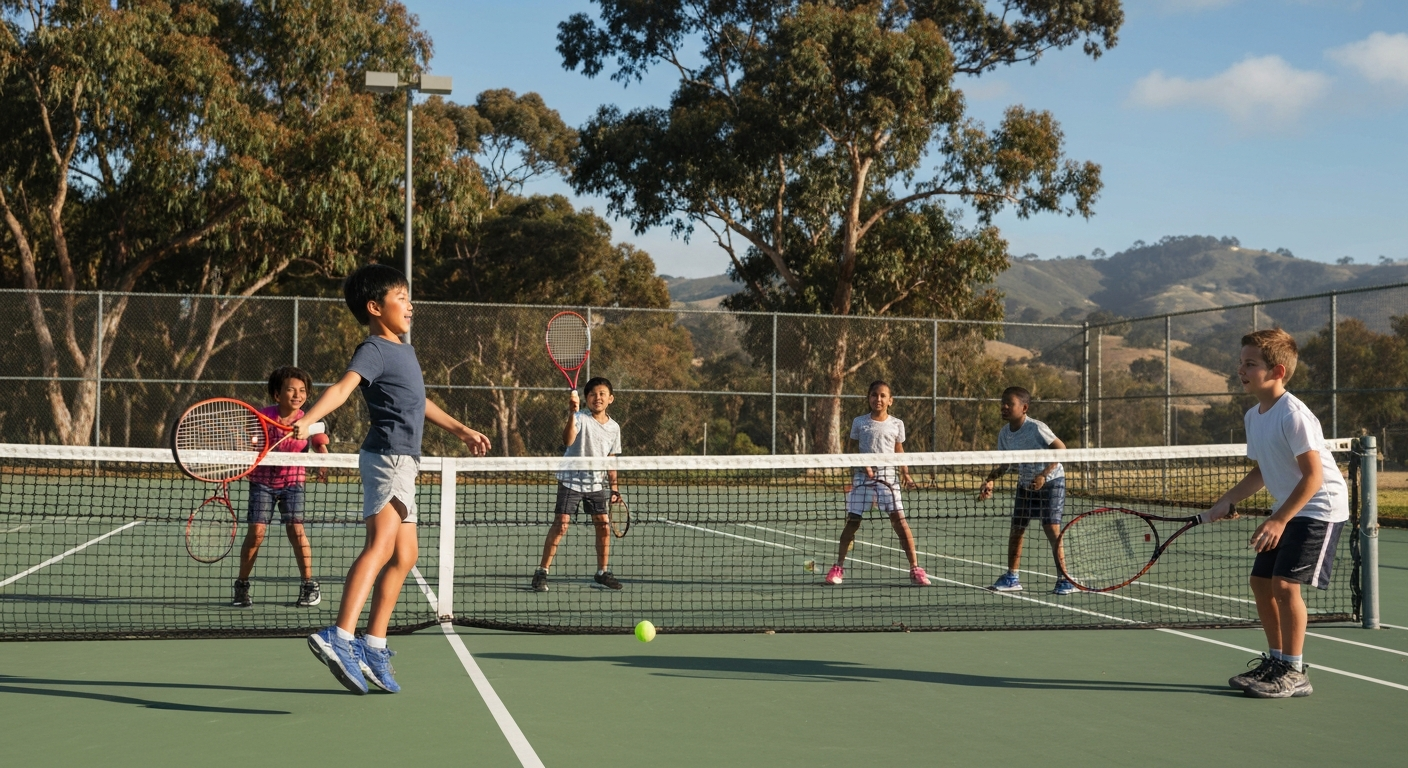
What it is: Modified courts (smaller), foam or low-compression red balls (slower bounce), and shorter racquets (19-23 inches). Focus is on rallying, not serving or scoring.
Typical structure: 45-60 minute group classes, 1x/week, 6-10 kids per court with 1-2 instructors.
Bay Area programs:
- Euro School of Tennis — After-school programs at multiple Bay Area locations, modified equipment for young beginners
- ANTS Sports — Play-based tennis for K-5th graders in SF and East Bay, summer camps available
- Youth Tennis Advantage — Free program at 6 Bay Area locations including SF, Oakland, and Berkeley (registration required)
Cost range: $25-40/session for group classes. Youth Tennis Advantage is free (funded by USTA and local grants).
Time commitment: 1 hour/week. Parents typically stay and watch.
How to tell if it's working: Your child asks when the next class is, talks about their "tennis friends," or practices at home with a balloon or beach ball.
Ages 8-11: Green/Yellow Ball Progression (Intermediate)
What it is: Transition to regulation courts and yellow balls. Kids learn serve, scoring, and match play. Group classes become more structured with drills and mini-matches.
Typical structure: 60-90 minute classes, 1-2x/week, focus shifts from "fun rallies" to "learning proper strokes and strategy."
Bay Area programs:
- Silicon Valley Tennis Academy — Branch locations in Santa Clara and Mountain View, serves South Bay Area including San Jose, Cupertino, Sunnyvale, Los Altos, Palo Alto
- Bay Team Tennis Academy — Weekly youth clinics and summer camps in San Jose
- South Bay Area Tennis & Pickleball — Sessions at Valley Church Tennis Courts (Cupertino) and other South Bay locations
- Lifetime Activities — Multiple Bay Area centers including SF and Walnut Creek, group lessons and camps
- Gripspin Tennis Academy — Affordable community-focused programs in San Jose with USTA clinics
Cost range: $30-50/session for group classes, $200-400/month for 2x/week programs.
Time commitment: 1-2 hours/week for recreational. 3-5 hours/week if your child joins a junior league or team.
How to tell if they're ready for more: They win rallies consistently, want to "keep score," or ask about playing matches. If they're bored in group class (too easy), consider private lessons or a competitive track.
Ages 12+: Competitive Track or High School Prep
What it is: Tournament preparation, USTA junior team tennis, or high school varsity prep. Assumes your child has solid fundamentals and wants to compete.
Typical structure: 2-3 practices/week + weekend matches. Commitment level jumps significantly — expect 6-10 hours/week.
Bay Area programs:
- Kim Grant Tennis Academy — Competitive junior programs
- Stanford Junior Tennis School — Premier summer camp at Arrillaga Tennis Center, full-day intensive (June 8-11, 2026)
- SF Tennis Kids Club — Teen tennis programs (ages 13-17) with summer camps and year-round lessons
- USTA NorCal Junior Team Tennis — Recreational team format for ages 7-18, weekly matches at local facilities
Cost range: $400-800/month for academy programs. Private coaching $80-150/hour. Tournament fees $30-75 per event.
Time commitment: 6-12 hours/week (practices + matches + travel). Not compatible with other intensive sports.
This is NOT for everyone: Most kids who play tennis recreationally will never enter this level — and that's perfectly fine. Competitive programs require family buy-in (weekend travel, financial commitment, prioritizing tennis over other activities). If your child loves tennis but isn't interested in tournaments, stick with recreational programs and enjoy the sport without the pressure.
Group Classes vs. Private Lessons — Which to Choose?
| Format | Best For | Pros | Cons | Cost |
|---|---|---|---|---|
| Group classes (6-10 kids) | Beginners ages 5-10, social kids, budget-conscious families | Affordable, built-in peers, less pressure | Slower individual progress, limited personalized feedback | $25-50/session |
| Semi-private (2-4 kids) | Kids who outgrow group but aren't ready for 1-on-1 | More reps, some personalization, still social | Harder to schedule, limited availability | $40-70/session per kid |
| Private lessons | Kids with specific goals (e.g., make school team), fast learners, kids who get bored in groups | Customized instruction, faster skill development | Expensive, can feel isolating, high pressure | $60-120/hour |
| Clinics/camps | Trying tennis for the first time, summer break, adding variety | Low commitment, exposure to different coaches | No long-term progression, inconsistent instruction | $150-500/week |
The pattern most Bay Area families follow: Start with group classes → if child loves it after 8-12 weeks, add occasional private lessons (1-2x/month) to work on specific skills → join a junior team or league if they want match play experience → stay recreational or move to competitive track based on interest.
Don't skip group classes. Even if you can afford private lessons from day one, group classes teach kids how to wait their turn, encourage each other, and handle wins/losses with peers watching. Tennis is an individual sport, but learning it in a group builds social skills private lessons don't provide.
How to Choose a Tennis Program (Decision Checklist)
Answer these 5 questions before signing up:
1. What's your child's current experience level?
- Never held a racquet: Start with 4-6 week beginner group class (red ball for ages 5-7, green/yellow ball for ages 8+)
- Played a few times (camps, PE class): Group class at appropriate level (ask program for placement assessment)
- Plays regularly, wants to improve: Semi-private or private lessons + match play opportunity (junior league)
- Competitive interest: Academy or USTA junior team program (requires tryout or assessment)
2. How much time can your family commit?
- 1 hour/week: Recreational group class
- 2-3 hours/week: Group class + occasional private lesson or junior league
- 5+ hours/week: Competitive program (practices + matches)
- Summer only: Tennis camp (1-2 weeks, no year-round commitment)
3. What's your realistic budget?
- Under $150/month: Group classes 1x/week or free programs (Youth Tennis Advantage)
- $200-400/month: Group classes 2x/week or 2 private lessons/month
- $500+/month: Academy programs, frequent private lessons, or competitive track with tournament travel
4. What's your child's learning style?
- Social, motivated by peers: Group classes, junior team tennis
- Independent, self-driven: Private lessons, then match play
- Needs immediate feedback: Semi-private (small group) or private
- Easily distracted in groups: Start with private, transition to group when fundamentals are solid
5. What's the end goal?
- Fun, fitness, lifelong skill: Recreational group classes indefinitely — no need to escalate
- Make friends, play socially: USTA junior team tennis (low-key competition, team format)
- High school team: Start 2-3 years before (age 11-12), add private lessons in 8th grade, focus on consistency over power
- College recruiting: Competitive academy by age 12, USTA tournament ranking, year-round commitment (this is 1-2% of junior players — not required to enjoy tennis)
Red Flags When Evaluating a Program
- No trial class offered: Reputable programs let you try 1-2 sessions before committing to a multi-week package.
- Instructor credentials unclear: Ask if coaches are USTA-certified or have competitive playing experience. Not required for beginner red-ball programs, but matters for intermediate and advanced instruction.
- Pressure to buy private lessons immediately: Group classes should be the default starting point. If a program pushes private lessons for a beginner, they're prioritizing revenue over what's best for your child.
- Class size over 10 kids per court: 6-8 is ideal for group classes. 10+ means kids spend more time waiting than playing.
- No clear progression path: Good programs explain what comes after the current level (e.g., "After red ball, kids move to orange ball, then green ball, then yellow ball with match play").
- Facility is run-down or courts are poorly maintained: Cracked courts, torn nets, or poor lighting suggests the program isn't reinvesting in quality.
Facility Types — Does It Matter Where Your Child Learns?
Public Parks & Recreation Courts
Examples: Local city parks, Walnut Creek Tennis Center
Pros: Affordable ($15-35/session), accessible, low-pressure environment
Cons: Quality varies by instructor, limited court availability, weather-dependent (no covered courts)
Best for: Beginners, budget-conscious families, kids trying tennis for the first time
Private Tennis Clubs
Examples: Bay City Tennis, Palo Alto Tennis Club
Pros: Well-maintained courts, consistent instruction, structured programs, indoor/covered courts available
Cons: Higher cost ($40-60/session), membership fees may apply, more formal environment
Best for: Families committed to long-term tennis, kids moving from recreational to intermediate/competitive
Academy Programs
Examples: Kim Grant Tennis Academy, Silicon Valley Tennis Academy, Stanford Tennis School (summer)
Pros: Elite coaching, clear progression path, exposure to tournament culture, college prep resources
Cons: Expensive ($500+/month), high time commitment, competitive environment may not suit all kids
Best for: Kids with competitive goals, high school varsity prep, college recruiting track
The honest truth: For beginners and recreational players (ages 5-11), facility matters less than instructor quality and class size. A great coach at a public park will deliver better results than a mediocre coach at a fancy club. Focus on the program structure and instructor credentials first, facility second.
Month-by-Month: When to Start Tennis
Tennis is offered year-round, but timing affects availability and experience:
| Season | What's Available | Best For |
|---|---|---|
| Jan-Feb | New year enrollment, indoor programs | Starting fresh, avoiding summer crowds |
| Mar-May | Spring session starts, outdoor courts open | Ideal weather, high availability |
| Jun-Aug | Summer camps (1-2 week intensive) | Trying tennis for the first time, no long-term commitment |
| Sep-Oct | Fall session, school year programs | Routine-building, pairs well with academic year |
| Nov-Dec | Indoor programs, holiday camps | Maintaining skills through winter |
Best time to start for most families: March-April (spring session). Weather is good, outdoor courts are available, and your child has 3-4 months to build skills before summer camps or fall league registration.
Summer camps are NOT the best starting point. Camps are great for kids who already play and want intensive practice, but for first-timers, a 1-week camp doesn't provide enough time to develop fundamentals. Start with a 6-8 week session instead, then add camp the following summer.
What to Expect: First Day, First Month, First Year
First Day
- What to bring: Athletic shoes (not running-only — lateral support matters), water bottle, sunscreen. The program will provide racquets for beginners (don't buy one yet).
- What happens: Warm-up game (tag, relay races), introduction to forehand grip, hitting foam balls or balloons, short rallies with instructor feeding balls.
- Common surprises: "My kid didn't learn to serve!" Correct — beginners start with rallying. Serving comes later (month 2-3 for older kids, month 6+ for young kids).
- Emotional range: Excitement → frustration when the ball doesn't go where they want → small win (first successful rally) → pride. Totally normal.
First Month
- Skills developing: Forehand, backhand (basic form), ready position, tracking the ball.
- What to watch for: Is your child engaged during class? Do they practice at home (even just swinging at air)? Do they mention the instructor or other kids positively?
- Red flag: If they resist going by week 3-4, tennis may not be their sport right now — and that's OK. Try again in 6 months or pivot to a different activity.
First Year
- Realistic progress for ages 5-7: Consistent rallies (5-10 hits), basic serve motion (underhand or simple overhand), understanding of scoring, comfort playing with peers.
- Realistic progress for ages 8-12: Reliable forehand and backhand, serve that clears the net 60%+ of the time, can play a full game with scoring, comfortable in match situations.
- What NOT to expect: Tournament wins, college scholarship talk, or varsity-level skill. First-year players are building fundamentals and deciding if they love the sport. Anything beyond that is bonus.
Conversation Starter: Talking to Your Child About Tennis
Before signing up, have this 3-minute conversation:
You: "I'm thinking about trying tennis classes. Have you ever wanted to learn tennis?"
Listen for: Genuine interest ("yes!"), neutral ("I guess"), or reluctance ("not really"). If reluctant, dig deeper — is it fear of something new, or actual disinterest?
You: "Tennis is a sport you can play your whole life. Some kids do it just for fun, and some kids get really into it and compete. We're just trying it for now — no pressure."
Important: Frame it as exploration, not commitment. "We'll try 6 weeks and see if you like it. If you don't, we'll find something else."
After 2-3 classes, check in:
"What's your favorite part of tennis so far? Is there anything frustrating about it?"
If they say: "I like it, but I'm not good yet" → Normalize learning curves: "Nobody's good at first. You're learning, and you're already better than week 1."
If they say: "It's boring" → Ask why (waiting too much? too easy? too hard?). Sometimes it's fixable (different class level), sometimes it's not their sport.
If they say: "I love it!" → Great. Keep going. Don't immediately escalate to private lessons or competitive programs. Let them enjoy recreational tennis for 6-12 months before adding intensity.
Cross-Track Linking: Summer Camps + Year-Round Planning
Many Bay Area tennis programs offer both afterschool classes and summer camps. If your child loves tennis, consider:
- Winter/spring: Weekly afterschool tennis classes (skill-building)
- Summer: 1-2 weeks of tennis camp (intensive practice, new drills, match play experience)
- Fall: Continue afterschool classes or join a junior league
Search Bay Area summer camps on KidPlanr → to compare tennis camps alongside other activity options (sports, STEM, arts) and build a balanced summer schedule.
For families juggling multiple activities, our afterschool schedule template helps you plan weekly commitments without overloading your child or your calendar.
Decision Tool: Which Tennis Format for My Kid?
Use this checklist to narrow down your options:
Start here:
- [ ] Child's age: 5-7 (red ball) | 8-11 (green/yellow ball) | 12+ (full court)
- [ ] Experience level: Never played | Played a few times | Plays regularly | Competitive interest
- [ ] Weekly time available: 1 hour | 2-3 hours | 5+ hours
- [ ] Monthly budget: Under $150 | $200-400 | $500+
- [ ] Learning style: Social (loves groups) | Independent (prefers 1-on-1) | Competitive (wants to win)
Your recommended starting point:
| If you checked... | Start with... |
|---|---|
| Age 5-7 + never played + social + under $150 | Beginner red-ball group class at Youth Tennis Advantage (free) or public parks |
| Age 8-11 + played a few times + 2-3 hours + $200-400 | Group class 2x/week at Silicon Valley Tennis Academy or Lifetime Activities |
| Age 8-11 + plays regularly + independent + $200-400 | 1 private lesson/month + group class 1x/week (build consistency, then add skill refinement) |
| Age 12+ + competitive interest + 5+ hours + $500+ | Academy program or USTA junior team — requires assessment/tryout |
| Any age + just trying it out + 1 hour + under $150 | 4-6 week beginner group class at public facility (low commitment, affordable, social) |
Next steps:
1. Pick 2-3 programs from the list above that match your child's age and your budget
2. Contact each program and ask: "Do you offer a trial class?" (Most do — 1-2 sessions before committing)
3. Attend trial classes and observe: Is the instructor engaged? Is the class size manageable? Does your child seem comfortable?
4. After 4-6 weeks, evaluate: Is your child asking to go? Talking about tennis at home? Showing improvement?
5. If yes → continue. If no → it's OK to stop and try something else.
Frequently Asked Questions
Do I need to buy a racquet before the first class?
No. Most beginner programs provide racquets for the first few weeks. If your child sticks with it, the instructor will recommend the right size (based on height and age). Expect to spend $30-60 on a beginner racquet.
How do I know what racquet size my child needs?
Stand your child upright with arms at their sides. The racquet should reach from the ground to their wrist. Most programs use this guide: Ages 5-6 (19-21 inch racquet), Ages 7-8 (23 inch), Ages 9-10 (25 inch), Ages 11+ (26-27 inch adult racquet).
Can my child do tennis AND another sport?
Yes, especially at recreational levels (1-2 hours/week per sport). Conflict happens if your child joins competitive tennis (6+ hours/week) AND competitive soccer/basketball/etc. Most families choose one "primary" sport and one "secondary" sport for balance.
What if my child is shy or nervous about group classes?
Start with semi-private (2-4 kids) or private lessons until they build confidence, then transition to group. Some kids warm up to groups faster after they know the basics and don't feel "behind" other kids.
Is tennis safe for young kids (ages 5-6)?
Yes. Red-ball programs use modified equipment (soft balls, small courts, light racquets) specifically designed for young kids. Injury risk is very low compared to contact sports.
How long until my child can play a "real" match?
Realistic timeline: 6-12 months for kids ages 8+ who practice 1-2x/week. For ages 5-7, expect 12-18 months (younger kids need more time to develop coordination and understand scoring).
Do tennis programs offer financial aid or scholarships?
Some do. Youth Tennis Advantage (free), Lifetime Activities scholarships for SF residents, and some USTA programs offer need-based assistance. Ask when you call — many programs don't advertise this on their website.
What's the difference between USTA programs and private academies?
USTA programs emphasize fun, team format, and broad participation (junior team tennis, net generation). Private academies focus on skill development, competition prep, and individual progression. USTA is more accessible and affordable; academies are more intensive and expensive.
Should I stay and watch classes, or drop off?
For ages 5-8, most parents stay (kids feel more comfortable). Ages 9+, drop-off is common. Ask the program — some prefer parents stay back to avoid distractions.
Can my child start tennis at age 12 and still make the high school team?
Yes, but it requires 2-3 years of consistent practice (2-3x/week) plus private lessons to build fundamentals quickly. Most high school players started at ages 7-10, but late starters can catch up with focused effort.
What Happens Next: Join the Waitlist for Activity Tracking
You've picked a tennis program. Your child loves it. Now you're adding gymnastics on Tuesdays and swim lessons on Thursdays, and you're losing track of what's happening when.
KidPlanr's activity tracker is launching this fall — designed for Bay Area families managing multiple afterschool activities. Track class schedules, instructor notes, progress milestones, and never forget which kid has what activity on which day.
Join the waitlist at kidplanr.com/afterschool →
Early access goes to families who sign up before July 2026. We're building this specifically for parents who are juggling 2-4 activities per child and need one place to see it all.
Bottom line: Most Bay Area kids (ages 5-12) thrive in group tennis classes at $25-50/session, 1-2x/week. Start there, try 4-6 weeks, and let your child tell you if they want more. Private lessons and competitive programs are options, not requirements — plenty of kids play tennis recreationally for years and love it.
You don't need to commit to a year-round academy or spend $500/month to give your child a great tennis experience. Find a program that matches your child's age and interest level, show up consistently for 8-12 weeks, and see what happens. That's the starting point that works for most families.
Planning summer camps too? Search 3,000+ Bay Area camps on KidPlanr →
Build your summer plan
Map every week of summer in 3 minutes
KidPlanr lays out every week with camps that match each kid's age and interests — and tracks which weeks still have spots.
Build my calendar