Choose Elementary School Bay Area 2026 — Decision Guide
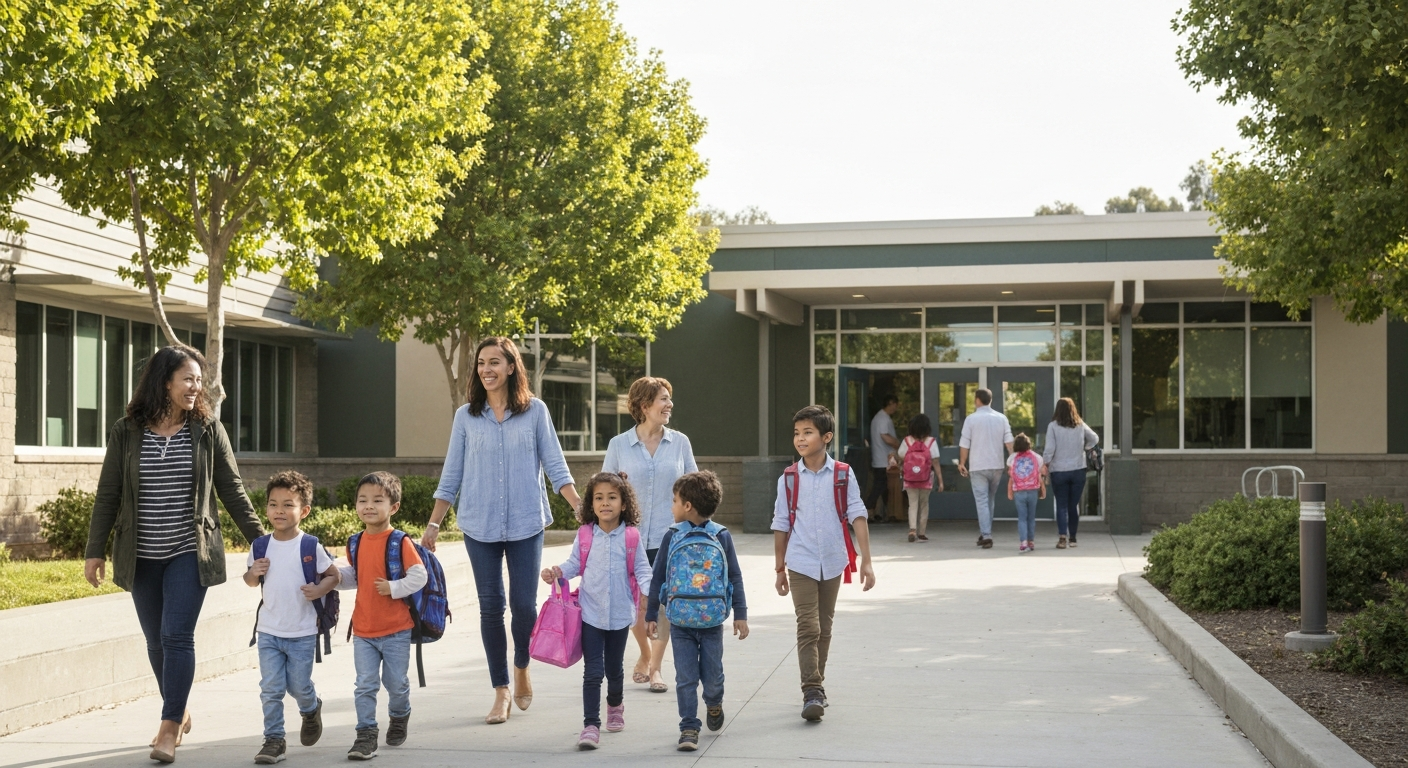
Most Bay Area parents start their elementary school search the same way: pulling up GreatSchools ratings and ranking schools by their test scores.
It's the wrong place to start.
Quick Answer: When choosing an elementary school in the Bay Area, evaluate 5 factors in this order: child-school fit (personality, learning style), school culture and values, teaching approach and class size, logistics (location, schedule, cost), and academic track record. Test scores are only one data point — not the whole picture. Use a comparison scorecard to evaluate 3-5 schools before deciding.
Why Most Parents Start in the Wrong Place
Bay Area parents plan ahead with KidPlanr
Free, week-by-week summer plans for your kids
Plan summer between school years — match camps to each kid's age, interests, and your work calendar. Free to use.
Plan my summer →Test scores are easy to compare. You can rank 50 schools in 10 minutes on GreatSchools. But here's what those numbers don't tell you:
- Whether your child will feel safe and welcomed
- If the teaching style matches how your kid learns
- Whether you can actually get your child there every morning
- If the school's values align with your family's
A 9-rated school that's a terrible fit for your child is worse than a 7-rated school where they thrive.
The 5-Factor Decision Framework
Here's the framework Bay Area education advisors actually use when helping families choose schools. Use this order — it matters.
Factor 1: Child-School Fit (30% of Your Decision)
Start here, not with test scores. Ask:
Does my child's personality match the school's culture?
- Quiet, introverted kids may struggle at large, loud, activity-heavy schools
- High-energy kids may get in trouble at structured, quiet-focused schools
- Kids who need routine thrive at schools with consistent schedules; kids who need variety need flexible programs
Does the school's learning approach match how my child learns?
- Montessori: Self-directed, hands-on, mixed-age classrooms — great for independent learners
- Traditional: Teacher-led, structured curriculum, age-grouped — good for kids who thrive with clear expectations
- Progressive/project-based: Collaborative, creative, less structured — ideal for kids who learn by doing
Red flag: If you're trying to change your child to fit the school, that's the wrong school.
Factor 2: School Culture and Values (25% of Your Decision)
Visit the school. Spend 30 minutes in the hallway and cafeteria during recess. Look for:
How do teachers and students interact?
- Do teachers greet kids by name?
- Do kids seem comfortable approaching adults?
- How do staff handle conflicts? (Watch one playground interaction.)
What does the school prioritize?
- Academic achievement only? Or social-emotional learning too?
- Diversity and inclusion — is it real or just on the website?
- Parent involvement — required, encouraged, or optional?
What do current parents say?
Don't ask "Is this a good school?" Ask:
- "What surprised you about this school after a year?"
- "When has the school handled a problem well? When did they drop the ball?"
- "Would you choose this school again?"
Factor 3: Teaching Approach & Class Size (20% of Your Decision)
Class size matters more than test scores for K-2.
- Public schools: Bay Area averages 22-24 students per class (K-3), 26-28 (4-5)
- Private schools: Averages 12-18 students per class
Smaller isn't always better — some kids thrive in larger, more social environments. But if your child needs more 1-on-1 attention, class size is critical.
Teacher credentials and stability:
- How long do teachers stay? (High turnover is a red flag.)
- What's the teacher-to-student ratio for support (reading specialists, counselors)?
Curriculum flexibility:
- Can advanced learners move ahead?
- Do struggling learners get intervention without stigma?
- Is there time for art, music, PE — or just test prep?
Factor 4: Logistics (15% of Your Decision)
The best school in the Bay Area doesn't matter if you can't get your child there.
Location and commute:
- Can you do drop-off/pickup every day? (Elementary = 180 days/year)
- Public schools: Neighborhood assignment or lottery?
- Private schools: Average 20-30 minute drive; some families drive 45+ minutes
Schedule and aftercare:
- School hours: Most Bay Area elementary schools run 8:30am-2:30pm or 9am-3pm
- Do you need before/after care? (Public schools often have onsite programs; private schools vary.)
- Half-day Kindergarten vs. full-day — does the school offer both?
Cost:
- Public schools: Free tuition; budget $200-500/year for supplies, fundraisers, field trips
- Private schools: Bay Area averages $25,000-$50,000/year (K-5)
- Financial aid available at most private schools (typically 20-40% of families receive aid)
- Sliding scale based on family income
Enrollment timeline:
- Public schools: Enrollment opens January-March for Fall; lottery results by April
- Private schools: Applications due December-January; decisions by March-April
- Waitlists: Common at popular schools; movement happens May-August
Factor 5: Academic Track Record (10% of Your Decision)
Yes, only 10%. Here's why.
Test scores tell you about the student body, not the school.
A school with a 9 rating often means: wealthy neighborhood, highly educated parents, lots of tutoring. It doesn't mean better teaching.
What to look at instead:
- Growth, not just achievement: Are kids improving year-over-year?
- Equity: Are all student groups progressing, or just some?
- Beyond tests: Arts programs, science fairs, student projects
Where test scores DO matter:
- If you're comparing two schools that are otherwise equal, yes, look at scores
- If your child will need academic support, check if the school has strong intervention programs
The Decision Tool: School Evaluation Scorecard
Use this scorecard to compare 3-5 schools. Score each factor 1-5 (1 = poor fit, 5 = excellent fit).
| Factor | School A | School B | School C | Why it matters |
|---|---|---|---|---|
| Child-School Fit (30%) | ___ / 5 | ___ / 5 | ___ / 5 | Does my child's personality + learning style match this school? |
| School Culture (25%) | ___ / 5 | ___ / 5 | ___ / 5 | Do the values align? Do we trust the staff? |
| Teaching Approach (20%) | ___ / 5 | ___ / 5 | ___ / 5 | Class size, teacher quality, curriculum fit? |
| Logistics (15%) | ___ / 5 | ___ / 5 | ___ / 5 | Can we make this work daily for 6 years? |
| Academic Track Record (10%) | ___ / 5 | ___ / 5 | ___ / 5 | Solid academics + growth data? |
| Weighted Total | ___ / 5.0 | ___ / 5.0 | ___ / 5.0 | Multiply each score by its % weight, then sum |
How to use it:
- Visit each school (tour + observation, 1-2 hours)
- Score each factor based on your family's priorities
- Calculate weighted total: (Fit × 0.30) + (Culture × 0.25) + (Teaching × 0.20) + (Logistics × 0.15) + (Academics × 0.10)
- The highest score is your best fit — not necessarily the highest-rated school
Example:
School A (Rated 9/10): Great test scores, but 45-minute commute, formal teaching style doesn't match your creative kid.
- Weighted score: 3.2/5.0
School B (Rated 7/10): Strong culture fit, 10-minute walk, project-based learning matches your kid, smaller class sizes.
- Weighted score: 4.5/5.0
School B is the better choice.
Common Questions About Choosing Elementary Schools
How important is the school's test score rating?
It's one data point, not the whole picture. A 7-rated school can be better for your child than a 9-rated school if the fit is right. Look at growth scores (are kids improving?), not just absolute scores.
Should I choose a public or private elementary school?
It depends on your budget, your child's needs, and your local public school options. Many Bay Area public schools are excellent. Private schools offer smaller class sizes and more flexibility, but cost $25K-$50K/year. Visit both types before deciding.
What if I can't afford private school?
Most Bay Area private schools offer financial aid. Apply even if you think you won't qualify — sliding-scale aid is available to families earning up to $200K-$250K in some cases. Also explore excellent public schools, charter schools, and magnet programs.
When should I start the school selection process?
Start visiting schools in Fall (September-November) the year before enrollment. Applications for private schools are due December-January; public school enrollment opens January-March. Give yourself 3-6 months to visit, compare, and decide.
How many schools should I visit?
Visit 3-5 schools minimum. More than 7 becomes overwhelming. Use your scorecard to narrow down to your top 3, then revisit those before applying.
What if my top choice school has a waitlist?
Waitlists move. Accept a spot at your second-choice school, stay on the waitlist for your first choice, and be ready to switch if a spot opens (often happens in May-August). Many families get in off waitlists.
Can I switch schools after starting?
Yes. Switching is common in K-1 if the fit isn't right. It's harder to switch mid-year, but possible. Most families who switch do so between school years.
What NOT to Over-Interpret
- One bad review: Every school has unhappy parents. Look for patterns, not outliers.
- A single low test score year: Could be a small cohort or testing anomaly. Look at 3-5 year trends.
- The "best" school your friend chose: Your child ≠ their child. Fit matters more than reputation.
Your Next Steps
- Make a shortlist: Identify 5-7 schools in your area (mix of public/private, different teaching styles)
- Schedule tours: Call schools now; tours fill up fast (September-November is peak season)
- Use the scorecard: Bring the evaluation tool above to each visit
- Talk to current parents: Ask the 3 questions in Factor 2 above
- Apply to 2-3 schools: Not just one — give yourself options
Track Your School Search on KidPlanr
Planning your child's school transition while managing summer camps and afterschool activities? Join the waitlist for KidPlanr Activity Tracker — a simple way to organize all your kids' schedules in one place.
Related guides:
Bay Area parents plan ahead with KidPlanr
Free, week-by-week summer plans for your kids
Plan summer between school years — match camps to each kid's age, interests, and your work calendar. Free to use.
Plan my summer