Best Language Classes for Kids Bay Area 2026 | Mandarin, Spanish, French
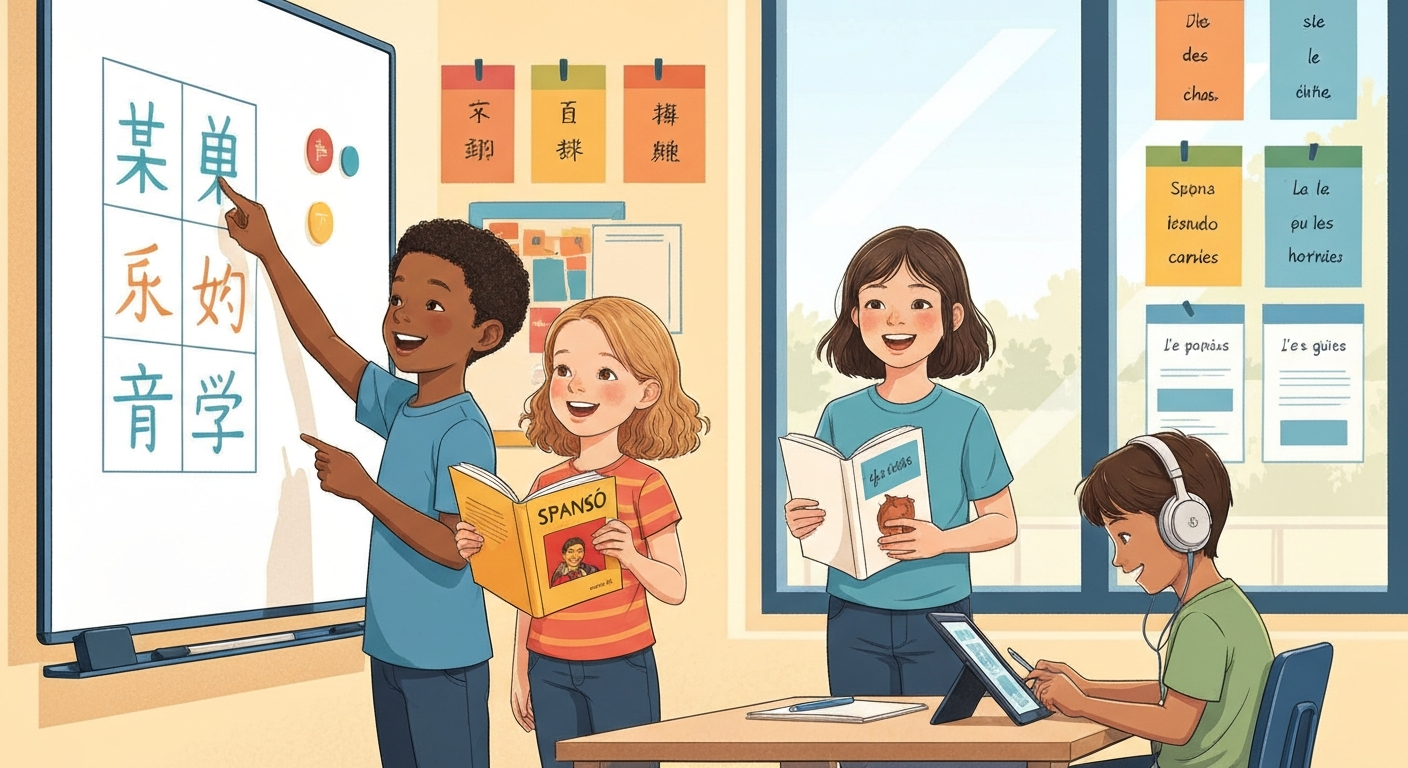
Every Bay Area parent I know is thinking about language classes. Mandarin for heritage. Spanish for practical fluency. French because... well, because it sounds sophisticated. But when you start looking, you find 100+ programs across three languages, formats ranging from Sunday heritage schools to full immersion daycares, and monthly costs from $150 to $2500.
Quick Answer: Bay Area offers 100+ language programs for kids across Mandarin ($150-800/month for weekend/afterschool), Spanish ($200-2500/month for classes to immersion daycare), and French ($180-600/month via Alliance Française network). Choose based on: family heritage goals (heritage program), academic prep (AP-track program), or conversational fluency (immersion/play-based). Most families see progress in 12-18 months with twice-weekly classes. Trial classes are available at nearly all programs.
Here's how to actually choose one — and what you should expect to pay.
Why Bay Area Parents Choose Language Classes
Build your summer plan
Map every week of summer in 3 minutes
KidPlanr lays out every week with camps that match each kid's age and interests — and tracks which weeks still have spots.
Build my calendar →Three common scenarios:
Heritage language preservation. You speak Mandarin or Cantonese at home. Your child understands but won't speak it. You want them connected to grandparents and culture.
Academic advantage. Spanish AP credit. Mandarin for college apps. French because your kid loves language and you want them ahead.
Early bilingualism. Research shows kids under 7 pick up languages faster than adults. You want them fluent while their brains are wired for it.
All three goals require different program formats. Mixing them up is the most common mistake.
Mandarin Programs: Heritage vs. Academic Tracks
The Bay Area has the densest concentration of Mandarin programs outside of Asia — over 40 programs serving kids ages 3-18.
Weekend Heritage Schools ($150-400/month)
Format: Saturday or Sunday classes, 2-3 hours, taught in Mandarin. Focus on speaking, character recognition, cultural activities.
Who it's for: Families where at least one parent speaks Mandarin. Kids have home exposure but need structured practice.
Bay Area Programs:
-
Mei Jia Chinese Learning Center (San Francisco) — Morning preschool program, after-school elementary, weekend classes for all ages. $200-350/month depending on frequency. Summer camp available (10-week program, five 2-week sessions).
-
Hanwen School (East Bay) — Serving East Bay community with Mandarin programs focused on heritage learners. $180-300/month.
-
Berryessa Chinese School (San Jose) — 46 years of Chinese language education. Nursery songs, games, stories for young learners. $150-250/month.
-
Bay Area Chinese Language School (Santa Clara) — Private and small group lessons. $250-400/month for weekly sessions.
Cost: $150-400/month for weekend classes (2-4 hours/week).
Timeline to fluency: 2-3 years for conversational fluency; 4-5 years for character literacy at grade level.
Daily After-School Immersion ($400-800/month)
Format: Monday-Friday after school, 2-3 hours/day. Full Mandarin immersion with homework, enrichment, cultural activities.
Who it's for: Families serious about fluency. Works best if child is motivated or already has some Mandarin exposure.
Bay Area Programs:
-
Everyday Mandarin (Daly City, SF locations) — Meets all school days, runs until 6PM. Students learn Chinese 5 days/week with cultural immersion. $600-800/month. Summer programs integrate Mandarin into daily activities with field trips.
-
MLCC (Mandarin Language and Cultural Center) (Peninsula) — Courses for Pre-K through high school. Heritage, CFL (Chinese as Foreign Language), AP Chinese, and cultural classes. $500-750/month for afterschool programs.
Cost: $400-800/month for 5 days/week after-school program.
Timeline to fluency: 12-18 months for conversational skills; 2-3 years for grade-level literacy.
What This Means for Your Family
A twice-weekly heritage school class is enough to maintain home language for kids who already hear Mandarin daily. But if your child starts from zero exposure, expect slow progress — heritage schools assume home reinforcement.
Daily after-school immersion accelerates fluency but requires 5-6 hours/week commitment. Most effective for ages 5-10 when kids have the attention span but haven't hit the "too cool for Chinese school" phase yet.
Spanish Programs: Conversational vs. Immersion
Spanish programs split into two camps: conversational enrichment classes (1-2 hours/week) and full immersion environments (preschool or elementary school).
Conversational Enrichment Classes ($200-400/month)
Format: Weekly or twice-weekly classes, 1-2 hours, songs, games, conversation practice.
Who it's for: Families who want Spanish as a skill, not necessarily fluency. Good for kids with no home Spanish exposure.
Bay Area Programs:
-
Spanish Academy — Partners with elementary schools and community centers across the Bay Area for before/after school programs and camps. $200-350/month for twice-weekly classes. Summer camps available 2026.
-
CASA de ESPAÑOL — Spanish language school offering structured classes for kids and teens. $250-400/month depending on frequency.
-
Kasa De Franko — Personalized Spanish lessons online or in-person for ages 3-17. Emphasizes fluency, cultural immersion, individualized attention. $300-500/month for weekly private or semi-private lessons.
Cost: $200-400/month for 1-2 classes/week.
Timeline to fluency: 3-4 years for basic conversational Spanish; vocabulary grows but grammar mastery requires home practice or immersion.
Full Spanish Immersion (Preschool/Elementary)
Format: All-day preschool or elementary program where Spanish is the primary language of instruction (50-90% Spanish, 10-50% English).
Who it's for: Families who want true bilingualism. Requires 4-5 year commitment (preschool through elementary).
Bay Area Programs:
-
Aventuras SF — Fun Spanish immersion programs in San Francisco. Summer camp 2026 registration open. Preschool immersion also available. $2000-2500/month for full-day immersion preschool.
-
KSS Immersion Preschools — Four convenient program options with 10-month and year-round schedules. Designed to feel like a second home. $1800-2500/month for dual language preschool.
-
The Dahlia School SF — Full Spanish-immersion in every toddler, primary, and elementary classroom. $2200-2800/month.
-
SFUSD Spanish Immersion — Public school option. 50% Spanish / 50% English K-5 starting 2025-26 school year. Free (public school).
Cost: $1800-2800/month for private immersion preschool; free for public school immersion (limited spots, lottery-based).
Timeline to fluency: 3-5 years for grade-level bilingual fluency (reading, writing, speaking).
How Common Is This?
Most Bay Area parents report that kids in twice-weekly conversational classes can hold basic conversations after 2 years — ordering food, talking about hobbies, asking directions — but struggle with complex grammar or academic vocabulary.
Full immersion produces bilingual kids by 2nd-3rd grade, but the cost is steep ($20K-30K/year for private preschool). The public school immersion option (SFUSD, some South Bay districts) is free but competitive — waitlists can be 100+ families.
French Programs: Alliance Française Network
French programs in the Bay Area are concentrated through the Alliance Française network — four locations offering consistent curriculum and cultural programming.
Alliance Française Classes ($180-600/month)
Format: Weekly or twice-weekly classes, age-grouped (ages 4-18), French-only instruction, cultural activities, prep for DELF exams.
Who it's for: Families who want French as a cultural skill or academic credential (AP French). Less heritage focus than Mandarin/Spanish.
Bay Area Locations:
-
Alliance Française de San Francisco — Classes in 4 locations including Sausalito. Large catalog of online classes for kids, teens, adults. $250-500/month for in-person kids classes; $180-350/month for online.
-
Alliance Française Silicon Valley — Serves San Jose, Los Gatos, Menlo Park, Palo Alto, Campbell, Saratoga. French classes for kids and teens at all levels, AP French prep. $220-450/month.
-
Alliance Française de Berkeley — Classes for adults, teens, children at all levels. Private lessons and family programs. $200-550/month depending on format.
-
EFBA (École Franco-Berkeley Américaine) — Nonprofit French school for ages 5-18. Online French classes, afterschool programs across Bay Area, summer camps. $300-600/month for afterschool classes.
Cost: $180-600/month depending on frequency (1-2 classes/week) and format (online vs in-person).
Timeline to fluency: 3-4 years for conversational French; 5-6 years for AP-level proficiency (reading literature, essay writing).
What You're Paying For
Alliance Française classes follow European CEFR standards (A1 beginner → C2 fluent). This means consistent curriculum across all Bay Area locations — if you move from SF to Palo Alto, your child continues at the same level.
The trade-off: less flexibility than private tutors. Classes follow semester schedules, homework is required, and cultural programming (French film screenings, Bastille Day events) is part of the package whether you want it or not.
For families serious about AP French or planning time in France, the structured approach works. For casual "enrichment French," it can feel overly academic.
How to Choose: Decision Framework
Here's the framework that works for most Bay Area families:
Step 1: Define Your Goal
Heritage preservation → Weekend heritage school (if you speak the language at home)
Conversational fluency → After-school immersion or twice-weekly classes
Academic credential (AP, college apps) → Structured program with exam prep track
Early bilingualism (ages 3-7) → Full immersion preschool or daily after-school
Step 2: Match Format to Age
| Age Range | Best Format | Why |
|---|---|---|
| Ages 3-5 | Immersion preschool OR parent-child classes | Play-based, no homework, natural acquisition |
| Ages 6-9 | After-school immersion OR twice-weekly enrichment | Attention span supports 1-2 hour classes; still young enough for accent-free pronunciation |
| Ages 10-13 | Academic track with grammar focus | Transitioning to literacy; can handle homework and structured study |
| Ages 14-18 | AP prep or conversation clubs | Exam-focused or maintaining fluency; harder to start from zero |
Step 3: Budget Reality Check
| Monthly Budget | What You Can Afford |
|---|---|
| $0-150 | Library story times (free), home practice with apps, community classes at churches/cultural centers |
| $150-300 | Weekend heritage school (1-2 hours/week), online group classes |
| $300-600 | Twice-weekly in-person classes, private tutoring (1 hour/week), structured enrichment programs |
| $600-1000 | Daily after-school immersion, intensive summer programs |
| $1800-2800 | Full immersion preschool/elementary (if you're replacing daycare, cost is comparable) |
Step 4: Trial Before Committing
Every program below offers trial classes. Use them.
What to watch during trial:
- Does your child ask when the next class is? (Green flag — genuine interest)
- Are they quiet the whole class or actively participating? (Shyness is normal first class; check again at class 2-3)
- Does the teacher speak to your child directly or just lecture to the group? (Small classes with individual attention work better for most kids)
- Is homework required? Can your family handle the weekly commitment? (Be honest about your schedule)
Red flag: Programs that pressure you to commit to a full year upfront without trial. Most reputable programs offer drop-in trials or 4-week trial sessions.
Step 5: The 30-Day Check-In
After your child starts, reassess at 30 days:
- Green flags: Child mentions class unprompted, uses new vocabulary at home, asks to practice
- Yellow flags: Child is neutral — doesn't resist but doesn't bring it up
- Red flags: Child resists going, complains the whole time, shows zero vocabulary retention
If you hit 30 days and see red flags, it's time to switch programs or take a break. Language learning only works if the kid is at least neutral. Fighting them weekly is a recipe for resentment.
What NOT to Over-Interpret
"My child forgot everything over summer break"
This is normal. Language skills are "use it or lose it" for kids. A 3-month summer break without practice will reset conversational vocabulary — but it comes back faster the second time. Don't panic and don't quit. Resume classes in fall and you'll see progress again within 4-6 weeks.
"The other kids in class are more advanced"
Heritage language classes mix levels more than you'd expect. Some kids have grandparents who speak daily; others have parents who understand but don't speak at home. Your child's pace is their pace. Comparing is useless.
"We're spending $400/month and my kid still can't read"
Literacy lags behind speaking by 1-2 years in second language acquisition. A 7-year-old in year 2 of Mandarin classes might speak at a 5-year-old level but read at a 3-year-old level. That's normal. Reading comes with time and structured practice.
Free and Low-Cost Alternatives
If $300-600/month isn't in the budget right now, here are Bay Area options under $150/month:
Free:
- Public library story times in Mandarin, Spanish, French (SF Main Library, San Jose libraries, Berkeley Public Library)
- Language exchange meetups (BayAreaParentsSocial on Meetup has Chinese, Spanish playgroups)
- YouTube channels (PBS Kids Spanish, Little Pim, Muzzy)
Under $150/month:
- Community-based heritage schools (Chinese schools run through churches, temples often charge $100-200/semester)
- City recreation programs (Palo Alto, Mountain View, San Jose rec centers offer 6-week intro Spanish or Mandarin classes for $80-120)
- Online group classes via Outschool or Varsity Tutors ($15-25/class, pay as you go)
Home practice tools:
- Duolingo ABC (free app for ages 3-8, Spanish and French)
- Little Pim DVDs (library checkout, Mandarin/Spanish/French)
- Bilingual picture books (check out 20-30 from library, rotate monthly)
The catch: free options require parental consistency. If you can commit to 20-30 minutes of daily practice at home, free tools work. If you need the structure of a scheduled class to make it happen, budget for a program.
What to Do Now
Here's your 7-day action plan:
Day 1-2: Pick one language. Don't try to do Mandarin AND Spanish simultaneously unless your family speaks both at home. Split focus = half the progress.
Day 3-4: Shortlist 3-5 programs that match your format (heritage, immersion, enrichment) and budget. Use the program lists above.
Day 5: Email all 3-5 programs asking for trial class info. Most respond within 24-48 hours. Ask: "Do you offer trial classes? What's the age range and current level of the class my child would join?"
Day 6: Book 2-3 trial classes for the same week if possible. Comparing back-to-back helps you see differences in teaching style, class size, energy level.
Day 7: Let your child pick. If they say "the one with the singing teacher" or "the class where we played the dumpling game," that's your answer. Kids know what clicks for them.
After trial: Commit to one semester (12-16 weeks). That's enough time to see real progress but not so long you feel trapped if it's not working.
Decision Tool: Which Language Program Format for My Child?
START HERE:
Q1: Do you or your partner speak this language fluently at home?
- YES → Heritage program (weekend school, 2-4 hours/week)
- NO → Go to Q2
Q2: What's your primary goal?
- "I want my child bilingual by age 10" → Daily immersion (after-school 5 days/week OR immersion preschool)
- "I want conversational skills for travel/culture" → Twice-weekly enrichment classes
- "I want AP credit or college prep" → Academic track program with exam prep
- "I'm not sure yet, just exploring" → Start with once-weekly trial classes, reassess in 3 months
Q3: What's your monthly budget?
- $0-150 → Community programs, library story times, home practice (see Free Alternatives above)
- $150-400 → Weekend heritage school OR twice-weekly enrichment
- $400-800 → Daily after-school immersion
- $1800+ → Full immersion preschool (if replacing daycare)
Q4: How old is your child?
- Ages 3-5 → Immersion preschool (if budget allows) OR parent-child play classes
- Ages 6-9 → After-school immersion OR twice-weekly enrichment (sweet spot for starting)
- Ages 10-13 → Academic track with grammar focus (literacy matters now)
- Ages 14-18 → AP prep OR conversation clubs (harder to start from zero but maintaining fluency works)
Q5: Can your family commit to weekly homework (15-30 min)?
- YES → Academic or heritage track (homework reinforces learning)
- NO → Immersion or play-based programs (no homework, just attendance)
YOUR MATCH:
- If you answered Heritage + $150-400 budget + Ages 6-9 → Weekend Mandarin heritage school like Mei Jia or Berryessa
- If you answered Conversational + $200-400 budget + Ages 6-9 → Twice-weekly Spanish enrichment like Spanish Academy or CASA de ESPAÑOL
- If you answered AP/College Prep + $300-600 budget + Ages 10-18 → Alliance Française academic track
- If you answered Bilingual + $600-1000 budget + Ages 6-9 → Daily Mandarin immersion like Everyday Mandarin
- If you answered Early bilingual + $1800-2800 budget + Ages 3-5 → Spanish immersion preschool like Aventuras or KSS
Frequently Asked Questions
Q: How long until my child is fluent?
A: Define "fluent." Conversational fluency (can chat with native speakers, understand movies without subtitles) takes 2-3 years with twice-weekly classes for ages 6-10. Literacy fluency (can read novels, write essays) takes 4-6 years. Immersion programs accelerate this to 12-18 months for conversational, 2-3 years for literacy.
Q: Should I do Mandarin or Spanish?
A: Mandarin if you have family heritage or live in an area with high Chinese-speaking population (East Bay, South Bay, SF). Spanish if your goal is practical communication — 40% of California speaks Spanish. French if your child loves language for its own sake or you have European travel plans. There's no "best" choice — only best fit for your family.
Q: My child is 12 and has never studied a language. Is it too late?
A: Not too late, but harder. Ages 6-9 is the sweet spot for accent-free pronunciation and natural grammar acquisition. Ages 10-13 can still learn fluently but will have a slight accent and need more structured study. Ages 14+ should focus on academic track (AP prep) rather than immersion — their brain is wired for grammar rules now, not natural acquisition.
Q: Can I switch programs mid-year if it's not working?
A: Yes. Most programs allow drop-out after the first month with prorated refunds or credit toward future semesters. Don't stay in a program that's clearly wrong just because you paid upfront. Better to lose one month's tuition than waste six months in the wrong format.
Q: How do I know if my child is actually making progress?
A: Track vocabulary at home. Ask your child to name 5-10 objects in the target language every month. If the list grows (even slowly), they're progressing. If they can't name 5 things after 3 months of classes, something's wrong — either the program isn't effective or your child needs more practice at home.
Q: Should we do language classes over summer or take a break?
A: Depends on your child's level. If they're in year 1, a 3-month summer break will erase most progress — better to do summer camp in the target language or at least weekly classes. If they're in year 3+, they can handle a break and bounce back quickly in fall. Use summer for travel to a country where the language is spoken if possible — 2 weeks of immersion beats 8 weeks of classes.
Related Resources
Looking for more year-round activities? Check out our guide to Afterschool Activities for Kids in Bay Area for a full comparison of gymnastics, swimming, tennis, and more.
Already juggling multiple activities? Use our Afterschool Schedule Template for Working Parents to manage pickups, dropoffs, and homework time.
Wondering if your child actually enjoys their current activity? Read How to Know If Your Kid Is Enjoying Their Activity for the conversation framework that works.
Planning summer alongside language classes? See our Summer Camps Bay Area 2026 hub for 1,500+ camps across all interests and budgets.
Track your child's year-round activities — language classes, sports, arts, and more — all in one place. Join the KidPlanr waitlist to be first to try the activity tracker launching summer 2026.
Build your summer plan
Map every week of summer in 3 minutes
KidPlanr lays out every week with camps that match each kid's age and interests — and tracks which weeks still have spots.
Build my calendar