
Height & Youth Sport Selection: Bay Area Parent Guide
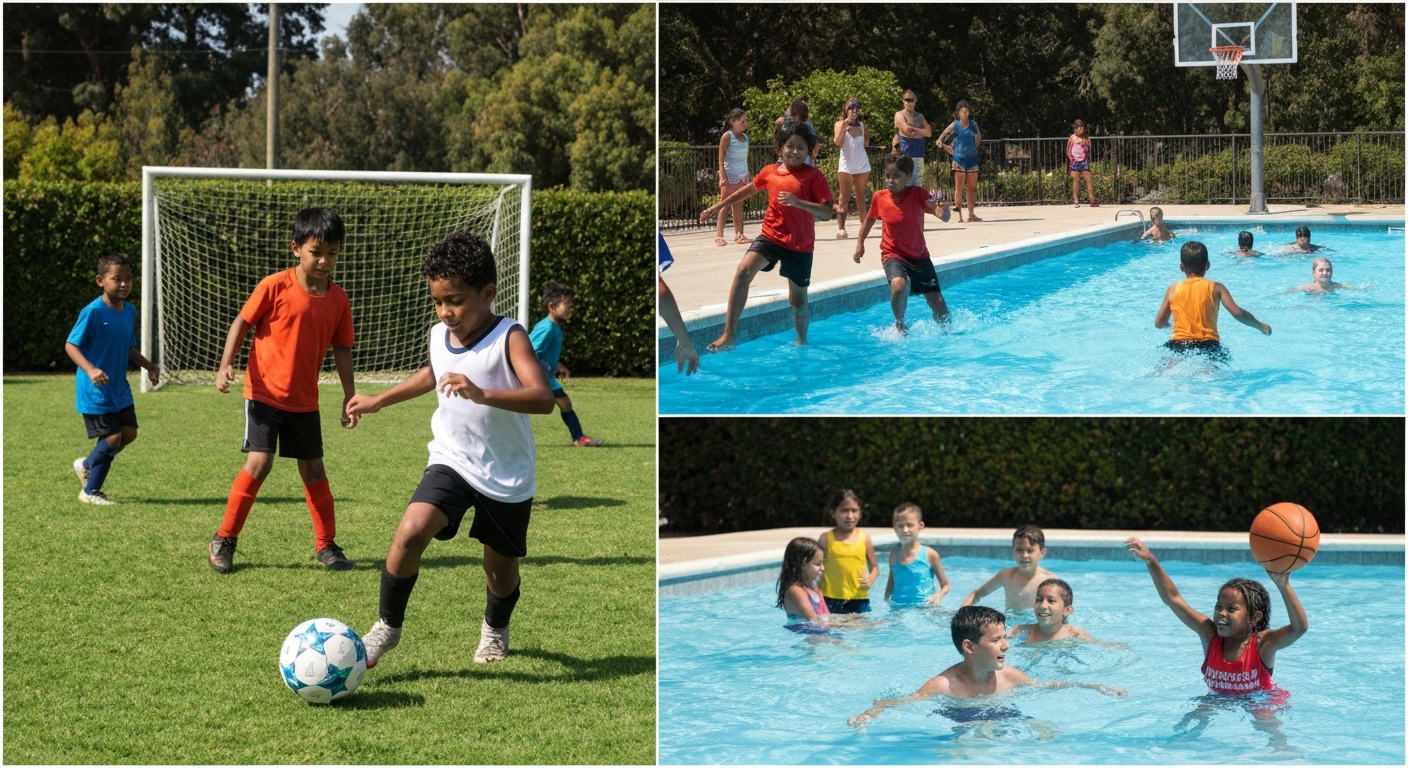
One of the most practical questions in youth sport selection — and one of the least openly discussed — is how a child's projected adult height affects their ceiling in a given sport. For Bay Area families thinking about long-term athletic development, and particularly about college recruitment, height isn't destiny. But it is a real variable that changes the math on which sports offer the best return on years of training investment.
Quick Answer
- Sports where height is genuinely decisive at the D1 level: basketball, volleyball, rowing, water polo. A projected 5'0" adult athlete faces structural barriers in all four.
- Sports where height is irrelevant or even advantageous if shorter: diving, gymnastics, fencing, squash, golf, distance running.
- Best sport for Ivy League recruitment regardless of height: fencing (7/8 Ivy schools, viable late start at age 12–15) and squash (8/8 Ivy schools, relatively small national talent pool).
- The expert consensus for ages under 12: multi-sport exploration is more valuable than early specialization in any single sport.
How to Estimate Your Child's Adult Height
Build your summer plan
Map every week of summer in 3 minutes
KidPlanr lays out every week with camps that match each kid's age and interests — and tracks which weeks still have spots.
Build my calendar →The mid-parental height formula gives a reasonable estimate of a child's adult height:
For boys: (Father's height + Mother's height + 5 inches) ÷ 2
For girls: (Father's height + Mother's height − 5 inches) ÷ 2
Add or subtract 4 inches (±2 standard deviations) for the 95% confidence range. This formula is most accurate after age 2 and loses precision during growth spurts. Bone age X-rays provide a more precise estimate when planning matters (used by some elite youth programs and pediatric sports medicine practices).
A few caveats: nutrition, sleep quality, and general health can affect realized height versus genetic potential. And in sports, technique, work ethic, and coachability matter more than height in almost every sport except basketball and volleyball at elite levels.
Sports Where Height Is Decisive
Basketball and Volleyball
No sport has a more direct relationship between height and career ceiling. The average WNBA player stands 6'0". NCAA D1 women's basketball averages 5'11"–6'1" at center positions and 5'7"–5'9" at guard. For a projected 5'0" adult athlete, a D1 basketball scholarship is effectively not on the table — the structural gap (7–10 inches below position averages) is not compensable through skill alone.
Volleyball similarly favors height. NCAA D1 women's volleyball averages ~6'0" at outside hitter. Shorter players can succeed at lower division levels but face ceiling effects in D1 recruitment.
Water Polo
Average NCAA D1 women's water polo player height: 5'7"–5'8". The reach and wingspan advantages in water are structural — a 7-inch height deficit is not a conditioning or technique problem. Brenda Villa, often cited as the shortest elite water polo player in modern history at 5'4", was exceptional; she was named FINA Player of the Decade for the 2000s and is widely regarded as one of the greatest players ever. She is the exception, not the baseline.
Rowing
NCAA D1 women's rowers average ~5'9"–5'11". Stroke length is directly correlated with height, which creates a biomechanical advantage at the top levels that training cannot replicate.
Sports Where Height Is Irrelevant or Advantageous if Shorter
Gymnastics: Short Is an Advantage
Average NCAA women's gymnast height: 5'1"–5'3" (range 4'11"–5'10"). A lower center of gravity improves balance. Smaller moment of inertia enables faster rotation. Better power-to-weight ratio contributes to explosive performance. For a projected 5'0" athlete, gymnastics is biomechanically well-suited.
The major constraint: gymnastics is not offered as a varsity sport in the Ivy League. Top programs are at Stanford, Michigan, UCLA, and UC Berkeley — excellent schools, but if an Ivy recruitment pathway is the goal, gymnastics doesn't provide one. Starting age is also demanding: most coaches recommend beginning by ages 5–8. After age 10, Olympic-caliber gymnastics becomes structurally difficult to pursue.
Diving: Short Is an Advantage, Ivy Pipeline Is Strong
Average Olympic female diver height (London 2012 data): 5'3" (160.2 cm). Shorter athletes have better rotational control during aerial maneuvers and a biomechanical edge. Critically, all 8 Ivy League schools have varsity swimming and diving programs — making diving one of the strongest Ivy recruitment pathways for a shorter athlete.
Swimmers often transition to diving well at ages 10–12. The skill transfer from competitive swimming is substantial, and coaches actively recruit swimmers with strong body awareness and flexibility.
Fencing: Height Is Irrelevant, Best Late-Start Option
Fencing coaches and recruiting guides explicitly state that height provides no meaningful advantage: "Whether you are 5'2" or 6'2", you can be a great fencer." Speed, technique, and tactical intelligence dominate. 7 of 8 Ivy League schools offer varsity fencing (all except Dartmouth), as do Stanford, MIT, Duke, and Northwestern.
What makes fencing especially useful for strategic sport selection: it has the most forgiving late-start window of any recruitment sport. Many world-class fencers started at ages 10–14. A child who begins fencing at age 12–13 and trains consistently can reach a college-recruitable level by junior year. That's a 5–6 year runway, which is more than manageable for a family that hasn't committed to a sport yet.
Squash: Neutral, All 8 Ivies, Small Talent Pool
Squash rewards speed, agility, and racquet skill — height is irrelevant. All 8 Ivy League schools field varsity squash teams. The most important variable for squash recruitment: the national talent pool is relatively small compared to soccer, tennis, or basketball. That means less competition for roster spots at top programs. Formal college recruitment begins September 1 of junior year.
Golf: Neutral at the Professional Level
Golf's irrelevance of height is proven at the highest professional levels: Akaya Furue (5'0", 4x LPGA winner), Alison Nicholas (5'0", 1997 US Women's Open champion), and Amelia Rorer (4'11.5", LPGA Tour competitor). All 8 Ivy League schools have varsity golf. AJGA tournament eligibility begins at age 12; coaches track results from age 14 onward.
Distance Running: Minor Advantage for Shorter Athletes
Shorter athletes often have biomechanical advantages in distance running: lower energy cost per stride, better heat dissipation, and more favorable power-to-weight ratios at longer distances. Many elite distance runners are 5'2"–5'5". All 8 Ivy League schools plus Stanford and MIT field varsity cross country and track. Distance running also has the latest viable serious start of any recruitment sport — a child who begins training seriously at ages 14–15 can still reach D1-competitive levels with strong natural ability and coaching.
Summary: Height vs. Ivy Recruitment by Sport
| Sport | Height at 5'0" | Ivy Schools Offering | Latest Viable Start | Notes |
|---|---|---|---|---|
| Basketball | Major disadvantage | 8/8 | Age 8–10 | 7–10" below avg at D1; structural gap |
| Volleyball | Major disadvantage | 8/8 | Age 8–10 | Similar structural gap |
| Water Polo | Major disadvantage | Varies | Age 8–10 | 7–8" below avg; reach matters |
| Rowing | Major disadvantage | Varies | Age 12 | Stroke length is height-linked |
| Diving | Advantage | 8/8 | Age 10–12 | Transition from swimming |
| Fencing | Neutral | 7/8 | Age 12–15 | Best late-start sport |
| Squash | Neutral | 8/8 | Age 10–13 | Small talent pool nationally |
| Golf | Neutral | 8/8 | Age 8–12 | Proven at pro level at 5'0" |
| XC/Distance | Slight advantage | 8/8 | Age 14–15 | Latest viable start |
| Gymnastics | Advantage | 0/8 Ivy | Age 5–8 | No Ivy pathway; excellent at Stanford/UCLA |
| Field Hockey | Workable (avg 5'3.5") | Most | Age 10–13 | Concentrated in Northeast |
When to Specialize (And When Not To)
The expert consensus in pediatric sports medicine and youth athletic development is consistent: early specialization before age 12 increases injury risk and burnout rates without improving elite-level outcomes. Multi-sport participation through age 11–12 develops broader athletic foundations — coordination, spatial awareness, reaction time — that transfer across sports.
For a family thinking strategically about eventual recruitment:
- Ages 5–10: Multi-sport exploration. Try swimming, soccer, gymnastics, martial arts. Find what the child loves. Physical literacy is the goal, not specialization.
- Ages 10–12: Begin exploring sports with late-start-viable Ivy pipelines (fencing, diving, squash). Formal instruction is appropriate; elite competition is not yet the priority.
- Ages 12–14: One or two primary sports. For fencing and distance running especially, this is when dedicated training can begin with college recruitment still achievable.
- Ages 14–16: If recruitment is a goal, compete at the club and regional levels. Coaches begin tracking results. AJGA for golf, regional fencing circuits, squash tournaments, cross country invitationals.
For height-uncertain situations — where your child's adult height is still an open question at age 10 — prioritizing sports with neutral height requirements is simply better risk management. Investing 8 years into volleyball only to find the adult height projection falls short is a painful outcome that earlier sport diversification can avoid.
A Note on Sports as College Hooks
Athletic recruitment is one of the most powerful admissions hooks at Ivy+ schools. At Sacred Heart Preparatory (Atherton) — the one Bay Area private school with public athlete data — roughly 50 of 133 Ivy+ enrollees over five years were confirmed recruited athletes in water polo, lacrosse, football, and rowing. That's a meaningful share of outcomes attributable directly to athletic recruitment.
The sports with the most documented Ivy recruitment pipelines for women — fencing, squash, rowing, swimming/diving, golf, cross country — are all accessible regardless of height. The question isn't whether sports matter for admissions. They do. The question is which sports give your child the most viable pathway given their body type, the timeline you're working with, and the athletic culture available in the Bay Area.
Bay Area summer sports camps are the most efficient way to introduce multiple sports to a younger child before any decision is made. Multi-sport exposure through age 10–12 is the expert recommendation — and summer is the obvious time to experiment.
Find Bay Area sports summer camps on KidPlanr
Frequently Asked Questions
How accurate is the mid-parental height formula?
The formula estimates adult height within about 4 inches (±2 standard deviations) for 95% of children. It's a reasonable planning tool, not a guarantee. Bone age X-rays, ordered by a pediatrician, provide more precise estimates. The formula is least accurate during active growth spurts and most accurate when growth has stabilized around age 2 and again in early adolescence.
My daughter is projected to be 5'0". Should she quit volleyball?
Not necessarily for the love of the game — but if college recruitment at D1 or Ivy level is a priority, the data is sobering. The structural height gap at D1 is difficult to overcome with skill alone. This doesn't mean volleyball isn't a great sport for fitness, teamwork, and enjoyment through high school. It means setting realistic expectations about the D1 recruitment ceiling and perhaps investing parallel development time in a height-neutral sport with stronger Ivy pipelines.
Is fencing realistic for a Bay Area family with no fencing background?
Yes. Fencing clubs are active throughout the Peninsula, South Bay, and East Bay. The sport has a lower equipment cost than golf and a more accessible competitive circuit than some other Olympic sports. Coaches specifically note that many world-class fencers started after age 10. The 5–6 year runway from a middle school start to high school recruitment age is realistic.
Do club sports matter for Ivy recruitment, or only high school sports?
For most Ivy-recruited sports, club and AAU competition results are what coaches track. High school teams demonstrate commitment and coachability. For golf, AJGA tournament results are essential. For squash and fencing, regional and national circuit rankings matter. Coaches typically begin actively recruiting after they've seen competition results from age 14 onward.
Which Bay Area summer sports camps are best for multi-sport exposure?
The best early programs let children sample multiple sports in a low-pressure environment without committing to specialization. KidPlanr's search filters surface programs by sport category, age range, location, and schedule. The priority for ages 5–11 is breadth — coaching quality and a fun, non-pressuring environment matter more than whether the camp is sport-specific.
Build your summer plan
Map every week of summer in 3 minutes
KidPlanr lays out every week with camps that match each kid's age and interests — and tracks which weeks still have spots.
Build my calendar