
Full Day vs Half Day Camps: Which Is Right? | Decision Guide
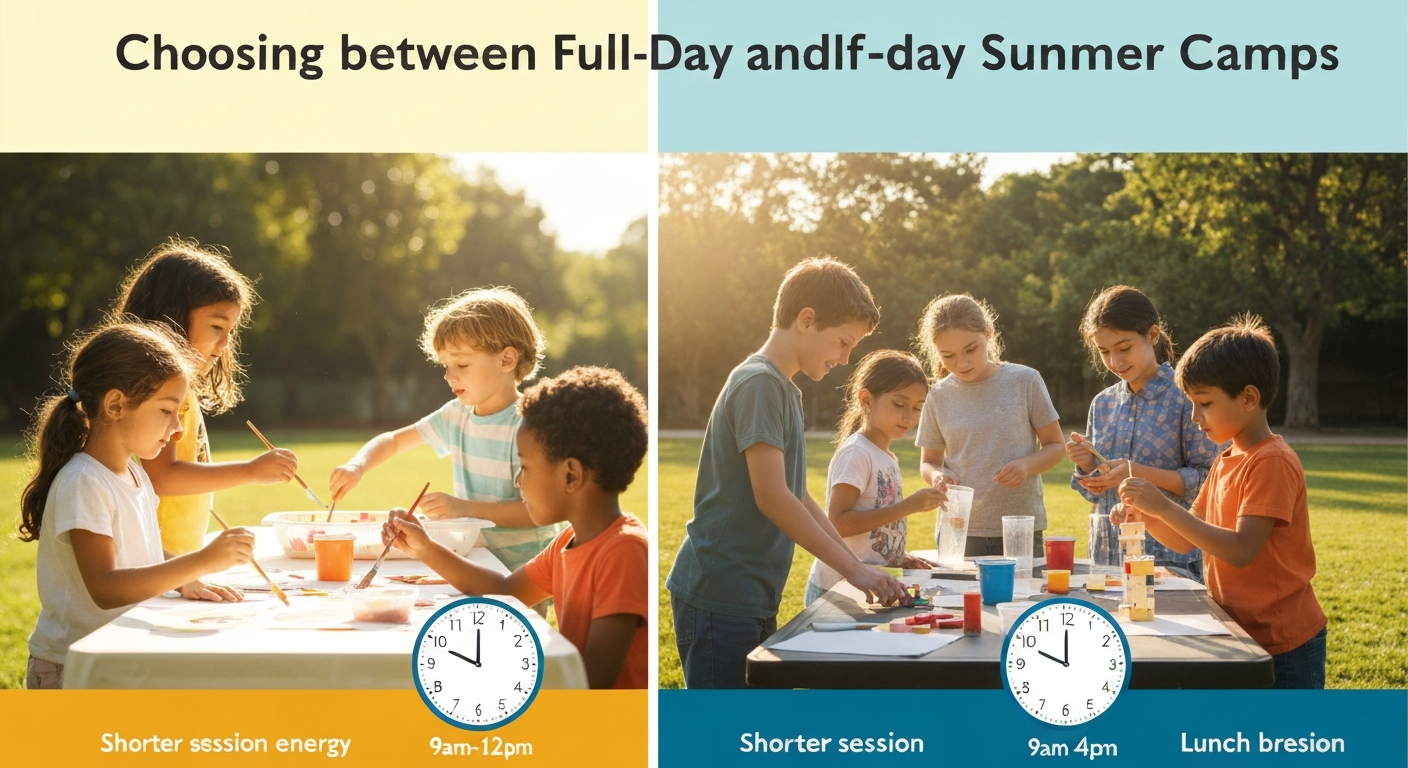
You're looking at two versions of the same camp — one runs 9am-3pm for $385/week, the other 9am-5pm for $625. Your kid would do the same activities either way. The half-day option saves you $240 a week, but you work until 6pm. Do you pay for the extra three hours, or scramble to figure out extended care?
This is the full-day vs half-day decision, and most Bay Area parents make it in a panic without realizing they're choosing between two completely different cost structures, logistical models, and developmental fits.
Quick Answer: Full-day Bay Area camps run 9am-5pm and cost $550-750/week on average; half-day runs 9am-12pm or 9am-3pm for $300-450/week. For kids under 8, half-day is often developmentally ideal — and adding extended care (before/after) still costs $100-200 less per week than full-day. Choose based on your kid's age, your work schedule, and whether your goal is all-day care or skill-building in a specific activity.
The Decision You're Actually Making
Build your summer plan
Map every week of summer in 3 minutes
KidPlanr lays out every week with camps that match each kid's age and interests — and tracks which weeks still have spots.
Build my calendar →When you choose full-day vs half-day, you're not just picking hours. You're deciding three things at once:
- How much structured activity time is right for your child's age and energy level
- What coverage model fits your work schedule (all-in-one vs mix-and-match)
- Whether you're optimizing for convenience or cost savings
Most parents default to full-day because "that's what working parents do." But 40% of Bay Area camps offer half-day options, and many experienced camp parents report that half-day + extended care delivers better outcomes for kids under 8 — at $200-400 less per week.
Let's walk through the framework.
Framework: 3 Questions to Decide
Question 1: What Is Your Work Schedule Reality?
Be specific. "I work full-time" isn't enough — when do you actually need coverage?
If you need 8am-6pm coverage every day:
- Full-day camp (9am-5pm) + extended care (7:30am-6pm) = one provider, one pickup, simple logistics
- Typical cost: $625/week camp + $150/week extended care = $775/week total
- Or: Half-day camp (9am-3pm) + extended care (7:30am-6pm) = same provider, same logistics
- Typical cost: $385/week camp + $180/week extended care = $565/week total
- Savings: $210/week, or $1,680 over 8 weeks
If you have flexible hours or a co-parent who can do 3pm pickup:
- Half-day camp (9am-3pm) = $385/week, no extended care needed
- You're comparing $385 vs $625 for full-day
- Savings: $240/week, or $1,920 over 8 weeks
If you work from home and can be "around" but need your kid occupied:
- Half-day camp (9am-12pm) is enough — they come home for lunch, you're present but not actively supervising all afternoon
- Typical cost: $300-350/week for morning-only programs
- Savings: $275-325/week vs full-day
The cost gap narrows significantly once you add extended care to both options. The difference is often $150-250/week, not $400.
Question 2: What Can Your Kid Actually Handle?
Camp advisors often see parents overestimate how much structured time younger kids want.
Ages 4-5 (Pre-K):
Most camps offering this age group default to half-day (9am-12pm or 9am-1pm). Full-day programs exist, but experienced camp directors report that 4- and 5-year-olds often "hit a wall" after lunch — they need downtime, not more activities.
Red flag to watch for: If your 4-year-old comes home from full-day camp and immediately crashes (tantrum, meltdown, refusal to engage), they may be overstimulated. Half-day might be a better developmental fit.
Ages 6-7 (K-1st grade):
This is the transition age. Some kids thrive in full-day; others still benefit from half-day with afternoon free play at home.
Green light for full-day: Your child regularly does 6+ hour school days without exhaustion, loves group activities all day, and asks for "more camp time."
Green light for half-day: Your child is an introvert who recharges alone, gets overstimulated by group activities, or still naps occasionally.
Ages 8+ (2nd grade and up):
Most kids this age can handle full-day camp comfortably. The question becomes: do you need full-day coverage, or is your kid asking to stay all day because they love the program?
If they're asking to stay, full-day is often worth it. If they're indifferent and you're choosing for convenience, half-day + extended care gives them built-in downtime.
Question 3: What's Your Real Goal for Camp?
Be honest about why you're signing them up.
Goal: Childcare coverage while you work
→ Either format works. Optimize for cost and logistics.
→ Lean toward: Half-day + extended care (if camp offers it) — saves $150-250/week, same coverage window.
Goal: Deep skill-building in a specific activity (coding, theater, sports)
→ Full-day specialty camps often provide more skill progression because there's time for both instruction and practice.
→ Lean toward: Full-day at a specialty program.
→ Example: iD Tech coding camps (full-day) vs Code Ninjas (half-day drop-in) — the full-day format allows for building a complete project over the week.
Goal: Social experience and "something fun to do"
→ Half-day is enough for socialization and fun. Kids don't need 8 hours of structured activities to make friends.
→ Lean toward: Half-day, especially for ages 4-8.
Goal: Trying a new activity without major commitment
→ Half-day lowers the stakes. If your kid hates it, you're only losing 3-4 hours a day, not the whole day.
→ Lean toward: Half-day for the first week; upgrade to full-day if they love it.
Decision Matrix
Use this table to match your situation to a format recommendation.
| If your priority is... | Consider | Example Bay Area Camps | Typical Price Range |
|---|---|---|---|
| Full coverage, 8am-6pm, working parent | Half-day + extended care | Galileo (half-day option), YMCA camps, city rec programs | $500-650/week total |
| Maximum skill progression in specialty (coding, sports, arts) | Full-day specialty | iD Tech, Dance Connection, Camp Galileo full-day | $600-800/week |
| Developmentally appropriate for ages 4-7 | Half-day (morning or 9-3pm) | Foothills Fun Camp (Palo Alto), Palo Alto Rec half-day programs, Mountain View STEAM camps | $300-450/week |
| Trying a new activity without big commitment | Half-day trial week | Code Ninjas, local art studios, community center drop-ins | $300-400/week |
| Cost savings without losing coverage | Half-day + mix in free activities | Half-day camp 3 days + library programs 2 days + extended care as needed | $200-400/week |
| Maximum convenience (one provider, one pickup) | Full-day with extended care included | Galileo (9am-6pm option), YMCA full-day + care, Camp Kinetic | $650-850/week |
What Surprises New Camp Parents
Surprise 1: Half-Day Camps Often Have Waitlists Too
Half-day isn't the "fallback" option. For ages 5-7, half-day programs at popular providers (Palo Alto Rec, Galileo) fill just as fast as full-day — sometimes faster, because parents realize it's a better developmental fit.
What to do now: If you're leaning half-day, register early. Don't assume half-day will be easier to get into.
Surprise 2: "Full-Day" Doesn't Always Mean 9am-5pm
Some camps market themselves as "full-day" but end at 3pm. Others run 9am-4pm. Check the actual hours before comparing prices.
What NOT to over-interpret: A camp ending at 3pm instead of 5pm doesn't mean it's lower quality — it means they're accounting for younger kids' energy levels. But you'll need to plan for that 3pm pickup.
Surprise 3: Extended Care Isn't Always Available at Half-Day Camps
Not all camps offer extended care with their half-day option. If you need before/after care, confirm it exists before registering.
Call ahead: Ask, "Do you offer extended care for the half-day program, and what are the hours and cost?"
What This Does NOT Mean
Choosing half-day does NOT mean:
- Your kid is "missing out" on the full camp experience — they're getting the core program, just in a shorter window
- You're being cheap — you're making a developmentally-informed choice that happens to cost less
- You can't switch to full-day later — many camps allow week-by-week format changes if your kid wants more time
Choosing full-day does NOT mean:
- You're over-scheduling your kid — plenty of 6- and 7-year-olds thrive in full-day programs
- You're paying for "babysitting" — full-day specialty camps often deliver real skill gains
- You're locked in — you can drop to half-day if your kid is exhausted
Your Decision Tool: Fill This In
Answer these three questions:
- Work schedule: Do I need coverage 8am-6pm, or can I flex for 3pm pickup?
- Need 8am-6pm → Consider half-day + extended care (saves $150-250/week vs full-day + extended care)
-
Can flex → Consider half-day only (saves $240+/week)
-
Kid's age and energy:
- Ages 4-5 → Half-day is usually ideal (9am-12pm or 9am-1pm)
- Ages 6-7 → Depends on temperament — introverts benefit from half-day, extroverts may prefer full-day
-
Ages 8+ → Full-day usually works well
-
Camp goal:
- Childcare coverage → Optimize for cost and logistics (half-day + extended care often wins)
- Skill-building specialty → Full-day at a focused program
- Social fun / trying something new → Half-day is enough
Now search camps by format:
Compare full-day and half-day camps on KidPlanr →
Filter by:
- City (your zip code)
- Age range
- Activity type
- Price range
You'll see camps tagged with their format. Look for "half-day option available" or "extended care offered" in the camp details.
One More Thing: The Extended Care Logistics
If you're considering half-day + extended care, here's what to expect:
Extended care typically covers:
- Before camp: 7:30am or 8am drop-off (vs 9am regular start)
- After camp: 3pm or 5pm pickup extended to 6pm
- Cost: $15-30/day ($75-150/week) on top of camp tuition
What they do during extended care:
Most camps offer free play, board games, crafts, outdoor time — it's less structured than the core camp program. This is actually developmentally helpful for kids who benefit from downtime after 3-4 hours of structured activities.
What this means for your budget:
- Half-day camp: $385/week
- Extended care: $150/week
- Total: $535/week (vs $625-750/week for full-day)
- Savings: $90-215/week, or $720-1,720 over 8 weeks
Real Parent Scenarios
Scenario 1: Working Parent, Two Kids (Ages 5 and 8)
- Decision: Half-day camp (9am-3pm) + extended care (7:30am-6pm) for both kids
- Why: The 5-year-old benefits from built-in downtime during extended care (less structured than full-day camp). The 8-year-old is fine with full-day but doesn't need it. Same logistics as full-day (one provider, one pickup), $400/week savings.
- Total cost: $1,070/week for both kids vs $1,470 for full-day both kids.
Scenario 2: Remote Worker, One Kid (Age 6)
- Decision: Half-day camp (9am-12pm), no extended care
- Why: Kid comes home for lunch, has free play in the afternoon while parent works nearby. Parent can handle interruptions.
- Total cost: $325/week vs $625 for full-day.
Scenario 3: Stay-at-Home Parent Trying New Activity
- Decision: Half-day specialty camp (coding, dance, etc.) for 2 weeks
- Why: Kid gets skill exposure without full-day commitment. If they love it, can extend to full-day or continue in fall.
- Total cost: $700 for 2 weeks vs $1,250 for full-day trial.
What's the Catch?
There isn't one — but here are three realities:
- Half-day camps at top providers fill up just as fast as full-day. Don't wait.
- Not all camps offer half-day. Specialty programs (especially teen-focused or intensive skills) are often full-day only.
- You'll need to coordinate extended care separately if your camp doesn't offer it. Some parents mix half-day camp with grandparent pickup, babysitter, or another parent's house.
Bottom Line
Most Bay Area parents choose full-day because they assume that's what working parents "have to" do. But if your kid is under 8, you're optimizing for cost, or you have any schedule flexibility, half-day + extended care often delivers the same coverage window at $150-250/week less — with better developmental fit for younger kids.
The decision isn't "full-day = good parent, half-day = cheap parent." It's "which format fits my kid's age, my schedule, and my camp goals?"
Next step:
Search camps by format on KidPlanr. Filter by your city, age, and activity type — you'll see which camps offer full-day, half-day, or both. Add a few options to your list, call to confirm extended care availability, and make your decision based on your three answers above.
Search Bay Area camps by format →
FAQ
Q: Can I switch from half-day to full-day mid-summer if my kid loves it?
Many camps allow week-by-week changes (subject to availability). Call the camp director before registering to confirm their policy. Some camps lock you into a format for the full session; others are flexible. YMCA and city rec programs typically allow changes; specialty camps (iD Tech, Galileo) often do not.
Q: Is half-day camp "worse" than full-day?
No. Half-day camps deliver the same core activities — instruction, projects, socialization. The difference is duration, not quality. For ages 4-7, half-day is often better developmentally because it avoids overstimulation. For ages 8+, full-day adds more project time and free play, which some kids prefer. Match format to your kid's energy level, not to what "everyone else" is doing.
Q: What if my kid is the only one doing half-day at a camp that offers both?
Most camps integrate half-day and full-day kids in the same morning program, so your child won't be singled out. The full-day kids just stay for lunch and afternoon activities. Your kid won't feel like they're "leaving early" — they're finishing at the scheduled time for their group.
Q: Do half-day camps have lower-quality instructors?
No. Instructors are usually the same across formats. The staffing model differs for extended care (often different staff), but the core camp instructors teach both half-day and full-day groups.
Q: How do I know if extended care is high-quality or just "parking lot supervision"?
Ask the camp: "What do kids do during extended care?" Good extended care offers free play, board games, crafts, and outdoor time — structured enough to be engaging, loose enough to let kids recharge. Red flag: if they say "we just supervise them in the gym," that's lower quality. Green flag: "we rotate through stations — arts and crafts, board games, outdoor play — and kids choose what they want to do."
Q: Can I do half-day camp at one provider and extended care at another?
Logistically difficult. Most camps offering half-day also offer extended care at the same location — it's designed as one package. Mixing providers means you're driving twice a day. Only do this if your half-day camp is truly exceptional and worth the logistics hassle.
Q: What if I can only afford half-day but need full-day coverage?
Mix strategies:
- Half-day camp 3 days/week + grandparent or babysitter 2 days
- Half-day camp + free city library programs (many offer 2-hour afternoon programs)
- Half-day camp + playdates with another parent (trade off coverage)
- Look for camps with sliding scale or financial aid — some offer full-day at reduced cost
Explore financial aid options for Bay Area camps →
Q: My 10-year-old wants to do full-day. Should I let them, or is half-day "enough"?
If your 10-year-old is asking for full-day, they're telling you what they need. At that age, full-day is usually fine developmentally — they can handle the structure and often enjoy the extra project time and free play with friends. The decision is budget and logistics, not "is this too much for them."
Build your summer plan
Map every week of summer in 3 minutes
KidPlanr lays out every week with camps that match each kid's age and interests — and tracks which weeks still have spots.
Build my calendar