How to Choose Afterschool Activities for Kids (Ages 4-12) | Guide
Last updated: April 2026
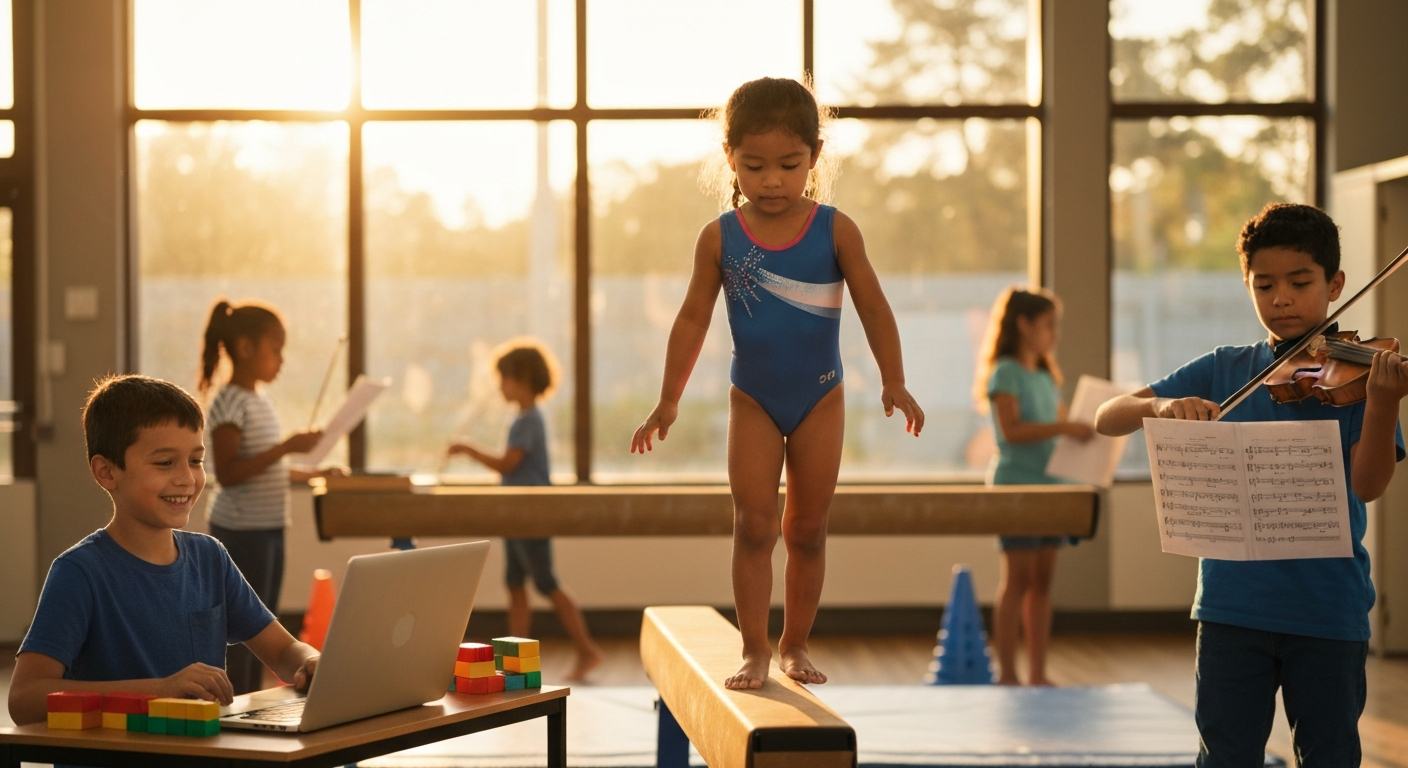
You're standing in front of the community center bulletin board. Gymnastics on Tuesdays. Coding camp on Wednesdays. Soccer on Thursdays. Your kid is excited about all of them—or none of them. How do you choose?
Quick Answer: Focus on your child's natural interests first, then filter by time commitment (1-2 activities max for ages 4-7, 2-3 for ages 8-12), budget reality ($80-300/month typical), and logistics that fit your family schedule. Trial classes reveal if it's a genuine match—most Bay Area programs offer free or $10 trials before full commitment.
Why Choosing the Right Activities Actually Matters
Bay Area parents plan ahead with KidPlanr
Find afterschool programs near you
Browse enrichment classes and afterschool care across the Bay Area. Filter by age, day, and pickup location.
Find afterschool programs →Afterschool activities aren't just about keeping kids busy while you work. Research shows they enhance academic achievement, improve social and emotional skills, and help children build positive relationships with peers and adults. The question isn't whether to do activities—it's which ones, and how many.
The Bay Area has overwhelming options: over 500 afterschool programs across the peninsula alone. YMCA, city recreation centers, private studios, school-based programs. Without a framework, parents default to whatever's convenient or what their neighbor's kid is doing.
That's where this guide helps.
The 5-Question Framework for Choosing Activities
Question 1: What Does Your Child Naturally Gravitate Toward?
Before looking at programs, observe what your child already does when given free choice.
For ages 4-6: Do they build with blocks? Draw? Run around? Sing? Young kids show preferences through play. A child who spends 30 minutes arranging toy animals is showing organizational and visual thinking—consider art, music, or STEM activities.
For ages 7-9: Are they reading sports stats? Watching cooking shows? Making friendship bracelets? Middle elementary kids start expressing explicit interests. Ask: "If you could do one thing after school every week, what would it be?"
For ages 10-12: They're developing identity through interests. Tech-focused? Creative? Athletic? Social? Tweens often know what they want but need help narrowing options.
Red flag: If your child shows zero interest in any activity type, don't force it yet. According to child development experts, ages 4-7 benefit more from unstructured play than structured activities. It's okay to wait.
Question 2: How Much Time Can Your Family Actually Commit?
Research from the Child Mind Institute shows overscheduling harms kids. The test: Can they still do homework? Get 8+ hours of sleep? Spend time with family? Hang out with friends? If any answer is "no," it's too much.
Age-based guidelines:
- Ages 4-6: 1-2 activities max, 45-60 minutes per session
- Ages 7-9: 2-3 activities max, 60-90 minutes per session
- Ages 10-12: 2-3 activities (or 1 intensive activity like competitive sports/theater)
For working parents: Consider programs at or near your child's school. Transportation and pickup timing matter. A strong program only helps if it fits your daily routine. Bay Area traffic means a 15-minute drive can become 40 minutes—factor that in.
Weekly time budget:
- After-school pickup: 3:00-3:30 PM
- Homework time: 30-90 minutes (age-dependent)
- Dinner/family time: 6:00-7:00 PM
- Bedtime routine starts: 7:30-8:00 PM (younger kids), 8:30-9:00 PM (tweens)
That leaves a 1.5-2 hour window on weekdays. One activity = doable. Two activities = tight. Three activities = you'll be stressed.
Question 3: What's Your Budget Reality?
Bay Area afterschool activities range from free (city parks programs) to $300+/month (intensive programs). Most fall in the $80-200/month range for weekly classes.
Typical monthly costs by activity type:
| Activity Type | Entry-Level | Mid-Range | Intensive/Competitive |
|---|---|---|---|
| Gymnastics | $80-120/mo | $150-200/mo | $250-400/mo |
| Swimming lessons | $100-150/mo | $180-250/mo | $300+/mo (competitive) |
| Music (private lessons) | $120-180/mo | $200-280/mo | $300+/mo |
| Coding/STEM | $150-200/mo | $250-350/mo | N/A |
| Team sports (rec league) | $50-100/season | $150-250/season | $500+/season (club) |
| Dance | $80-120/mo | $150-220/mo | $300+/mo (performance track) |
Budget-stretching strategies:
- City recreation programs: Many Bay Area cities offer subsidized programs at $20-80/month
- Sibling discounts: Most studios offer 10-15% off second child
- Session-based vs. drop-in: Committing to 8-12 week sessions is cheaper per class than drop-in
- Financial aid: YMCA, JCCs, and many community centers offer sliding-scale tuition
Planning summer camps too? Bay Area summer camps typically cost more ($400-700/week). Budget for both by planning year-round activity spend. Search camps by budget on KidPlanr →
Question 4: Does the Instructor/Program Match Your Child's Learning Style?
Not all programs are created equal—even within the same activity type.
Class size matters:
- Small groups (4-8 kids): Better for shy kids, beginners, or kids needing more attention
- Medium groups (10-15 kids): Good balance for most kids; enough peers for socialization, still manageable
- Large groups (20+ kids): Works for confident, self-directed kids; often less individualized attention
Teaching style varies:
- Structured/drill-based: Good for kids who thrive on clear expectations and progression (common in martial arts, competitive sports)
- Play-based exploration: Better for creative, self-directed learners (common in art, music, STEM programs)
- Performance-focused: Suits kids who enjoy showcasing work (theater, dance recitals)
Bay Area-specific tip: Many programs offer free trial classes. Use them. One trial reveals more than any brochure.
Question 5: What Are You Hoping Your Child Gets Out of This?
Be honest about your goals—they shape which activities fit.
Common parent goals:
| Goal | Activities That Deliver | Red Flag Activities |
|---|---|---|
| Build confidence | Theater, martial arts, solo sports (tennis, swimming) | Hyper-competitive team sports (if child isn't naturally competitive) |
| Make friends | Team sports, group music, dance | Solo lessons (beneficial but limited social time) |
| Develop focus/discipline | Music lessons, coding, martial arts, chess | Drop-in activities with no progression |
| Stay active | Sports, gymnastics, dance, rock climbing | Purely seated activities (though coding/STEM have value) |
| Explore creativity | Art, theater, music, LEGO engineering | Overly structured "follow the template" programs |
| Prepare for school/academics | STEM programs, reading clubs, tutoring | Calling it an "activity" when it's just homework help |
Don't pick based on college applications. For ages 4-12, exploration beats specialization. A child who tries multiple activities discovers what they love. Depth comes later (middle/high school).
How to Know If Your Child Is Actually Enjoying It
You signed up. Three weeks in, your kid is dragging their feet. Is it normal adjustment, or a bad fit?
Green flags (they're enjoying it):
- They mention the activity unprompted ("We learned a cool trick today")
- They practice at home (drawing, dribbling a ball, humming a song)
- They talk about other kids in the class
- They ask "When's the next class?"
- They're tired after but in a good mood
Red flags (time to reassess):
- Consistent resistance or tantrums before class
- Never mentions it; when asked, says "fine" with no detail
- Physical complaints that only appear before this activity ("my stomach hurts")
- No social connection after 4-6 weeks
- They look miserable in the car afterward
The 30-day test: Most activities need 4-6 sessions before kids feel comfortable. If they're still resistant after 6 weeks, it's okay to switch. According to AACAP, pushing a child to continue when they're genuinely unhappy can harm their confidence.
Bay Area Program Options by Activity Type
Here are vetted Bay Area programs across major activity categories. All programs verified for 2026 operation.
Gymnastics
San Jose / South Bay:
- West Valley Gymnastics School (San Jose) — Ages 3+, beginner to competitive, $100-250/month, multiple locations
- Airborne Gymnastics (San Jose) — Ages 18 months+, recreational to team, $90-180/month
Palo Alto / Peninsula:
- Bay Aerials (Redwood City) — Ages 4+, focus on aerial skills and tumbling, $120-200/month
- Peninsula Gymnastics (Palo Alto) — Ages 3+, recreational and competitive programs, $110-220/month
East Bay:
- East Bay Gymnastics (Berkeley) — Ages 3+, family-owned program emphasizing fun and skill development, approximately $80-150/month
- EBAC Afterschool Programs (Oakland) — Ages 5-12, gymnastics component as part of broader afterschool program
Swimming
Peninsula:
- Calphin Swim Academy (Menlo Park, Palo Alto) — Ages 6 months+, small group lessons, $150-220/month, award-winning program
- Alto Swim Club (Palo Alto) — Ages 4+, year-round instruction, approximately $130-190/month
South Bay:
- San Jose Aquatics (multiple locations) — Ages 6 months+, city-run program, $80-120/month
- Saratoga Swim Club — Ages 5+, emphasis on water safety and stroke development, $100-180/month
San Francisco:
- The Bay Club After School Clinics — Multiple SF locations, swimming as part of athletic clinics, approximately $150-250/month
Coding & STEM
Peninsula:
- CodeWizardsHQ (online, local support) — Ages 8-18, live online classes with Bay Area instructors, $200-300/month
- Tinker Coop (San Mateo) — Ages 5-14, hands-on STEM projects, $180-250/month, award-winning program
South Bay:
- iD Tech (Stanford campus, San Jose) — Ages 7-17, coding and game design, $250-400 per week-long session
- Brains & Motion Education — Multiple Bay Area locations, STEAM afterschool programs, approximately $200-300/month
East Bay:
- Code Ninjas (multiple East Bay locations) — Ages 7-14, game-based coding curriculum, $150-250/month
Music
Peninsula:
- Village Music School (Menlo Park, Palo Alto) — Ages 4+, private lessons and group classes, $150-300/month
- Peninsula Conservatory of Music (Burlingame) — Ages 4+, classical training, $180-280/month
East Bay:
- Oakland School for the Arts — Ages 5-18, instrumental and vocal programs, sliding-scale tuition available
- PEBCC Music Programs (Oakland, Berkeley) — Ages 5-18, group choral and ensemble training, $100-200/month
San Francisco:
- Community Music Center (SF Mission) — Ages 3+, instrument lessons and ensembles, sliding-scale tuition ($50-250/month)
Sports (Rec Leagues)
Soccer:
- AYSO (Bay Area-wide) — Ages 4-18, recreational league, $50-150/season, volunteer-run
- West Valley Soccer Club (South Bay) — Ages 4-18, competitive and recreational, $200-400/season
Basketball:
- Peninsula Youth Basketball League (Palo Alto, Menlo Park) — Ages 5-14, recreational league, $100-200/season
- SF Youth Basketball League — Ages 5-17, neighborhood-based teams, $80-150/season
Note: All prices listed are approximate ranges based on 2026 program websites. Always verify current pricing, session dates, and availability directly with providers before enrolling.
Ready to Track Your Child's Progress Across All Activities?
Choosing the right activity is step one. Tracking whether it's working—and keeping a record of what your kid actually enjoys over time—is step two.
Most Bay Area parents juggle 2-4 activities per child, across different studios, different schedules, different payment systems. It's a lot.
We're building KidPlanr Activity Tracker—a simple tool to log what your kids do each week, track their genuine interests, and see patterns over time. No more guessing whether they still love soccer or if it's time to try something new.
Join 120+ Bay Area parents on the waitlist → kidplanr.com/afterschool
FAQ: Choosing Afterschool Activities
Q: How many activities should my child do per week?
Ages 4-6: 1-2 max. Ages 7-9: 2-3 max. Ages 10-12: 2-3, or 1 intensive activity. If they can't complete homework, get 8+ hours sleep, and have family/friend time, it's too much.
Q: Should I let my child quit if they want to?
After 4-6 sessions, if they're still unhappy and showing red flags (tantrums, physical complaints), it's okay to switch. Forcing continuation when genuinely miserable harms confidence. The 30-day test is a good benchmark.
Q: What if my child doesn't show interest in any activities?
Ages 4-7 benefit more from unstructured play than structured activities. It's developmentally appropriate to wait. Expose them to different experiences casually (museum visits, park play, cooking at home) and watch for organic interest.
Q: Are free city programs as good as private studios?
Not always, but often yes. Bay Area city recreation programs like Oakland Parks & Rec, Palo Alto Community Services, and San Mateo Parks offer excellent instruction at $20-80/month. Instructor quality matters more than price—use trial classes to judge.
Q: How do I balance afterschool activities with summer camp planning?
Budget year-round: afterschool activities are typically $80-200/month (September-June), while Bay Area summer camps cost $400-700/week. If you're maxing out the afterschool budget, scale back in spring to save for summer. Search summer camps by activity type and budget →
Q: My child wants to do everything. How do I narrow it down?
Start with 2 activities max. After 8-12 weeks, ask: "Which one do you talk about more? Which one do you practice at home? If you could only pick one, which?" Their answers reveal genuine interest vs. passing excitement.
Bay Area parents plan ahead with KidPlanr
Find afterschool programs near you
Browse enrichment classes and afterschool care across the Bay Area. Filter by age, day, and pickup location.
Find afterschool programs