Chess Classes for Kids Bay Area 2026 | Complete Guide
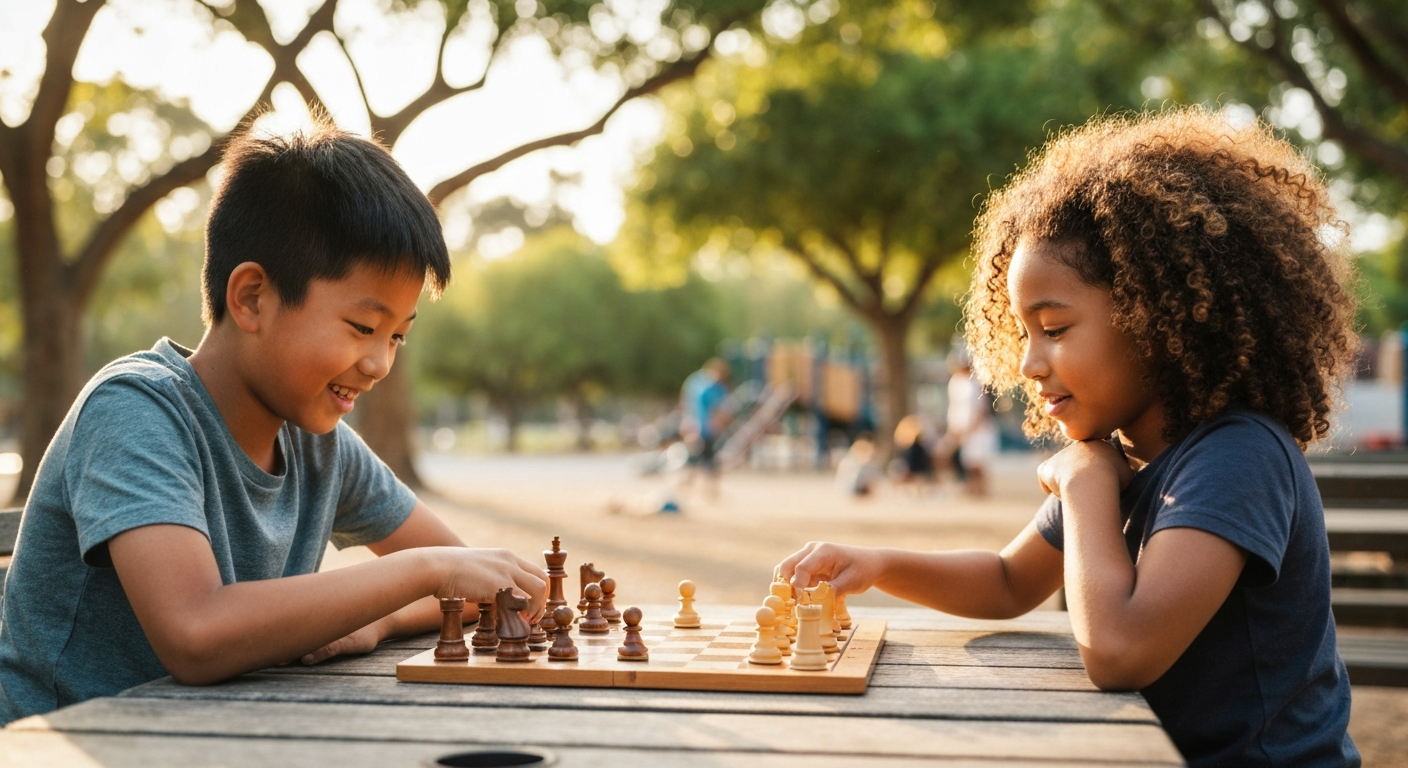
Your child mentions wanting to learn chess. You remember reading about cognitive benefits —problem-solving, planning ahead, patience. But when you start looking, you find weekend library classes, structured academies with 10-level curricula, and competitive tournament tracks. Which one fits a kid who just learned how the knight moves?
Quick Answer: Bay Area offers three main chess program types: recreational (library/community classes, $15-25/session, drop-in friendly), structured academies (curriculum-based, $35-45/week, progress tracking), and competitive training (tournament prep, $45+/week, rating advancement focus). Most kids ages 5-7 start recreational; 8-10 year-olds ready for weekly commitment thrive in structured programs; 11+ with tournament interest explore competitive tracks. Try 2-3 trial classes before committing to see which environment your child enjoys.
Why Chess Works for Bay Area Kids
Plan summer in 3 minutes
Find the right summer camps for your kids
KidPlanr searches hundreds of Bay Area camps and builds a week-by-week calendar tailored to your kids' ages and interests.
Start planning for free →Chess offers something rare: a structured mental challenge kids can pursue at their own pace. Unlike team sports with fixed schedules and physical requirements, chess adapts. A 6-year-old can play recreationally at the library. An 11-year-old can compete in rated tournaments. Both are doing chess; neither path is wrong.
Bay Area parents typically discover chess through one of three entry points:
School enrichment program — Many Bay Area schools partner with organizations like Bay Area Chess or San Jose Chess School for after-school clubs. Kids learn basics in a familiar setting, then some want more.
Friend's invitation — A classmate invites your child to their chess club. Suddenly your kid wants to learn "scholar's mate" and asks for a chessboard.
Academic interest — Parents researching enrichment activities read about chess benefits (pattern recognition, planning, resilience) and wonder if it's a good fit.
All three paths are valid. The question isn't whether chess is worthwhile — it's which program type matches your child's current interest level and learning style.
Three Program Types (And How to Tell Which Fits)
Type 1: Recreational Chess (Library & Community Classes)
Best for: Ages 5-8, absolute beginners, kids exploring whether they like chess, families wanting low-commitment intro
What it looks like:
- Drop-in or short 4-6 week sessions
- Mix of instruction and free play
- Volunteer or part-time instructors
- 8-15 kids per class, mixed ages
- No rating, no competition pressure
Bay Area examples:
- Palo Alto Libraries offer monthly chess clubs (free, registration required)
- San Mateo County Libraries run beginner chess sessions (free)
- City recreation departments often have 6-week intro courses ($75-120 for the session)
Pricing: $0-25/session (library programs free, rec department $15-20/session)
What kids learn: How pieces move, basic checkmate patterns, sportsmanship, playing full games
Parent note: Recreational programs work when your kid is curious but you're not sure if the interest will stick. After 4-6 sessions, you'll know if they want more structure.
Type 2: Structured Academies (Curriculum-Based Programs)
Best for: Ages 6-12, kids ready for weekly commitment, families wanting measurable progress, children who respond well to structure
What it looks like:
- Weekly 60-90 minute classes, semester-long enrollment
- Leveled curriculum (beginner → intermediate → advanced)
- Certified chess instructors
- 6-12 kids per class, grouped by skill level
- Progress assessments, occasional informal tournaments
Bay Area programs:
King's Land Chess Education Center (Pleasanton, Fremont, Foster City)
- 10-level curriculum from New Beginner to Grandmaster
- Ages 5+, grouped by skill level
- Pricing: $35-45/week depending on level
- One-time $50 registration fee (includes materials, t-shirt, chess bag)
- Spring semester (22 weeks): $770-990; Summer (10 weeks): $380-490
- Make-up classes available at any location
- Founded by Woman FIDE Master Coach Kiki Chen; FIDE World Gold School Award winner
Silicon Valley Chess Kids Academy (Palo Alto, Cupertino, Sunnyvale, Santa Clara)
- Ages 4-12, all skill levels
- Saturday classes in Palo Alto/Sunnyvale/Santa Clara; Friday & Sunday in Cupertino
- Small group instruction
- Free trial class available
- Spring tournaments (April Rapid, May USCF Championship)
Bay Area Chess (BAC) (San Jose, Palo Alto, 100+ school locations)
- Largest provider of after-school chess programs in Bay Area
- Ages 5+, absolute beginners welcome
- In-person and online options
- Weekend clubs with pay-at-door option (~$20/session)
- School-year programs and summer camps
Berkeley Chess School
- Operating since 1982
- Sunday morning classes for youngsters
- All Girls Chess Class option
- Camps throughout entire Bay Area
Pricing: $35-45/week (structured programs), $20-25/session (drop-in clubs)
What kids learn: Opening principles, tactical patterns (pins, forks, skewers), endgame fundamentals, clock management, tournament etiquette
Time commitment: 1 class per week + optional practice at home (many families do 30-60 min practice between classes)
Parent note: This is the Bay Area's most common chess path for kids ages 7-10. Structured programs balance instruction with play, give kids a peer group, and let them advance at their own pace. If your child sticks with it for 6-12 months, you'll see measurable improvement.
Type 3: Competitive / Tournament Track
Best for: Ages 10-14, kids who want to compete, families ready for significant time commitment, children who thrive on challenge and ranking advancement
What it looks like:
- Multiple classes per week (2-3 sessions)
- Tournament preparation focus
- USCF rating advancement
- Homework assignments between classes
- Weekend tournaments (local and regional)
- Private coaching options
Bay Area programs:
- King's Land Chess (Advanced II, Tournament Group, Elite Group levels)
- Bay Area Chess tournament preparation tracks
- Private coaches (typically $50-100/hour)
Pricing: $45-60/week (group classes), $50-100/hour (private coaching)
Time commitment: 5-10+ hours per week (classes, practice, tournaments)
What kids learn: Advanced opening theory, deep tactical calculation, positional play, endgame mastery, tournament strategy
Parent note: Competitive chess is for kids who've decided "I want to get really good at this." It's not inherently better than recreational chess — it's just a different goal. Some 12-year-olds love the challenge of rating advancement and weekend tournaments. Others prefer playing casually with friends. Both are fine. The question is what your kid wants, not what chess culture says they should want.
Age Readiness Guide
Ages 5-6: Can learn how pieces move, play simple games. Most successful in very small groups (3-5 kids) or one-on-one with patient instructor. Recreational programs work best. Attention span for chess typically 20-30 minutes at this age.
Ages 7-8: Sweet spot for starting structured programs. Can follow multi-step instructions, remember basic patterns, sit for 45-60 minute sessions. Many Bay Area chess academies see highest beginner enrollment at age 7.
Ages 9-10: Can handle abstract strategy (planning 3-4 moves ahead), learn opening principles, understand why moves are good or bad beyond "it captures a piece." Ready for weekly structured programs. Some show interest in tournaments by this age.
Ages 11-14: Can commit to serious study if interested. Rating improvement becomes visible with consistent practice. Age where kids split into recreational vs. competitive paths based on their goals. Tournament players at this age often practice 1-2 hours daily.
Teen beginners (13-15): Absolutely can start chess at this age despite what some competitive programs imply. Teens learn faster than younger kids due to abstract reasoning skills. Starting "late" only matters if your goal is grandmaster title (it doesn't matter for 99.9% of families).
Chess instructors typically recommend starting structured programs at age 7-8, but the real readiness signal is your child's interest level, not their age. A highly interested 6-year-old will outperform a dragged-along 9-year-old.
How to Choose the Right Program
Use this decision framework during your search:
Step 1: Define Your Goal (Be Honest)
What does your family actually want from chess?
Goal A: "Fun enrichment activity that builds thinking skills"
→ Start with recreational or structured academy (Type 1 or 2)
Goal B: "Serious competitive skill development"
→ Start with structured academy, transition to tournament track when ready (Type 2 → 3)
Goal C: "Trying it out to see if they like it"
→ Library program or academy trial class (Type 1)
Most families are Goal A or C. That's completely fine. Chess doesn't have to be competitive to be valuable.
Step 2: Check Your Schedule Reality
Can your family commit to the same day/time every week for 10-22 weeks?
- Yes → Structured academy
- Not sure → Recreational/drop-in
Can you make weekend tournaments happen (6-10 Saturdays per year)?
- Yes → Competitive track is feasible
- No → Structured academy without tournament pressure
Be realistic. Overcommitting creates stress. A missed chess class isn't a crisis, but if your kid misses 40% of sessions because your schedule doesn't actually support weekly commitment, the program won't work.
Step 3: Consider Learning Style
Does your child respond well to:
- Structured lessons with clear goals? → Structured academy
- Free play and exploration? → Recreational program
- Competition and measurable progress (ratings)? → Tournament track
- Low-pressure social environment? → Library or community program
No learning style is better. They're just different. A child who thrives in free play can burn out in a rigid competitive environment. A child who loves clear goals may feel aimless in a drop-in program.
Step 4: Evaluate Budget
What's realistic for your family?
- $0-25/month: Library programs, occasional drop-in classes
- $150-200/month: Structured academy (1 class/week)
- $300-500/month: Competitive track (multiple classes + tournaments)
Bay Area chess ranges from free to $100/hour for private coaching. Most families spend $35-45/week for quality instruction in a structured academy. That's $150-180/month, comparable to other afterschool activities (music lessons, sports, art classes).
Financial aid: Some programs offer need-based scholarships. King's Land Chess, Bay Area Chess, and Berkeley Chess School all have scholarship applications. Ask during enrollment if cost is a barrier.
Trial Class Evaluation Checklist
Book 2-3 trial classes at different programs (most offer free or low-cost first session). Bring this checklist:
During the class, observe:
- [ ] Instructor engagement: Does the teacher notice when kids are confused? Do they adjust explanation when someone doesn't understand?
- [ ] Your child's body language: Are they leaning in or checking the clock? Asking questions or zoning out?
- [ ] Class structure: Is there a clear plan (10 min instruction → 20 min games → 5 min wrap-up) or does it feel chaotic?
- [ ] Skill grouping: Are kids at similar levels, or is a beginner sitting next to a tournament player? (Mixed levels work for some kids, but many do better with peers at similar stage)
- [ ] Pace: Does the class move too fast for your kid to absorb concepts? Too slow and they're bored?
After the class, ask your child:
- [ ] "Did you have fun?" (Not "did you learn a lot" — fun matters more for retention)
- [ ] "Would you want to go back next week?"
- [ ] "What was your favorite part?"
- [ ] "Was anything confusing or frustrating?"
Ask the program:
- [ ] What happens if my child misses a class? (Make-up options?)
- [ ] How do you handle different skill levels in the same class?
- [ ] What's your progression path if my child wants to advance?
- [ ] Do you offer any tournaments or performance opportunities? (Even non-competitive kids often enjoy low-key club tournaments)
Trust your observations over the program's marketing. A "world-renowned" chess academy doesn't help if your child dreads going. A humble library program that your kid loves is better.
What About Online Chess Programs?
Many Bay Area programs added online options during 2020-2022 and kept them because they work for some families. Online chess classes cost $25-35/week (slightly less than in-person).
Online works well for:
- Kids ages 9+ with decent focus (younger kids often need parent nearby)
- Families with schedule flexibility (recorded lessons, asynchronous practice)
- Children who already play chess online (Chess.com, Lichess) and are comfortable with digital board
Online struggles with:
- Very young beginners (ages 5-6) who need hands-on piece manipulation
- Kids who get distracted by other tabs/devices
- Social motivation (online lacks the peer energy of in-person clubs)
If considering online: try one month in-person first to see if your child likes chess as an activity. If they do and online is more convenient, transition after the basics are solid.
Common Questions Parents Ask
Q: Is chess really good for kids' brains, or is that overhyped?
Research shows chess develops pattern recognition, planning, and focus. It's not magic brain food, but it does help kids practice sitting with a problem until they solve it — a useful skill beyond chess.
That said, many activities build these skills (music, martial arts, coding, art). Choose chess if your kid is interested, not because you read a study about IQ gains. Motivation matters more than the activity itself.
Q: Will my child be behind if they start at age 9 instead of 5?
For recreational or structured academy play: no. A 9-year-old beginner will catch up to a 7-year-old with 2 years of casual play within 6-12 months.
For competitive/tournament play: starting age matters more, but mostly for grandmaster-level ambitions (which applies to maybe 50 Bay Area kids total). If your goal is state championship or professional play, earlier is better. For school clubs and recreational tournaments, starting age doesn't matter much.
Q: My child plays chess online (Chess.com, Lichess). Do they still need classes?
Online play is great for practice but doesn't teach fundamentals systematically. Many kids develop bad habits (moving too fast, ignoring tactics) from online-only play. Classes provide:
- Structured instruction on why moves work
- Coach feedback on repeated mistakes
- Social play with peers (different dynamic than anonymous online)
Ideal combination: classes for learning + online play for practice between sessions.
Q: What if my child wants to quit after 3 months?
Let them. Chess is an enrichment activity, not a life commitment. Some kids try it, decide it's not their thing, and move on. That's normal.
The exception: if your child is frustrated because they're losing games and thinks they're "bad at chess," that's often a teaching opportunity. Chess has a steep learning curve. Everyone loses constantly at first. Good programs teach resilience (analyzing what went wrong, trying again) as part of the curriculum. But if your child simply isn't enjoying it after a fair trial (8-10 sessions), there's no benefit to forcing it.
Q: Are chess tournaments intense/competitive in a bad way?
Depends on the tournament. Scholastic tournaments (school-age, lower ratings) are generally supportive environments. Kids shake hands, parents cheer for all players, losing is normal. State championships and higher-level tournaments get more intense.
If your child is interested in tournaments, start with local club events (often held at the chess academy, low-key, same kids they know from class). If they enjoy that, try a regional scholastic tournament. You'll know pretty quickly if competitive chess is a good fit for your kid's personality.
Making the Decision
Most Bay Area families follow this path:
Month 1-2: Try a library program or academy trial class (recreational or beginner structured). See if your child enjoys chess as an activity.
Month 3-8: If they like it, enroll in a structured academy for one semester (10-22 weeks). This gives your child enough time to get past the initial learning curve and develop real skill.
Month 9+: Decide if continuing. Options:
- Stay in structured academy (most common path)
- Transition to competitive/tournament track (if child shows strong interest)
- Step back to drop-in recreational programs (if weekly commitment is too much)
- Try online chess classes (if in-person scheduling is hard)
- Pause chess and try other activities (also fine!)
No decision is permanent. Kids' interests change. A 7-year-old who loves chess may want to try soccer at age 9. A 9-year-old who tried chess and quit may come back at 12. This is normal.
Starting This Week
If your child is 5-7 and has never played:
Try a library chess program or Silicon Valley Chess free trial class. Keep it low-pressure. Your goal is "does my kid think this is fun?" not "will they be good at chess?"
If your child is 8-10 and showed interest at school:
Book trial classes at 2-3 structured academies (King's Land Chess, Bay Area Chess, Berkeley Chess School, SV Chess). See which environment they enjoy. Ask about mid-semester enrollment if we're between spring and fall terms.
If your child is 11-14 and wants to compete:
Start with a structured academy's intermediate or advanced level class. Let the program assess their current skill and place them appropriately. Mention interest in tournaments; most academies have tournament prep tracks or can recommend next steps.
If you're not sure and want to explore:
Join a library chess program this month. It's free, low-commitment, and gives your child a taste of chess without financial or schedule pressure. After 4-6 sessions, you'll know if they want more.
Planning summer camps too? Search 3,000+ Bay Area summer camps on KidPlanr →
Looking for other year-round activities? Track your child's full schedule with KidPlanr →
Sources
Plan summer in 3 minutes
Find the right summer camps for your kids
KidPlanr searches hundreds of Bay Area camps and builds a week-by-week calendar tailored to your kids' ages and interests.
Start planning for free