Real Cost of Summer Camp Bay Area 2026 | Hidden Fees Guide

You found a camp for $500 per week. You're relieved — that fits your budget. But when registration closes, you've actually spent $650-700 per week.
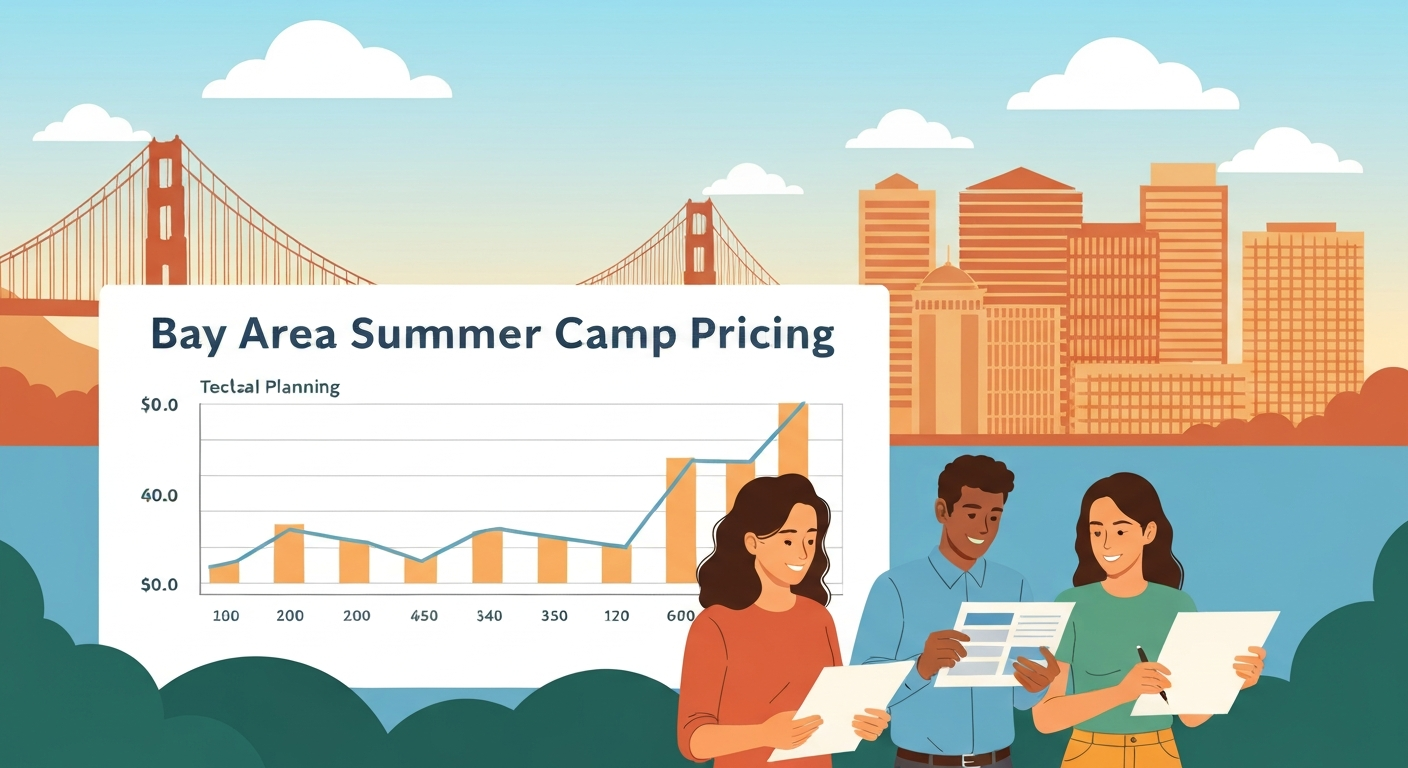
Quick Answer: Bay Area summer camps advertise weekly rates, but most families spend 20-40% more than the sticker price. Registration fees ($50-150), extended care ($50-200/week), activity fees ($25-100), supplies ($30-75), and transportation can add $150-350+ per week. A $500 camp typically costs $2,600-2,800 for four weeks — not the $2,000 you expected. Use our cost calculator below to budget accurately before you register.
The Sticker Price Is Just the Starting Point
Plan summer in 3 minutes
Find the right summer camps for your kids
KidPlanr searches hundreds of Bay Area camps and builds a week-by-week calendar tailored to your kids' ages and interests.
Start planning for free →When Bay Area camps advertise "$500/week," they're showing the base program fee. What they often don't show up front:
- Registration fees (one-time, typically $50-150 per family)
- Extended care or "extended day" ($10-50 per day when you drop off early or pick up late)
- Activity fees for specialty programs ($25-100 per week for things like horseback riding, go-karts, or advanced robotics)
- Supplies and equipment ($30-75 one-time for art supplies, swim gear, or sports equipment)
- Snacks and lunch (some camps charge $10-25/day if you don't pack)
- Transportation or shuttle fees ($50-150/week if the camp offers it)
- Sibling "discounts" that only apply to week 2+ (not your first registration)
The result? What looks like an affordable $450-550/week camp often becomes a $600-750/week camp once you're actually enrolled.
Hidden Cost #1: Registration Fees
Typical range: $50-150 per family (one-time), $25-75 per additional child
Most Bay Area camps charge a registration fee that's separate from the weekly tuition. This is a one-time annual fee, but if you're registering multiple kids or trying multiple camps, it adds up fast.
Examples from 2026:
- Galileo Learning: $75 registration fee per family
- iD Tech Camps: $149 registration fee per student
- YMCA of Silicon Valley: $50 family registration (covers all kids)
- Palo Alto Recreation: $40 resident registration fee per child
Why this matters: If you're comparing three camps before deciding, and each requires registration just to secure a spot, that's $150-450 you've spent before week one even starts.
Hidden Cost #2: Extended Care (The Real Budget Killer)
Typical range: $10-50 per day, $50-250 per week
"Extended care" or "extended day" is how camps charge for drop-off before 9 AM and pickup after 3 PM. For working parents in the Bay Area — which is most parents — this isn't optional. It's survival.
The advertised camp rate almost always assumes 9 AM - 3 PM. If you need 8 AM - 5 PM (which most working parents do), you're paying extra.
Common extended care pricing models:
- Per-hour: $10-15 per hour before/after core hours
- Half-day add-on: $25-40 for morning care (7:30-9 AM), $30-50 for afternoon care (3-5:30 PM)
- Full extended day: $50-100/week flat rate for 8 AM - 5:30 PM coverage
Real-world example: A $500/week camp becomes $600-650/week when you add morning and afternoon extended care. Over four weeks, that's $400-600 more than you budgeted.
Bay Area parent community insight: "We thought we were paying $450/week. By week three we realized it was actually $575/week with before and after care. Should have read the fine print." — common experience reported on r/bayarea and r/Parenting forums.
Hidden Cost #3: Activity and Specialty Fees
Typical range: $0-100 per week depending on camp type
Some camps include all activities in the base price. Others charge extra for "specialty activities" or "premium experiences."
What triggers extra fees:
- Horseback riding or equestrian programs ($50-100/week)
- Go-karts, laser tag, or amusement park field trips ($25-75/week)
- Advanced robotics kits that the camper keeps ($50-150 one-time)
- Overnight or multi-day trips built into the session ($100-300 additional)
- Swim lessons beyond recreational swim time ($30-60/week)
How to spot this: If a camp advertises "horseback riding and robotics," check the fine print. Many camps say "horseback riding available for an additional fee."
Rule of thumb: STEM camps (coding, robotics, engineering) and sports-specialty camps (competitive soccer, elite basketball) are more likely to have add-on fees than general day camps.
Hidden Cost #4: Supplies and Equipment
Typical range: $30-75 one-time, sometimes per session
Art camps, science camps, and sports camps often require or sell supplies:
- Art camp: Smock, sketchbook, specialized paints ($30-60)
- Sports camp: Cleats, shin guards, team jersey ($40-80)
- STEM camp: Robotics kit or take-home project materials ($50-150)
- Swim camp: Swim cap, goggles, rash guard ($25-50)
Some camps include supplies in tuition. Others charge separately or "strongly encourage" you to buy from them.
What to watch for: Camps that say "all materials provided" vs. camps that say "supply list will be emailed after registration."
Hidden Cost #5: Snacks and Lunch
Typical range: $0 (pack your own) to $10-25 per day
Most camps let you pack lunch and snacks. But some charge if you forget, and some camps (especially full-day programs) include or require you to buy lunch.
Common models:
- Bring your own: Most city recreation and nonprofit camps (free)
- Optional lunch purchase: $10-15 per day if you don't want to pack
- Lunch included: Premium camps ($800+/week) often include catered lunch
- Snack bar / camp store: Kids can buy snacks and treats ($3-10/day)
Parent reality check: Even if lunch is "optional," many Bay Area parents report spending $30-60/week on the camp snack bar when their kids ask for treats or forget lunch.
Hidden Cost #6: Transportation
Typical range: $50-150 per week (if offered)
Some camps offer bus or shuttle service from central pickup points. This is convenient but adds cost.
Example pricing (2026):
- Galileo shuttle service: $65-95/week depending on route
- iD Tech airport shuttle: $149 each way (one-time for week-long programs)
- YMCA van transport: $50-75/week from select locations
Many camps don't offer transportation at all — you're driving, which means gas, parking, and time. For working parents, this can mean asking a neighbor, hiring a sitter to do drop-off/pickup, or paying for a rideshare service.
Hidden time cost: If your camp is 25 minutes away and requires 9 AM drop-off / 3 PM pickup, you're losing 2+ hours of work time daily unless you pay for extended care or transportation.
The "Discount" That Doesn't Apply
Sibling discounts and multi-week discounts often don't kick in until your second registration.
Many camps advertise:
- 10-15% sibling discount
- 5-10% off when you book 3+ weeks
But these typically apply like this:
- Sibling discount: Second child gets 10% off, first child pays full price
- Multi-week discount: Week 2+ get the discount, week 1 is full price
Why this matters: If you're only doing 2 weeks of camp with 2 kids, your "discount" is much smaller than you expected. You're getting 10% off one child for one week — not 10% off your entire summer.
So What Do Bay Area Parents Actually Spend?
Let's calculate the true cost for a typical scenario.
Example family: 2 kids, 4 weeks of camp, mid-range camp ($500/week advertised rate), both parents work full-time
| Cost Category | Per Child | For 2 Kids (4 weeks) |
|---|---|---|
| Base tuition ($500 × 4 weeks) | $2,000 | $4,000 |
| Registration fee (one-time) | $75 | $150 (family rate) |
| Extended care ($50/week × 4) | $200 | $400 |
| Supplies (one-time) | $50 | $100 |
| Lunch/snacks ($10/day × 20 days) | $200 | $400 |
| Total | $2,525 | $5,050 |
Advertised cost: $4,000 (just tuition)
Actual cost: $5,050 (26% more)
For a $500/week camp, the real cost per week per child is $630 — not $500.
What This Means for Different Budget Tiers
Budget Tier: Under $300/Week Advertised
True cost: $350-450/week after fees
City recreation programs and nonprofit camps (YMCA, JCC, Boys & Girls Clubs) tend to have:
- Lower or no registration fees ($0-50)
- More affordable extended care ($25-50/week vs. $100+/week)
- Fewer add-on activity fees
- Bring-your-own lunch policies
Bottom line: The advertised price is closer to the true price. Budget-friendly camps have fewer surprises.
Mid-Range Tier: $400-600/Week Advertised
True cost: $500-750/week after fees
This is the most common tier for private day camps in the Bay Area (Galileo, Adventure Day Camp, specialty STEM programs).
Extended care and activity fees are where the costs add up. A $500 camp + $50/week extended care + $100 registration + supplies = $630/week true cost.
Premium Tier: $700+/Week Advertised
True cost: Often closer to advertised price (but starting higher)
Elite camps like Stanford's programs, exclusive academic camps, and intensive specialty programs often include more in the base price:
- Lunch sometimes included
- Fewer add-on fees (activities are built in)
- Higher-quality extended care included or minimal extra charge
But: You're starting at $700-1,200/week, so even with fewer add-ons, the total is still $750-1,300/week.
The Cost Calculator Worksheet
Use this to calculate the true total cost for any camp you're considering.
Step 1: Base Costs
- Weekly tuition × number of weeks: $__
- Registration fee (one-time): $_
- Subtotal: $___
Step 2: Extended Care (if needed)
- Morning care: $__ per day × _ days = $
- Afternoon care: $ per day × days = $
- OR: Full extended day rate: $ per week × weeks = $
- Subtotal: $___
Step 3: Activity & Specialty Fees
- List any activities that cost extra: ____ $__
- Subtotal: $____
Step 4: Supplies & Equipment
- Camp-required supplies: $__
- Optional but encouraged: $_
- Subtotal: $___
Step 5: Food
- Lunch (if not packing): $__ per day × _ days = $
- Snack bar / camp store budget: $ per week × weeks = $
- Subtotal: $___
Step 6: Transportation
- Camp shuttle/bus (if using): $__ per week × _ weeks = $
- Gas/parking (estimate): $
- Subtotal: $___
TOTAL TRUE COST: $______
Cost per week (divide by number of weeks): $______
Comparison metric: _____% more than advertised weekly rate
How to Avoid Budget Surprises
-
Ask about "total cost to attend" before you register. Don't just ask about weekly tuition. Say: "What's the total cost for one child to attend your camp for one week, including all fees, if I need 8 AM to 5 PM coverage?"
-
Read the parent handbook before you pay the deposit. Registration fees are often non-refundable. Make sure you know the true cost before you commit.
-
Compare camps by true total cost, not advertised rate. A $450/week camp with high fees might cost more than a $525/week camp with everything included.
-
Factor in your work schedule. If you need extended care, price that into your decision from the start. A $400 camp with $100/week extended care is really a $500 camp.
-
Look for camps that bundle extended care. Some camps charge a flat $550/week for 8 AM - 5:30 PM with everything included. That's often cheaper than a $475 base + $75 extended care + fees.
What to Do If You're Already Overbudget
If you've already registered and realized the true cost is higher than you planned:
-
Check if financial aid is available. Many camps have sliding-scale tuition or scholarships. Search camps with financial aid on KidPlanr →
-
See if you can drop extended care for some days. Maybe you can arrange a carpool or take a half-day off work for pickup.
-
Ask about sibling discounts even if it's not advertised. Some camps will offer 5-10% off for a second child if you ask.
-
Consider switching one week to a lower-cost option. Four weeks at a $600 camp can become three weeks at $600 + one week at a $200 city rec camp.
The Bottom Line
Most Bay Area families spend 20-40% more on summer camp than the advertised weekly rate once you add registration, extended care, supplies, and food.
A $500/week camp typically costs $2,600-2,800 for four weeks — not $2,000.
The camps aren't hiding this information, but they're not always up front about it either. Use the calculator above to get the true total cost before you register, and compare camps by their real price — not just the number on the marketing page.
When you search for camps on KidPlanr, we show price ranges and note which camps include extended care or have high add-on fees. It's not perfect (camps don't always publish every fee), but it's a more realistic starting point than "from $400/week."
Track Your Year-Round Activities Too
Summer camp is expensive. So are gymnastics, swim lessons, music classes, and everything else your kids do. If you're trying to budget for the full year — not just summer — check out KidPlanr's activity tracker for year-round scheduling →
FAQ
Q: Why don't camps just advertise the "all-in" price?
Bay Area camps advertise base tuition because not every family needs extended care or every add-on. A family with a stay-at-home parent who can do 9-3 drop-off/pickup pays less than a working family. Camps price à la carte so families only pay for what they use. The downside: it makes comparison shopping harder.
Q: Is extended care negotiable?
Sometimes. Some camps offer payment plans or sliding-scale extended care fees if you ask. Nonprofit camps (YMCA, JCC, city programs) are more likely to work with you than private for-profit camps.
Q: Are expensive camps worth it?
Depends on your kid and your priorities. A $900/week camp with world-class instructors and small groups might be worth it for one child. A $400/week city rec camp with great counselors and fun activities might be just as valuable for another. True cost matters less than fit. Read our full breakdown of camp value by price tier →
Q: Can I deduct camp costs on my taxes?
Day camp (not overnight) can qualify for the Child and Dependent Care Credit if both parents work. Check with your tax advisor, but you can typically claim up to $8,000 in care expenses for two or more children ($3,000 for one child). This can reduce your tax bill by $2,000-2,400 depending on your income.
Q: Do camps charge more for younger kids?
Not usually. Most camps charge the same rate for ages 5-12. Specialty camps for teens (leadership programs, intensive academic camps) sometimes cost more. Preschool/toddler programs (ages 3-4) might be slightly cheaper but have stricter ratios and shorter hours.
Q: What if I can't afford any of this?
Look for free or low-cost options. Many Bay Area cities offer free or subsidized summer programs through parks and recreation departments, libraries, and community centers. Search "free summer camps [your city]" or filter by price on KidPlanr →
Q: How do I know if a camp is including fees in their advertised price or charging extra?
Ask directly: "Is your weekly rate all-inclusive, or are there additional fees I should budget for?" Also check the camp's website for a "Parent Handbook" or "What's Included" page — reputable camps disclose this.
Plan summer in 3 minutes
Find the right summer camps for your kids
KidPlanr searches hundreds of Bay Area camps and builds a week-by-week calendar tailored to your kids' ages and interests.
Start planning for free