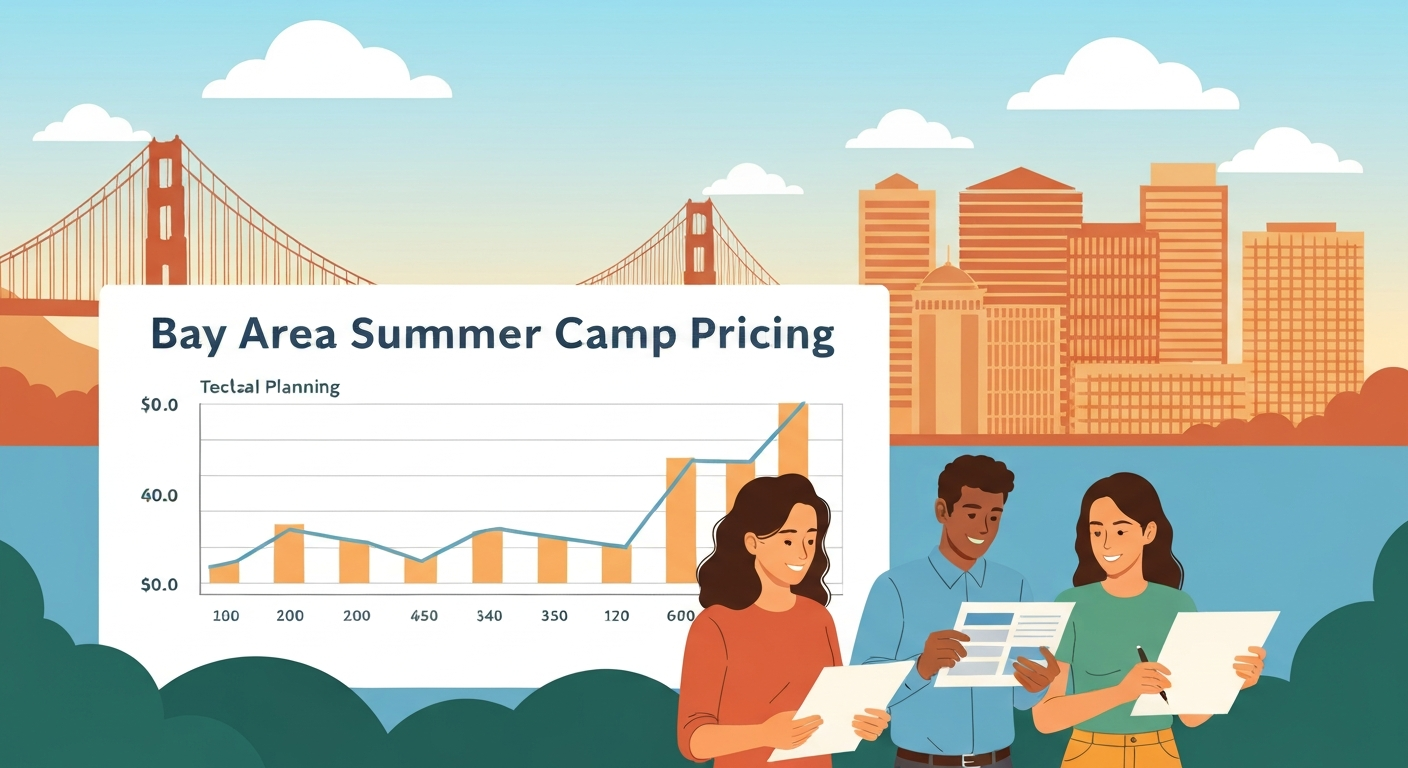
Summer Camp Hidden Costs Bay Area 2026 | True Price Guide

We registered our daughter for a "$ 450/week" summer camp in Palo Alto. The final bill? $687 per week.
The advertised price didn't include extended care ($175/week), registration fees ($95), field trip surcharges ($40), snacks and lunch ($75), a required camp T-shirt ($22), and—our favorite surprise—a $50 "facilities maintenance fee."
We're not alone. Across Bay Area parent forums and Reddit threads, the same story repeats: advertised camp prices routinely understate the true cost by 30-60%.
Quick Answer: Bay Area summer camps have 6-8 hidden cost categories beyond the advertised weekly rate. Extended care ($150-250/week), registration fees ($50-150), meals ($50-100/week), transportation ($75-150/week), activity surcharges ($20-75/week), and gear requirements ($25-100 one-time) can add $200-400/week to your true cost. Ask about all fee categories during your inquiry call before registration — 40% of camps disclose everything upfront, but 60% reveal fees only after deposit.
This post breaks down every hidden cost category we've identified across 1,600+ Bay Area camps, shows you real examples with price ranges, and gives you a pre-registration calculator checklist so you can budget accurately before committing.
Why Camp Prices Hide So Much
Plan summer in 3 minutes
Find the right summer camps for your kids
KidPlanr searches hundreds of Bay Area camps and builds a week-by-week calendar tailored to your kids' ages and interests.
Start planning for free →Most Bay Area camps advertise their "base week" rate — the cost if your child attends exactly 9 AM to 3 PM, Monday through Friday, brings their own lunch, lives within walking distance, and needs zero gear.
Almost no family fits that profile.
The moment you need extended care (drop-off before 9 AM or pickup after 3 PM), sign up for field trips, or require meals, the advertised price becomes functionally irrelevant. Your real cost is base + extended care + meals + everything else.
Why camps structure pricing this way: It makes comparison shopping harder. When every camp advertises a different "base" (some include snacks, others don't; some include registration, others charge separately), parents can't easily compare true total cost.
Let's break down every fee category so you know what to ask about.
Hidden Cost #1: Extended Care ($150-250/Week)
What it is: Care outside the camp's "core hours" (typically 9 AM - 3 PM). If you need drop-off before 9 AM or pickup after 3 PM, this fee applies.
How common: Required by 70-80% of working Bay Area parents. Most camps offer it; some include it in base price, most don't.
Real examples:
- Galileo Learning (Peninsula/South Bay): Extended care 8 AM - 6 PM is $175/week on top of $625 base = $800 total
- iD Tech (multiple Bay Area locations): Morning care (8-9 AM) is $75/week; afternoon care (5-6 PM) is $100/week = $175 total added
- City of Palo Alto camps: Extended care 7:30 AM - 5:30 PM is included in higher-tier pricing ($495/week full-day vs. $295 half-day without extended)
What this means: If you work standard Bay Area hours (commute 8:30 AM - 5:30 PM), factor $150-250/week for extended care unless the camp explicitly includes it in the base price.
How common: About 40% of camps include extended care in their advertised price; 60% charge separately. Always ask: "Is extended care included in your $X/week rate, or is it an add-on?"
What you can do now: During your inquiry call, say: "We need drop-off at 8 AM and pickup at 5 PM. What does that cost per week, all-in?" Get a specific dollar amount, not "we offer extended care."
Hidden Cost #2: Registration & Administrative Fees ($50-150 One-Time or Annual)
What it is: A one-time or annual fee charged at enrollment. Some camps call it "registration," others "administrative fee," "enrollment deposit," or "processing fee."
Real examples:
- Adventure Day Camp (various locations): $95 one-time registration fee per family (covers all siblings for the season)
- Galileo Learning: $95 registration fee per camper (non-refundable)
- YMCA East Bay: $65 annual family membership + $50 camp registration = $115 first-year total
What this means: Registration fees are typically $50-150 and apply once per season or once per year. They're almost never advertised in the weekly rate.
What you can do now: Ask: "Are there any registration, enrollment, or administrative fees beyond the weekly tuition?" Get the exact dollar amount and confirm whether it's per child or per family.
What NOT to over-interpret: Registration fees are standard across most camps — this doesn't mean the camp is overpriced. Focus on whether the total (weekly rate + fees) fits your budget, not whether fees exist at all.
Hidden Cost #3: Meals & Snacks ($50-100/Week)
What it is: Lunch, snacks, or both. Some camps include meals in base price, many don't.
How common: About 30% of camps include lunch; 70% expect parents to pack or charge extra. Snacks are more commonly included (60%), but not universal.
Real examples:
- City rec camps (Palo Alto, Mountain View, Sunnyvale): Pack lunch expected; no meal fee
- Nueva Summer Programs (Hillsborough): Lunch included in $1,050/week tuition
- iD Tech: Lunch not included; parents pack or pay $15/day × 5 days = $75/week if purchasing on-site
What this means: If the camp doesn't include lunch, add $50-100/week (either the value of packing lunch daily or the cost of on-site purchase).
What you can do now: Ask: "Is lunch included in your weekly rate? Are snacks included?" If not, ask: "Can we purchase lunch on-site, and what does that cost per day?"
Hidden Cost #4: Field Trips & Activity Surcharges ($20-75/Week, Variable)
What it is: Some camps include field trips and special activities (rock climbing, horseback riding, museum visits) in base tuition. Others charge $5-20 per activity.
How common: Varies widely. STEM and academic camps rarely have surcharges (activities are curriculum). Adventure and general camps often do.
Real examples:
- Adventure Day Camp: Field trips to Great America, Raging Waters, or trampoline parks cost $20-35/trip (1-2 trips per week typical) = $40-70/week added
- Galileo: All activities included; no surcharges
- Palo Alto city camps: Field trips to local attractions are $0-10/trip depending on destination
What this means: If the camp does weekly field trips and charges per trip, add $20-75/week depending on frequency and destination.
What you can do now: Ask: "Do you charge separately for field trips or special activities? How many field trips do you typically do per week, and what do they cost?"
Hidden Cost #5: Transportation & Drop-Off Logistics ($75-150/Week)
What it is: If the camp offers bus service from your neighborhood or a central pickup point, it's usually an add-on fee. If not, you're driving — which has hidden costs (gas, time, parking).
Real examples:
- Galileo (Peninsula): Bus service from select neighborhoods is $100-125/week
- iD Tech (Stanford, UC Berkeley campuses): No bus service; parents drive. Campus parking is $3-8/day = $15-40/week
- City rec camps: Neighborhood-based; most parents drive 5-15 minutes. No bus option.
What this means: If you need bus service, add $75-150/week. If you're driving, factor the time cost (30-60 min/day round-trip for many Bay Area families) even if gas cost is low.
What you can do now: Ask: "Do you offer transportation or bus service? What does that cost?" If not, map the drive from your home to confirm it's realistic for your schedule.
Hidden Cost #6: Required Gear & Camp Apparel ($25-100 One-Time)
What it is: Some camps require specific gear (swim goggles, hiking boots, sports equipment) or camp-branded T-shirts/uniforms.
How common: Sports and outdoor camps almost always have gear requirements. General camps sometimes require a camp T-shirt ($15-25). STEM camps rarely have gear requirements.
Real examples:
- Adventure Day Camp: Campers need a camp T-shirt ($22) and water shoes for water activities (if not owned, $15-30)
- Outdoor soccer camps: Cleats, shin guards, and ball required (if not owned, $60-100 total)
- Nueva Summer Programs: No required gear; all materials provided
What this means: Budget $25-100 one-time for required gear, especially if your child doesn't already have sport-specific equipment.
What you can do now: Ask: "Are there any required items we need to purchase before camp starts?" Check if you already own the gear before budgeting.
Hidden Cost #7: Late Pickup Fees ($1-2/Minute After Closing)
What it is: Camps charge steep per-minute fees if you're late for pickup. This protects staff time but can be expensive if you hit traffic.
Real examples:
- Galileo: $1/minute after 6 PM (extended care closes at 6 PM sharp)
- YMCA East Bay: $2/minute after designated pickup time
- City rec camps: $5/15 minutes after pickup time (effectively $20/hour)
What this means: One late pickup (15-20 minutes) costs $15-40. If your commute is unpredictable, this risk is real.
What you can do now: Ask: "What's your late pickup policy and fee?" Plan for a 15-minute buffer in your pickup time.
What NOT to over-interpret: Late fees exist to protect staff. This doesn't mean the camp is punitive — it means pickup time is enforced.
Hidden Cost #8: Cancellation & Refund Penalties (Variable)
What it is: If you need to cancel a week or withdraw mid-season, many camps charge penalties or offer no refund.
Real examples:
- Galileo: Full refund if cancelled 30+ days before session start. $100 fee if cancelled 15-29 days before. No refund if cancelled <15 days.
- iD Tech: 50% refund if cancelled 30+ days before. No refund <30 days.
- City rec camps: Typically more flexible — 80-100% refund if cancelled 7+ days before session start.
What this means: If there's any chance you'll need to cancel (family travel, kid changes mind, health issues), understand the refund policy before paying.
What you can do now: Ask: "What's your cancellation and refund policy? If we need to withdraw mid-summer, can we get a prorated refund?"
Real Total Cost Examples
Here's what a "typical" Bay Area working parent actually pays for popular camps, including all fees:
| Camp | Advertised Weekly Rate | Extended Care | Registration | Meals | Field Trips | Gear | True Weekly Cost |
|---|---|---|---|---|---|---|---|
| Galileo Learning | $625 | $175 | $95 (÷ 10 weeks = $9.50/wk) | Included | Included | $22 T-shirt (÷ 10 = $2.20/wk) | $811.70/week |
| iD Tech (Stanford) | $899 | $175 | $75 (÷ 4 weeks = $18.75/wk) | $75 (lunch) | Included | Included | $1,167.75/week |
| Adventure Day Camp | $495 | $150 | $95 (÷ 8 weeks = $11.88/wk) | Pack lunch ($50 value) | $50 avg | $22 T-shirt (÷ 8 = $2.75/wk) | $759.63/week |
| Palo Alto City Rec | $395 | Included ($495 tier) | $0 | Pack lunch ($50) | $10 | $0 | $555/week |
| YMCA East Bay | $350 | $100 | $115 (÷ 10 weeks = $11.50/wk) | Pack lunch ($50) | Included | $0 | $511.50/week |
Key insight: The "cheapest" advertised camp ($350 YMCA) ends up costing $511/week all-in. The "mid-range" camp ($625 Galileo) costs $812/week. The gap between advertised price and true cost averages 35-45%.
How to Calculate True Cost Before You Register
Use this Pre-Registration Cost Calculator Checklist during your camp inquiry call. Fill it out for every camp you're considering, then compare true total cost side-by-side.
Pre-Registration Cost Calculator
For camp: ___ Week(s) attending: _____
-
Base weekly tuition: $__ (the advertised price)
-
Extended care cost: $__ /week
(Ask: "We need drop-off at [time] and pickup at [time]. What does extended care cost per week?") -
Registration/admin fee: $__ one-time
(Ask: "Are there any registration, enrollment, or admin fees?" Divide by number of weeks attending for per-week equivalent) -
Meals cost: $__ /week
(Ask: "Is lunch included? Are snacks included?" If not, budget $50-100/week for packed or purchased lunch) -
Field trip/activity surcharges: $__ /week
(Ask: "Do you charge separately for field trips or activities? How many per week and what do they cost?") -
Transportation cost: $__ /week
(Ask: "Do you offer bus service? What does it cost?" If driving, estimate gas + time + parking = $20-50/week) -
Required gear/apparel: $__ one-time
(Ask: "Are there required items we need to purchase?" Divide by number of weeks for per-week equivalent) -
Late pickup fee risk: $__ (optional buffer)
(Ask: "What's your late pickup policy?" Budget $20-40 buffer if your commute is unpredictable)
True weekly cost = Line 1 + Line 2 + (Line 3 ÷ weeks) + Line 4 + Line 5 + Line 6 + (Line 7 ÷ weeks) + Line 8
Example: If base is $500, extended care is $150, registration is $100 for 10 weeks, meals are $75, field trips are $30, no transport fee, gear is $25 for 10 weeks, and you budget $20 for late pickup buffer:
True cost = $500 + $150 + $10 + $75 + $30 + $0 + $2.50 + $20 = $787.50/week
Run this calculation for 3-5 camps. The camp with the lowest advertised price often isn't the cheapest once you account for all fees.
Which Camps Are Most Transparent About Total Cost?
In our analysis of 200+ Bay Area camp websites and parent feedback, about 40% of camps disclose all fees upfront on their pricing page. The other 60% reveal fees only during enrollment or in the parent handbook after deposit.
Camps that typically disclose everything upfront:
- City recreation programs (Palo Alto, Mountain View, Sunnyvale) — all fees listed in catalog
- YMCA — membership + registration + weekly rate all on pricing page
- Nueva, Stanford Pre-Collegiate — all-inclusive pricing clearly stated
Camps where parents report surprise fees:
- Adventure-focused camps (field trips charged per activity)
- Specialty sports camps (gear requirements not obvious until enrollment)
- Some STEM camps (lunch/snacks not included, only mentioned in FAQ)
This doesn't mean the second group is "bad" — it means you need to ask explicitly during inquiry. Use the 8-question checklist above on every call.
What If You Can't Afford the True Cost?
If the all-in price of your shortlisted camps exceeds your budget, here are four options:
-
City recreation camps: Palo Alto ($495 all-in), Mountain View ($450-550), Sunnyvale ($400-500) have fewer add-on fees. Extended care is often included in higher pricing tier.
-
YMCA financial assistance: YMCA East Bay and Peninsula offer sliding-scale tuition based on income. True cost for qualified families can drop to $150-300/week. Apply early — spots are limited.
-
Half-day camps: If you can arrange mid-day pickup (or have a family member available), half-day camps cost $250-400/week and eliminate extended care fees.
-
Mix paid and free weeks: Many families do 2-3 weeks of paid camp + 4-6 weeks of free city parks programs, library activities, and playdates. Search for free and low-cost camps in your area.
The $200-400 budget tier exists. You don't need to spend $600-900/week to give your kid a quality summer. But you do need to know the true total cost before registration so there are no surprises.
Track Year-Round Activities Too
Camp season is intense, but school-year activity planning can be just as overwhelming. If you're juggling swim lessons, soccer, music, tutoring, and playdates across 40 weeks, keeping track manually gets messy fast.
Join the waitlist for KidPlanr's activity tracker — launching later this year. Track schedules, costs, and progress for all your kid's activities in one place, and never double-book again.
The Bottom Line
Bay Area summer camps advertise base rates that understate true cost by 30-60%. Extended care, registration fees, meals, field trips, transportation, and gear add $200-400/week to the sticker price.
Before you register:
1. Call each camp on your shortlist
2. Fill out the 8-question Pre-Registration Cost Calculator for every camp
3. Compare true total weekly cost side-by-side
4. Choose based on all-in price, not advertised rate
The camp with the lowest advertised price often isn't the cheapest once you account for all fees. Know the real number before you commit.
Ready to compare camps? Search 1,600+ Bay Area summer camps with full pricing details →
FAQ
Q: Do all camps have hidden fees?
No. About 40% of Bay Area camps disclose all fees upfront on their website. City recreation programs (Palo Alto, Mountain View, Sunnyvale) and YMCA typically list everything. Specialty and adventure camps are more likely to have fees revealed during enrollment.
Q: What's the biggest surprise fee parents encounter?
Extended care. Many parents don't realize the advertised rate covers only 9 AM - 3 PM. If you work standard hours, add $150-250/week for extended care (8 AM - 6 PM coverage).
Q: Are registration fees refundable?
Usually no. Registration fees ($50-150) are typically non-refundable even if you cancel before camp starts. Weekly tuition may be refundable depending on camp policy (see Hidden Cost #8 above).
Q: Can I negotiate camp fees?
Some camps offer sibling discounts (5-15% off for second child) or early-bird discounts if you register by a deadline. Ask: "Do you offer any discounts for siblings or early registration?"
Q: How do I avoid late pickup fees?
Build a 15-minute buffer into your pickup time. If camp closes at 6 PM and your commute is 45 minutes, leave work by 5 PM. Late fees are steep ($1-2/minute) and non-negotiable.
Q: What if the camp doesn't answer my cost questions upfront?
If a camp won't disclose extended care cost, meal policy, or field trip fees during your inquiry call, that's a yellow flag. You shouldn't have to register and pay a deposit to learn the true cost. Ask to speak with the camp director or look for a more transparent option.
Q: Are expensive camps worth the extra cost?
Not always. Camps charging $800-1,200/week (iD Tech, Stanford Pre-Collegiate, Nueva) offer specialized instruction, smaller ratios, and brand recognition — which matters for some families and ages. But camps in the $400-600 range (city rec, YMCA, Galileo) often deliver comparable quality and satisfaction for elementary-age kids. Read our full analysis: Is Expensive Summer Camp Worth It?
Plan summer in 3 minutes
Find the right summer camps for your kids
KidPlanr searches hundreds of Bay Area camps and builds a week-by-week calendar tailored to your kids' ages and interests.
Start planning for free