
Best Martial Arts Classes Kids Bay Area 2026 | Prices & Guide
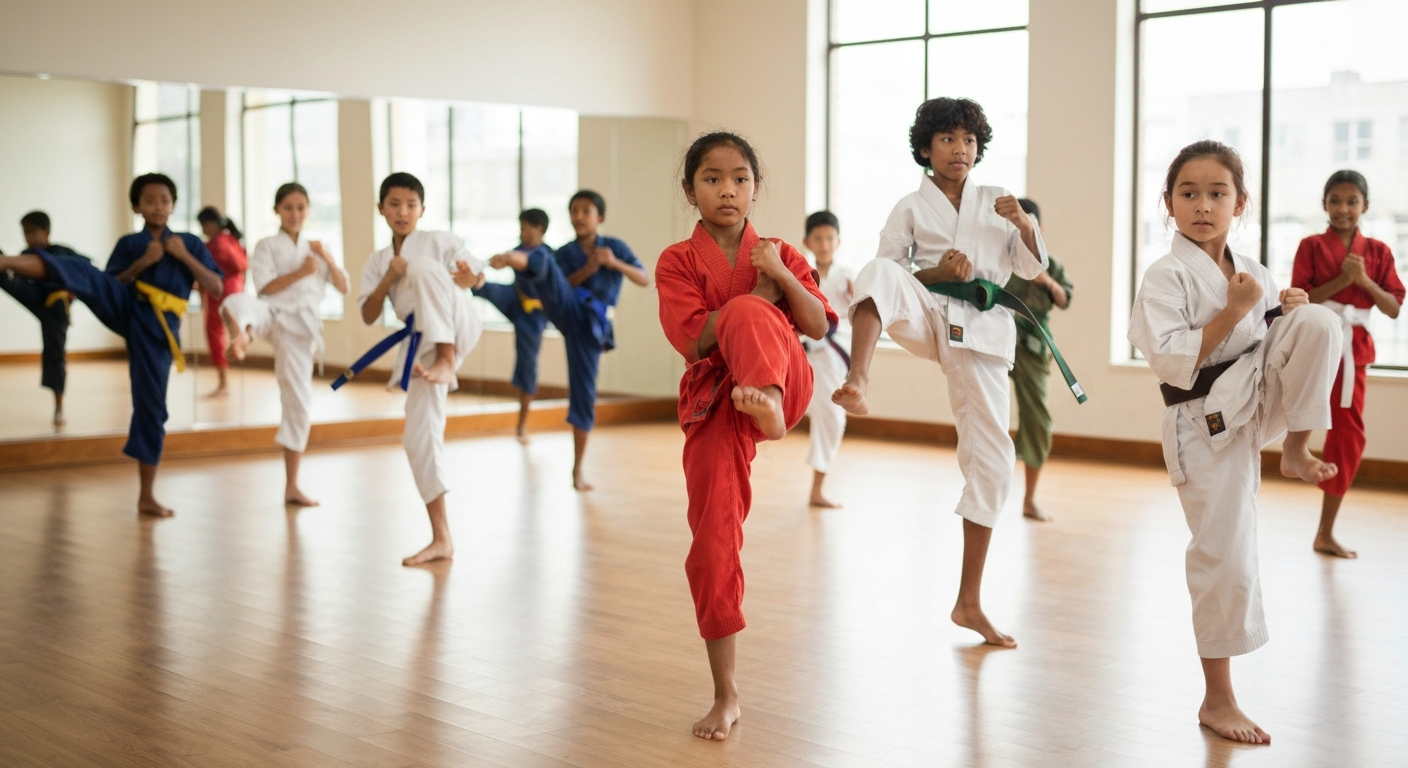
You've Googled "martial arts classes near me" and now you're staring at 50 studios within 10 miles — all claiming to build confidence, discipline, and self-defense skills. One teaches karate. Another does taekwondo. A third swears by Brazilian jiu-jitsu. Most require 6-12 month contracts at $150-250/month. If your child quits after two months (common), you're still paying.
Quick Answer: Bay Area has 50+ martial arts studios teaching five main styles (karate, taekwondo, judo, Brazilian jiu-jitsu, kung fu). Costs range $100-250/month, with most requiring 6-12 month contracts — but 40% offer month-to-month for $20-40 extra. Match your child's personality first: structure-loving kids thrive in karate/taekwondo ($120-180/mo), physical/energetic kids do better in jiu-jitsu or judo ($150-250/mo). Use the 2-week trial period to assess instructor quality and watch for safety red flags before committing.
Most parents pick a martial arts style based on what's closest or what they did as a kid. That's backwards. The style needs to match your child's temperament and developmental stage — otherwise they'll resist going, complain about class, and you'll be locked into paying for something they hate.
This guide walks through how to match personality to martial arts style, the real cost breakdown across Bay Area cities, what to look for during trial classes, and how to avoid the contract trap if your child wants to quit.
The Five Main Martial Arts Styles in Bay Area (and Which Kids They Fit)
All Bay Area martial arts camps in one place
Find martial arts camps tailored to your kid
Filter hundreds of martial arts camps by age, location, and week — then save them to a week-by-week calendar.
Find martial arts camps →Not all martial arts are the same. Here's what you'll encounter and which child personality types stick with each style long-term.
| Style | What It Teaches | Best For (Personality) | Best Ages to Start | Typical Bay Area Cost/Month |
|---|---|---|---|---|
| Karate | Striking (punches, kicks), forms (kata), discipline through repetition | Structure-loving, rule-following kids who respond well to clear progression systems (belt system) | Ages 5+ | $120-180 |
| Taekwondo | High kicks, forms, Olympic sport focus | Athletic, competitive kids who like measurable achievement (belt testing, tournaments) | Ages 5+ | $120-180 |
| Brazilian Jiu-Jitsu (BJJ) | Ground grappling, submission techniques, live sparring (rolling) | Physical, energetic kids who learn by doing, not by watching. Problem-solver types. | Ages 4+ (some studios 6+) | $150-250 |
| Judo | Throws, takedowns, ground control | Kids who are comfortable with close physical contact, enjoy tactile learning | Ages 5+ | $100-150 |
| Kung Fu | Fluid movements, animal-inspired forms, philosophical component | Creative, performance-oriented kids who like storytelling and tradition | Ages 6+ | $130-200 |
The personality-matching test most parents skip: Before booking trial classes, ask your child three questions:
- "Would you rather learn by watching a teacher demonstrate, or by trying it yourself and making mistakes?" (Watching → karate/taekwondo; Trying → jiu-jitsu/judo)
- "Do you like activities with clear levels and goals (like video games with levels), or do you like activities where you can be creative?" (Levels → karate/taekwondo; Creative → kung fu)
- "Are you okay with rolling around on the ground and wrestling, or would you rather keep space between you and the other person?" (Wrestling okay → jiu-jitsu/judo; Space → karate/taekwondo/kung fu)
If your child's answers point to different styles, book trial classes at 2-3 studios teaching different styles. Most 6-8 year olds don't know what they'll like until they try it.
What this does NOT mean: This framework is guidance, not destiny. Shy kids can thrive in jiu-jitsu if the instructor is patient. Athletic kids can love kung fu if the forms feel like dancing. Use your child's preferences as a starting filter — then let the trial class experience be the real decision point.
Bay Area Martial Arts Studios by City & Style
Here's where to find quality programs across major Bay Area cities, organized by the five main styles. Every studio listed has been verified to be operating in 2026 via official websites or Google Business profiles.
San Jose / Santa Clara / Sunnyvale
| Studio Name | Style | Ages | Location | Cost Range/Month | Notes |
|---|---|---|---|---|---|
| Academy of Self Defense | Krav Maga (self-defense focused) | 5+ | Santa Clara | $150-200 | 2-week free trial, focuses on practical self-defense over traditional forms |
| World Class Tae Kwon Do | Taekwondo | 5+ | San Jose | $130-180 | Competition team available, belt testing every 3 months |
| Guerrilla Jiu-Jitsu | Brazilian Jiu-Jitsu | 4+ | San Jose (multiple locations) | $150-220 | Month-to-month option available |
| PRIMETIME Martial Arts | Mixed (karate + kickboxing) | 5+ | San Jose | $140-190 | Good for kids who want variety |
Palo Alto / Mountain View / Los Altos
| Studio Name | Style | Ages | Location | Cost Range/Month | Notes |
|---|---|---|---|---|---|
| Caio Terra Academy | Brazilian Jiu-Jitsu | 3+ (toddlers), 7+ (kids II) | Palo Alto | $180-240 | Toddler classes 30 min, Kids II classes 45 min. 2-day free trial. |
| Taekwon Kids | Taekwondo | 5+ | Mountain View | $150-200 | 17,000 SF facility, month-to-month contracts, 30-day money-back guarantee |
| Silicon Valley Shotokan Karate | Karate (traditional Shotokan style) | 6+ | Palo Alto | $120-160 | Traditional dojo, emphasis on discipline and forms |
| Adam Hsu Kung Fu School | Kung Fu (Northern style) | 6+ | Palo Alto | $130-180 | Strong cultural/historical component, performances |
Oakland / Berkeley / East Bay
| Studio Name | Style | Ages | Location | Cost Range/Month | Notes |
|---|---|---|---|---|---|
| Rio Combat | Brazilian Jiu-Jitsu | 3+ | Alameda | $160-220 | Starts as young as age 3, family-friendly atmosphere |
| UCA Hayward | Mixed martial arts | 3+ | Hayward | $5 first class, then ~$120-150/mo | Affordable option, good for budget-conscious families |
| UC Berkeley Youth Rec Programs | Various styles | 6-16 | Berkeley | $100-140 | Seasonal programs (not year-round), excellent instructor:student ratio |
San Francisco
| Studio Name | Style | Ages | Location | Cost Range/Month | Notes |
|---|---|---|---|---|---|
| One Martial Arts | Kenpo Karate | 3+ | Millbrae / San Francisco | $150-200 | Award-winning program, both SF and Millbrae locations |
| Bay Jiu-Jitsu | Brazilian Jiu-Jitsu | Kids + adults | San Francisco | $180-250 | Premier academy, known for high-quality instruction |
If your city isn't listed: Every Bay Area city has at least 2-3 martial arts options within 15 minutes. Use Google Maps search for "[your city] kids martial arts" and filter by rating (4+ stars) and reviews mentioning kids programs specifically.
Search all Bay Area afterschool activities on KidPlanr →
The Real Cost Breakdown (What Parents Actually Pay)
Studio websites advertise "$120/month!" but here's what you actually pay in year one:
| Cost Category | Typical Range | When You Pay | Can You Avoid It? |
|---|---|---|---|
| Registration fee | $50-150 | Once (at signup) | No — nearly universal |
| Uniform (gi) | $30-100 | Once (first month) | No — required for class |
| Monthly tuition | $100-250 | Every month | No |
| Belt testing fees | $25-75 per test | Every 3-4 months | No (part of progression) |
| Equipment (protective gear) | $50-150 | As needed (sparring starts) | Sometimes (not needed for beginners) |
| Tournament fees (if competitive) | $40-80 per event | Optional | Yes — don't compete |
First-year cost example (typical):
- Registration: $100
- Uniform: $60
- 12 months tuition at $150/mo: $1,800
- Belt testing (3 tests): $150
- Total: $2,110
Budget range: If you choose a lower-cost studio ($100/mo), avoid tournaments, and buy used gear, you can get first-year costs down to ~$1,400. Premium studios in SF/Palo Alto run $200-250/mo, pushing first-year costs to $2,800-3,200.
The Contract Trap (and How to Avoid It)
Most Bay Area martial arts studios require 6-12 month contracts. Here's why that's risky: 40% of kids who start martial arts quit within the first 3 months — usually at the 6-8 week mark when the novelty wears off and the discipline/repetition becomes clear.
If you sign a 12-month contract and your child quits at week 6, you still owe the full contract amount.
How to protect yourself:
-
Use the trial period fully. Most studios offer 1-2 weeks free. Attend at least 4 classes during trial. Watch for the signals in the "Trial Class Evaluation Checklist" section below.
-
Ask about month-to-month options. About 40% of Bay Area studios offer month-to-month contracts for $20-40/month more than the contract price. Examples: Taekwon Kids (Mountain View), Guerrilla Jiu-Jitsu (San Jose).
-
Math: If the contract is $150/mo and month-to-month is $180/mo, the extra $30/mo ($360/year) is insurance against quitting early. If your child quits at month 3, you save $1,440 (9 months × $160/mo avoided).
-
Read the cancellation policy. Some contracts allow "medical out" (injury/illness) or "relocation out" (you move >20 miles away). Others are ironclad. Know before you sign.
-
Start with one month if possible. A few studios (especially smaller/independent ones) will let you pay month-to-month from day one without a premium. Ask — the worst they can say is no.
When the 6-12 month contract is worth it: If your child has done martial arts before and is restarting, or if they're 10+ and specifically asked for this activity, contract rates save money and you're less likely to face the early-quit scenario.
What to Watch For During Trial Classes (Red Flags + Green Flags)
The trial period is your only chance to assess the studio before committing money. Here's what to observe during your child's 1-2 week trial.
Instructor Quality (Most Important)
Green flags:
- Instructor kneels down to child's eye level when correcting technique
- Uses specific praise ("great hip rotation on that kick") vs. generic ("good job")
- Notices when your child is lost and re-explains without frustration
- Ends class with a bow/ritual (shows structure and respect)
- Asks your child's name and uses it during class
Red flags:
- Instructor yells at kids in a way that feels demeaning (not motivational)
- Corrects technique by physically moving child's body without asking first
- Ignores quieter/less athletic kids while focusing on star students
- Allows rough behavior (kids hitting too hard during sparring) without immediate correction
- Talks to other adults/checks phone during class
The one question to ask your child after trial class: "Did the teacher seem like they cared if you learned, or did they seem like they just wanted you to keep up?" If your child says "keep up," that's a yellow flag — observe one more class before deciding.
Class Size & Safety
Ideal class size: 8-12 kids per instructor for ages 5-9. Up to 15 kids per instructor for ages 10+. More than that and individual attention drops significantly.
Safety checks:
- Mats are clean, no visible tears or gaps
- Protective gear (if sparring happens) fits kids properly and is sanitized between uses
- Instructor stops class immediately if someone gets hurt (even minor)
- Studio has a visible first-aid kit and AED
What beginners should NOT be doing in week 1-2: Live sparring (rolling in jiu-jitsu, point sparring in karate). Beginners should be drilling techniques with partners, not free-fighting. If your 6-year-old is sparring on day 3, that's a red flag.
The Social Dynamics Test
Watch how the other kids in class treat newcomers. Do they welcome your child? Ignore them? Make fun of them for not knowing the moves yet?
Martial arts studios can develop a "cool kids" vs. "new kids" dynamic, especially in teen classes. If you see cliques forming and instructors not addressing it, your child may struggle to feel included.
Green flag: Instructor pairs your child with a friendly, patient partner during drills. Or assigns a "buddy" to help them learn the ropes.
Trial Class Evaluation Checklist (Print This)
Use this during your child's 1-2 week trial to decide whether to commit. Check YES or NO for each item.
Safety & Facility
- [ ] Mats are clean, no tears or gaps
- [ ] First-aid kit and AED visible
- [ ] Studio feels clean (bathrooms, changing area, main floor)
- [ ] Instructor stops class immediately when someone is hurt
Instructor Quality
- [ ] Instructor knows your child's name by class 2-3
- [ ] Instructor corrects technique with specific feedback (not generic "good job")
- [ ] Instructor kneels or gets at child's eye level when talking to them
- [ ] Instructor stops rough play or unsafe behavior immediately
Class Structure
- [ ] Class size is 8-15 kids per instructor (not 20+)
- [ ] Beginners are NOT sparring in first 1-2 weeks (drilling only)
- [ ] Class has clear start/end rituals (bow, lineup, etc.)
- [ ] Your child can follow along without constant confusion
Social Fit
- [ ] Other kids are friendly or neutral (not cliquey/exclusive)
- [ ] Your child seems engaged (not zoned out or resistant)
- [ ] Instructor notices when your child is lost and re-explains
- [ ] You can imagine your child wanting to come back next week
Decision rubric:
- 12+ YES: This is a strong fit — proceed to contract/month-to-month decision
- 8-11 YES: This is okay — consider trying one more studio before deciding
- Under 8 YES: Walk away — try a different studio or different martial arts style
Week 4-6: The Dropout Decision Point
If your child is going to quit, it almost always happens between week 4 and week 6. The novelty has worn off. The discipline and repetition become clear. They realize this is work, not just fun.
How to tell the difference between normal resistance and real misery:
| Normal Resistance (encourage persistence) | Real Misery (consider stopping) |
|---|---|
| "I don't feel like going today" (once per week) | "I hate this, I don't want to go" (every single class) |
| Complains during car ride but engages once at class | Cries, hides, refuses to participate during class |
| Says it's "boring" but can name one thing they liked | Cannot name a single positive about the experience after 4-6 classes |
| Tired after school, low energy before class | Physically resistant (stomach aches, headaches that disappear when class is skipped) |
The conversation to have at week 4-6:
Ask your child: "What's one thing you like about martial arts class?" and "What's one thing you don't like?"
- If they can name something they like (even small — "I like [instructor's name]" or "I like learning the kicks"), that's a signal to encourage 2-3 more weeks.
- If they cannot name anything positive after 4-6 classes, that's a signal to consider stopping or trying a different style.
The style-switching option most parents don't try: If your child hates karate but you think martial arts could still be a fit, try a different style. Karate (forms-heavy, lots of standing practice) feels very different from jiu-jitsu (ground grappling, constant partner work). Some kids who hate one love the other.
Before canceling entirely, book a trial class at a studio teaching a different style. It costs you nothing except time, and you might discover your child loves martial arts — just not the first style you picked.
What Your Child Actually Gains (Beyond "Confidence" and "Discipline")
Studio marketing promises "confidence!" and "discipline!" and "respect!" Those are real, but here's what parents report their kids actually gained after 6-12 months:
Observable Skills (What You'll See at Home)
- Better at losing: Kids who do martial arts regularly experience small failures (missed kick, lost sparring match, failed belt test) in a structured environment where failure is normal. This translates to less meltdown behavior at home when things don't go their way.
- Physical awareness: Kids learn where their body is in space (proprioception). Fewer bumps into furniture, better balance on playground equipment, improved handwriting (fine motor control transfers).
- Conflict de-escalation: Kids learn the difference between "I can defend myself if I have to" (confidence) and "I want to fight" (aggression). Many martial arts studios explicitly teach when to walk away vs. when to engage.
Social Skills (Especially for Shy Kids)
Martial arts classes are structured social interaction. Your child bows to a partner, works with them on drills, learns to give and receive feedback. For shy kids who struggle with unstructured socializing (playground, birthday parties), this structure is helpful.
After 6-12 months, parents of shy kids report their child is more comfortable initiating interactions with peers — not because they're suddenly extroverted, but because they've practiced structured interaction 2-3 times per week for months.
What Martial Arts Does NOT Fix
- Behavioral issues that stem from lack of sleep, inconsistent routines, or screen overload. Martial arts can teach self-control in the dojo, but if your child is getting 6 hours of sleep and spending 4 hours/day on screens, martial arts won't solve the root problem.
- Bullying that's already happening at school. Martial arts teaches self-defense, but it doesn't make your child immune to emotional bullying or peer exclusion. If your child is being bullied, martial arts might help their confidence, but it's not a replacement for addressing the school-side dynamics.
The honest framing from instructors: Martial arts gives kids tools (physical skills, emotional regulation, social structure). But they have to practice using those tools outside the dojo. It's not magic — it's skill-building, and skill-building takes time.
Style-Matching Quiz (Take This Before Booking Trials)
Answer these 5 questions about your child. Each answer maps to 1-2 martial arts styles that are the best fit.
1. When your child learns something new, they prefer to:
- A) Watch someone demonstrate it first, then try
→ Karate, Taekwondo, Kung Fu
- B) Jump in and try it immediately, even if they make mistakes
→ Brazilian Jiu-Jitsu, Judo
2. Your child is most engaged when activities have:
- A) Clear levels, goals, and visible progress (like video game levels or belt systems)
→ Karate, Taekwondo
- B) Room for creativity, personal expression, or storytelling
→ Kung Fu
- C) Problem-solving challenges where they figure things out through trial and error
→ Brazilian Jiu-Jitsu
3. When it comes to physical contact with peers, your child:
- A) Prefers activities with personal space (no wrestling/tackling)
→ Karate, Taekwondo, Kung Fu
- B) Loves rough-and-tumble play, wrestling, rolling around
→ Brazilian Jiu-Jitsu, Judo
4. Your child's energy level is:
- A) High energy, needs physical outlets, hard to sit still
→ Taekwondo, Brazilian Jiu-Jitsu
- B) Moderate energy, can focus on detailed tasks
→ Karate, Kung Fu, Judo
5. Your child responds best to:
- A) Structure, clear rules, predictable routines
→ Karate, Taekwondo
- B) Flexibility, experimentation, less rigid structure
→ Brazilian Jiu-Jitsu, Kung Fu
How to use your results:
- If 3+ answers point to one style → Start there. Book trial classes at 2 studios teaching that style.
- If answers split between 2 styles → Book trial classes at studios teaching both styles (e.g., one karate, one BJJ).
- If no clear pattern → Start with karate or taekwondo (most beginner-friendly, widest availability in Bay Area).
This quiz is directional, not definitive. Your child's trial class experience is the real deciding factor.
Conversation Starter Script (Use After Trial Class)
After your child's first or second trial class, use this script to understand how they're feeling:
You: "What was your favorite part of martial arts class today?"
[Let them answer. If they can't think of anything, that's a yellow flag.]
You: "Was there anything that felt hard or confusing?"
[This tells you if the class pace is too fast or if your child is lost.]
You: "Did you like working with the other kids, or would you rather practice by yourself?"
[Tells you if the social component is working or intimidating.]
You: "On a scale of 1 to 5, how much do you want to go back next week? 1 means 'no way,' 5 means 'I can't wait.'"
[If they say 1-2 after 2-3 classes, consider stopping or trying a different style. If they say 3, try 2 more classes. If they say 4-5, proceed.]
Important: Don't ask "Did you have fun?" Fun is not the goal of martial arts (learning is), and some kids will say "no" even if they're engaged because martial arts is work. Instead, ask what they liked — that surfaces engagement even if it wasn't "fun."
What Happens If Your Child Wants to Quit
Let's say you're 3 months into a 12-month contract and your child says they hate martial arts and won't go anymore. Here's your decision tree:
Step 1: Identify the Real Reason
- Reason: "It's boring" → This usually means the pace is too slow or too fast for your child. Talk to the instructor — they may move your child to a different class level.
- Reason: "The other kids are mean" → This is a social dynamics issue. Talk to the instructor. If they don't address it within 1-2 weeks, switch studios.
- Reason: "I just don't like it" → This is "real misery" territory. See Step 2.
- Reason: They won't articulate why → They may be embarrassed about struggling or scared of instructor. Observe one class from the lobby (if allowed) to see what's actually happening.
Step 2: Try One More Style Before Quitting Entirely
If your child hates karate, try jiu-jitsu (totally different experience). If they hate jiu-jitsu, try kung fu. Give yourself permission to try 2-3 styles across 2-3 months before deciding "martial arts isn't for us."
Many kids who hate one style thrive in another — because the teaching style, pace, and physical demands are genuinely different.
Step 3: Exit the Contract (If You Must)
If you're locked into a contract and need to get out:
- Check the contract for exit clauses. Medical, relocation, or financial hardship clauses may apply.
- Talk to the studio owner. Explain the situation honestly. Some owners will release you from the contract rather than force a miserable kid to keep attending. Others won't budge.
- Worst case: Negotiate a settlement. Offer to pay 2-3 months to exit early rather than the full remaining contract. Some studios will accept this.
If you're on month-to-month: Just give 30 days notice (or whatever the contract specifies) and walk away.
The financial lesson for next time: Month-to-month contracts cost more per month but save you thousands if your child quits early. The extra $20-40/month is insurance.
Planning Summer: Camp + Year-Round Martial Arts
Many Bay Area martial arts studios offer summer camps (half-day or full-day, 1-2 weeks at a time) for kids ages 5-12. These are distinct from regular classes.
Summer camp format: Usually 9am-12pm (half-day) or 9am-3pm (full-day), Monday-Friday. Combines martial arts training with games, outdoor activities, and field trips. Cost: $300-500/week depending on studio and half vs. full day.
Who summer martial arts camps are good for:
- Kids already taking year-round martial arts classes (camp is extra practice + social time)
- Kids considering martial arts for fall who want to "test drive" it over summer before committing
Who they're NOT good for:
- Families looking for affordable summer childcare (martial arts camps are mid-priced, $300-500/week vs. $200-400 for rec centers or $600+ for specialty camps)
- Kids who need full-day care all summer (most martial arts camps are half-day only)
If you're planning both summer camps and year-round activities: Consider this schedule:
- Weeks 1-4 of summer: Martial arts summer camp (builds routine, your child discovers if they like it)
- Weeks 5-8: Other camps (STEM, sports, arts) for variety
- Fall (Sept): Start year-round martial arts classes 2-3x/week if your child enjoyed summer camp
This way you're not committing to year-round martial arts before knowing if your child actually likes it, and summer camp serves as the trial period.
Search all Bay Area afterschool activities including martial arts on KidPlanr →
Related Resources for Bay Area Parents
Other afterschool activities to consider:
- Gymnastics classes for kids Bay Area →
- Swimming lessons Bay Area →
- Best afterschool activities Bay Area 2026 →
Planning tools:
- Afterschool schedule template for working parents →
- How to know if your kid is enjoying their activity →
Planning summer camps too?
- Search 3,000+ Bay Area summer camps by city, budget, and interest →
Frequently Asked Questions
What age should my child start martial arts?
Most martial arts studios accept kids starting at age 4-5, with some Brazilian jiu-jitsu programs starting as young as age 3 (toddler classes). The best age depends on your child's attention span and physical development, not a universal number. If your 4-year-old can follow 2-3 step instructions and participate in a 30-minute structured activity, they're ready. If your 6-year-old still struggles with focus, wait another year.
How many days per week should my child go to martial arts class?
Beginners (first 6 months): 2 days/week is ideal. This builds routine without overwhelming your child. More than 3x/week for beginners often leads to burnout. After 6-12 months, if your child is progressing well and asks to go more often, increase to 3-4x/week.
Do martial arts classes teach my child to fight?
Yes and no. Martial arts teach self-defense techniques (how to block, escape, defend yourself if necessary). But quality studios also teach when not to fight — de-escalation, walking away, verbal conflict resolution. The goal is competence + restraint, not aggression. If a studio emphasizes fighting over discipline and respect, find a different studio.
What's the difference between karate and taekwondo?
Both are striking-based martial arts (punches and kicks), but karate emphasizes hand strikes + stances, while taekwondo emphasizes high kicks + Olympic sport competition. In practice for kids: karate classes feel more traditional (lots of forms/kata practice), taekwondo classes feel more athletic (lots of kicking drills, tournament prep). Try both and see which your child prefers.
Is Brazilian jiu-jitsu safe for kids?
Yes, when taught properly. BJJ is ground grappling — kids learn to control opponents without striking them. Injuries are rare in kids BJJ because there's no punching/kicking (unlike karate or taekwondo). However, kids must be taught proper tapping (how to signal "I give up") from day one. If your child's BJJ studio lets kids roll (spar) without teaching tapping first, find a different studio.
How long does it take to get a black belt?
4-6 years on average for kids training 2-3x/week consistently. However, black belt timelines vary widely by style:
- Karate: 4-5 years (faster progression in some schools)
- Taekwondo: 3-4 years (Olympic sport emphasis speeds progression)
- Brazilian Jiu-Jitsu: 8-10 years (slowest progression, most rigorous testing)
- Judo: 4-6 years
Black belt is not the end goal for most kids — developing discipline, physical skills, and confidence along the way matters more than the belt color.
Can my child do martial arts if they're not athletic?
Absolutely. Martial arts builds athleticism — your child doesn't need to arrive athletic. In fact, many parents choose martial arts specifically because their child struggles in team sports (soccer, basketball) where being less athletic = less playing time. In martial arts, your child progresses at their own pace, gets individual attention, and isn't competing with teammates for playing time.
Track Your Child's Afterschool Activities
Planning year-round activities is hard. KidPlanr's activity tracker (launching 2026) helps you:
- Keep all your kids' activities in one place (no more "wait, does soccer start this week or next week?")
- Get reminders for registration deadlines, tryouts, and payment due dates
- See your weekly schedule at a glance
Join the waitlist — launching soon →
Sources
All Bay Area martial arts camps in one place
Find martial arts camps tailored to your kid
Filter hundreds of martial arts camps by age, location, and week — then save them to a week-by-week calendar.
Find martial arts camps