How to Choose Afterschool Activities for Kids (Ages 4-12)
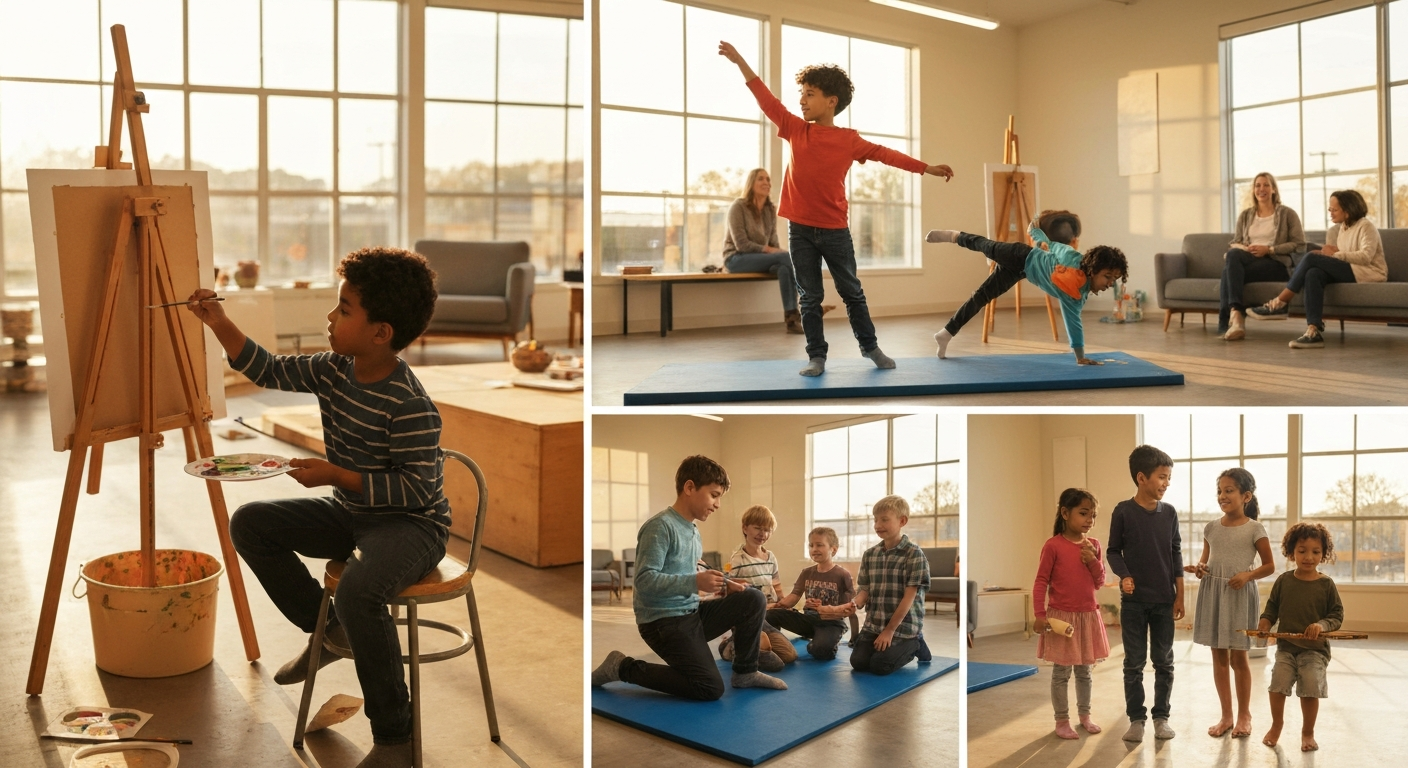
"My kid likes art, so I signed them up for art class."
Sounds reasonable. But three weeks in, they're dragging their feet. The class is 90 minutes — too long for a 5-year-old. The studio is 30 minutes away. They wanted to paint, but the class is all drawing. And you're realizing you signed up for a full semester.
Quick Answer: Choose afterschool activities by matching your child's personality (group vs. solo, high-energy vs. calm) and practical constraints (schedule, distance, cost) — not just interest categories. Kids ages 4-6 do best with 1-2 activities max; ages 7-12 can handle 2-3 if one is low-key. Always do a trial class before committing to a session.
Most Bay Area parents pick activities based on what's nearby or what their friends' kids are doing. But the right selection framework considers your child's temperament, energy level, and how many activities they can realistically handle — not just whether they "like art" or "like sports."
Here's the decision framework that actually works.
The Real Problem: Interest ≠ Format Fit
Bay Area parents plan ahead with KidPlanr
Find afterschool programs near you
Browse enrichment classes and afterschool care across the Bay Area. Filter by age, day, and pickup location.
Find afterschool programs →Your 7-year-old loves soccer. So you sign them up for the local soccer academy. Two months later, they're miserable.
Why? The academy is competitive. Your kid wanted to run around with friends, not drill passing patterns for an hour. Interest was there. Format fit wasn't.
Common mismatches:
- Kid likes gymnastics → parents pick a pre-team track (competitive format) → kid wanted rec tumbling (play format)
- Kid likes coding → parents pick a 2-hour Saturday intensive → kid burns out after 45 minutes (attention span mismatch)
- Kid likes music → parents pick private lessons → kid wanted group jam sessions (social learner, not solo format)
The fix: ask 5 questions before you sign up.
Framework: 5 Questions to Ask Before Signing Up
Question 1: Does the Format Match My Kid's Personality?
Bay Area studios typically offer 3 formats per activity: recreational (play-based), skill-building (structured), and competitive (performance-focused).
Format decision guide:
| If your kid... | Choose this format |
|---|---|
| Plays well with others, likes making friends | Group classes (6-12 kids) |
| Gets overwhelmed in groups, prefers 1-on-1 | Private lessons or small-group (2-4 kids) |
| Has boundless energy, fidgets during downtime | High-energy formats: sports, dance, gymnastics, parkour |
| Prefers calm, focused activities | Low-key formats: art, music, coding, chess |
| Thrives on competition, wants to "win" | Pre-team or competitive tracks |
| Just wants to have fun, no pressure | Recreational tracks |
Example: A 6-year-old who loves drawing but gets shy in groups? Look for small-group art classes (4-6 kids max) or parent-child art sessions — not the 15-kid studio class.
Question 2: Can My Kid Handle the Session Length?
Most Bay Area afterschool programs run 45 minutes to 90 minutes per session. But attention span varies by age.
Age-appropriate session lengths (typical):
| Age | Max session length (most kids) | What happens when it's too long |
|---|---|---|
| 4-5 years | 45-60 minutes | Fidgeting, wandering, asking to leave early |
| 6-7 years | 60-75 minutes | Losing focus in the last 15 minutes, complaints on the drive home |
| 8-10 years | 75-90 minutes | Fine if engaged; watch for burnout if back-to-back activities |
| 11-12 years | 90+ minutes | Can handle longer if interested; may resist if forced |
What to watch for during a trial class:
- Do they stay engaged the whole time, or check out halfway through?
- Are they asking "when is this over?" or fully absorbed?
- Are they energized after, or drained?
If they're dragging in the last 20 minutes, the session is too long. Look for shorter formats.
Question 3: How Many Activities Can They Actually Handle?
The Bay Area afterschool scene makes it easy to sign up for 4-5 activities. But child development experts have clear guidance on limits.
Age-based activity limits (typical capacity):
| Age | Max activities/week | Example schedule that works |
|---|---|---|
| 4-6 years | 1-2 activities | One 45-min gymnastics class, one weekend swim lesson |
| 7-9 years | 2-3 activities | Soccer practice 2x/week, piano 1x/week, open weekend |
| 10-12 years | 2-3 activities (or 1 intensive) | School robotics team 3x/week + one casual weekend activity |
Red flags you're doing too much:
- Your child can't complete homework without staying up past bedtime
- They're getting less than 8 hours of sleep per night
- They resist going to activities they used to enjoy
- You're spending every weeknight driving between studios
- Family dinners have disappeared from the schedule
The fix: Most Bay Area kids ages 4-7 do well with 1-2 activities max. Ages 8-12 can handle 2-3 if at least one is low-key (not every activity needs to be intense).
What NOT to over-interpret: Dropping an activity after 2-4 sessions is not "quitting." It's smart data collection. You tried it, learned it wasn't the right fit, and moved on. Many Bay Area studios offer 4-week trial sessions for exactly this reason.
Question 4: Can You Actually Make It Work Logistically?
An activity your kid loves but you can't reliably get them to? That's not going to work.
Logistics checklist:
- [ ] Drive time: Is the studio within 20 minutes of home or school? (30+ minutes each way = burnout for parents)
- [ ] Schedule fit: Does the class time work with your work schedule, sibling pickups, and dinner?
- [ ] Consistency: Can you commit to the same day/time every week for 8-12 weeks?
- [ ] Backup plan: If you're stuck at work, who can do pickup? Carpool? Grandparent? Neighbor?
Real Bay Area scenario: Your child wants coding classes in Palo Alto. You live in San Jose. Class is Tuesdays at 4:30pm. You get off work at 5pm. Even with carpool, this doesn't work. Look for San Jose options or weekend classes instead.
Question 5: What's the Trial-Before-Commitment Policy?
Most Bay Area studios offer trial classes. Always try before you commit to a full session.
Typical Bay Area trial formats:
- Drop-in trial: $10-25 for one class (common at YMCAs, rec centers)
- Free first class: Increasingly common at private studios
- Trial week: $40-60 for a full week (some coding academies)
- 30-day trial: Full refund if your child isn't loving it (rare but exists — California Strong Athletics offers this)
What to observe during the trial:
- Does your child engage with the instructor and other kids?
- Do they ask when the next class is, or resist going back?
- Does the instructor's style match your kid? (Some kids need high-energy coaches, others need calm and patient)
- Is the skill level appropriate? (Not too easy, not too hard)
If the trial goes well: Ask about session length, cost, and schedule before signing up. Get the full picture.
If the trial doesn't go well: Thank the studio and move on. You just saved yourself 12 weeks of struggles.
How to Know If Your Kid Is Actually Enjoying It
You've picked an activity. They've been going for 4-6 weeks. How do you know if it's working?
Green flags (keep going):
- They ask "when is [activity] this week?" without prompting
- They come home energized, not drained
- They talk about what they learned or show you new skills
- They mention friends from the class or the instructor by name
- They resist missing a session even when sick or tired
Yellow flags (check in):
- Neutral when you mention the activity — not excited, not resistant
- Goes without complaint but never brings it up unprompted
- Hasn't formed friendships with other kids in the class
- Skill progression has plateaued (could be format mismatch or wrong level)
Red flags (consider switching or stopping):
- Resists getting ready, complains about going
- Comes home grumpy or irritable after class
- Has stopped talking about it entirely
- Physical complaints (stomach aches, headaches) before class time
The conversation to have:
"I've noticed you don't seem as excited about [activity] lately. On a scale of 1-10, how much are you enjoying it? What would make it more fun?"
Listen without judgment. If they say "I want to quit," dig deeper:
- Is it the activity itself, or the format? (Maybe they'd like group guitar instead of private lessons)
- Is it the instructor's style? (Maybe they'd do better with a different teacher)
- Is it timing? (Maybe Tuesday after a long school day is too much)
When to stick with it: If your child is learning, progressing, and has good moments even if they occasionally resist, give it 8-12 weeks total before deciding. Early resistance often fades as they build skill and friendships.
When to stop: If they're consistently miserable after 8 weeks, it's not the right fit. Move on without guilt.
What About Cost?
Bay Area afterschool activities typically cost $80-300/month for once-per-week classes. Most fall in the $80-200/month range.
Typical price ranges by activity type:
| Activity type | Monthly cost (1x/week) | Notes |
|---|---|---|
| Recreation classes (city programs) | $20-80/month | Subsidized, often include sibling discounts |
| Gymnastics, dance, martial arts | $80-150/month | Private studios; pre-team tracks cost more |
| Swimming lessons | $100-180/month | Pool access fees included |
| Music lessons (private) | $120-200/month | Group classes are cheaper ($60-100/month) |
| STEM (coding, robotics) | $150-300/month | Materials and lab fees often included |
Budget options:
- City recreation programs: $20-80/month (Mountain View, Palo Alto, San Mateo rec centers)
- YMCA / JCC sliding-scale tuition: based on household income
- Sibling discounts: most studios offer 10-15% off for additional kids
Planning summer camps too? Search 3,000+ Bay Area camps by activity →
Before You Sign Up: Your Decision Checklist
Print this out (or save to your phone) and bring it to trial classes:
Format Match
- [ ] Does the class format (group vs. solo, competitive vs. rec) match my kid's personality?
- [ ] Is the session length appropriate for their age and attention span?
Practical Fit
- [ ] Can I reliably get them there every week without stress?
- [ ] Does the schedule work with our family rhythm (homework, dinner, bedtime)?
- [ ] Can they do this activity AND still have downtime/free play?
Trial & Commitment
- [ ] Did I do a trial class first?
- [ ] During the trial, did they engage the whole time or lose interest?
- [ ] What's the cancellation/refund policy if it doesn't work out?
Activity Load
- [ ] With this activity, how many total activities per week? (Compare to age-based limits above)
- [ ] Do they still have at least 2 completely free afternoons per week?
If you check 4-5 boxes, sign up. If you check fewer than 3, reconsider or try a different format.
Track Your Kid's Activities as You Explore
Struggling to track whether your kids are actually enjoying their activities? We're building KidPlanr Activity Tracker — a simple way to log what your kids do and see what they love.
Join 150+ Bay Area parents on the waitlist → kidplanr.com/afterschool
FAQ
Q: What's a good age to start organized afterschool activities?
Most Bay Area studios offer parent-child classes starting at 18 months to 2 years (music, gym-and-swim, toddler art). Solo classes typically start at age 3-4. But there's no "right" age — it depends on your child's temperament. Some kids thrive in group settings at 3; others need until 5 or 6.
Q: How do I know if my child is ready for a competitive track?
Competitive tracks (pre-team gymnastics, travel soccer, competitive dance) require 3-5 practices per week and significant family commitment. Most Bay Area advisors recommend waiting until age 7-8 minimum, and only if your child is self-motivated (asks to practice at home, resistant to missing sessions). If you're the one pushing for competitive, it's probably too soon.
Q: My child wants to try everything. How do I say no?
Frame it as "we're trying activities one at a time so you can really enjoy them." Pick one, commit to 8-12 weeks, then reassess. Most Bay Area kids who "try everything at once" end up burned out and enjoying nothing. Sequential exploration (gymnastics this quarter, coding next quarter) works better than simultaneous overload.
Q: Should I make my child finish the session even if they hate it?
If they're consistently miserable and it's affecting family life, no. But if they're just in the "I'm bored today" phase (common weeks 3-5), encourage them to stick with it through the trial period. The conversation to have: "We committed to trying this for 8 weeks. Let's finish the commitment, then decide together." This teaches follow-through without forcing them into something truly wrong for them.
Q: How much free time should my child have?
Child development experts recommend kids ages 4-12 should have at least 2 completely free afternoons per week (no activities, no homework pressure, just play). Free time is when kids process what they've learned, play creatively, and develop independent interests. If your schedule doesn't allow for this, it's time to cut an activity.
Bay Area parents plan ahead with KidPlanr
Find afterschool programs near you
Browse enrichment classes and afterschool care across the Bay Area. Filter by age, day, and pickup location.
Find afterschool programs