Best Afterschool Activities for Kids in Bay Area 2026
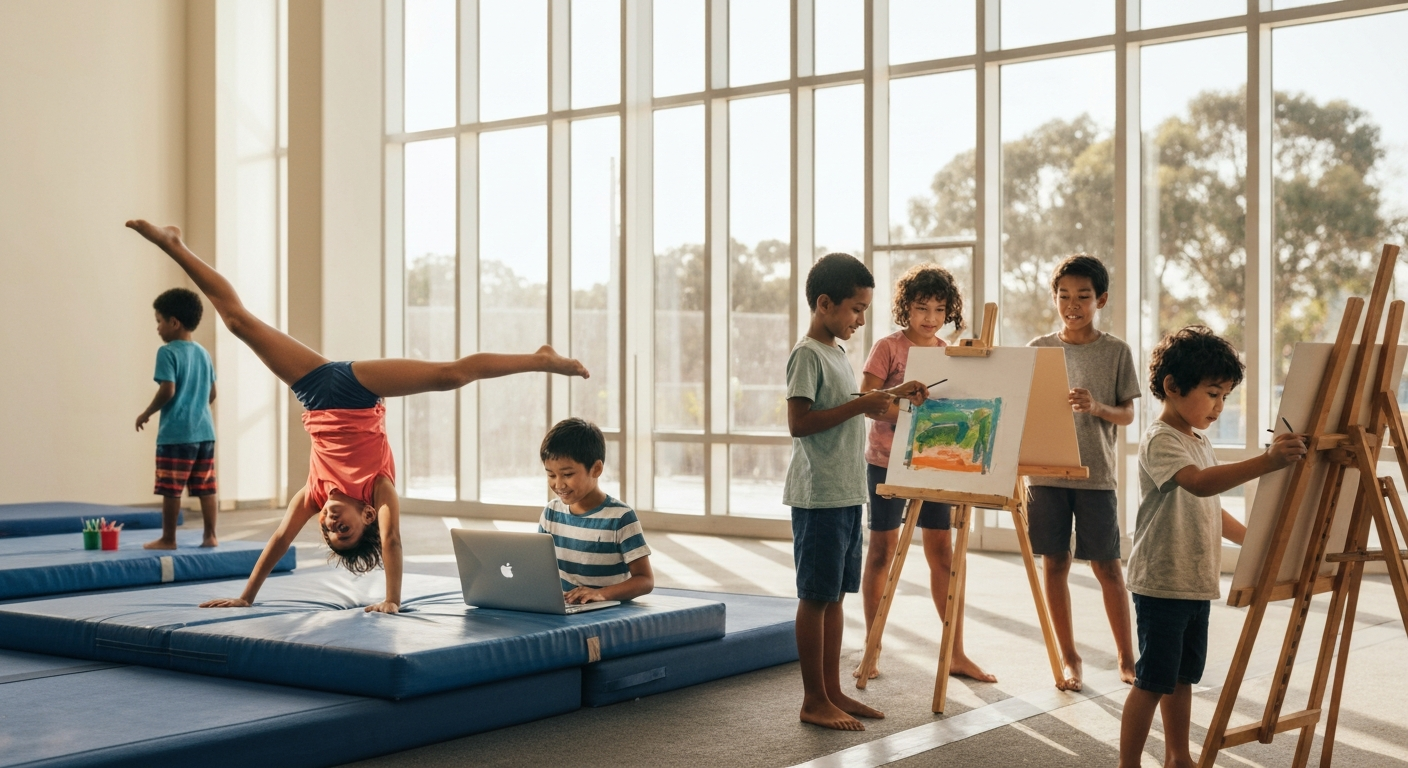
School ends at 3 PM. Your kid needs pickup at 3:15. You're in back-to-back meetings until 5. The after-school activity catalog arrived last week — 47 pages of options you haven't had time to read.
Quick Answer: Bay Area afterschool activities range from $50/month (city rec programs) to $400/month (specialized training). Most quality programs fall in the $120–$200/month range. Common categories: team sports (soccer, basketball), individual sports (gymnastics, swimming), creative arts, STEM/coding, and music. Try 3–5 trial classes before committing — most Bay Area programs offer free or $10 trials. Match activities to your child's temperament, not just their stated interests.
Why Parents Are Searching for Afterschool Activities
Bay Area parents plan ahead with KidPlanr
Find afterschool programs near you
Browse enrichment classes and afterschool care across the Bay Area. Filter by age, day, and pickup location.
Find afterschool programs →You're not just looking for childcare. You want your child to discover something they love, build skills, make friends — maybe find the thing that defines their elementary years. At the same time, you need something that fits your work schedule and doesn't require a second mortgage.
The Bay Area has hundreds of programs. The hard part isn't finding options — it's choosing among them without burning weeks of research time you don't have.
Best Afterschool Programs in the Bay Area (By Category)
Team Sports
Team sports build social skills, physical fitness, and commitment. Your child learns to win gracefully, lose gracefully, and show up for their teammates even when they'd rather stay home.
Soccer Programs
Most common team sport for elementary ages. Seasons run fall and spring; some programs offer year-round training.
- Soccer Shots (Bay Area, SF Bay, East Bay) — Ages 2–8, introductory programs focused on fun and foundational skills. Multiple Bay Area locations.
- Peninsula Soccer Club (Foster City) — Competitive youth club with development camps and skills clinics. Ages 5+, $150–$300/month depending on team level.
- Soccer Stars (Burlingame, Redwood City, Foster City, San Bruno) — Classes and camps for ages 1–12+. Approximately $120–$180/month.
- America SCORES Bay Area — Out-of-school program combining soccer, poetry, and service-learning. Check local schools for availability.
Basketball Programs
Many city rec departments (Palo Alto, Mountain View, San Mateo) run seasonal leagues for ages 6+. Pricing typically $80–$120 per season.
What this means: Team sports require consistent attendance (your child can't skip practices without affecting the team). If your work schedule is unpredictable, individual sports may fit better.
How common: Soccer and basketball are the two most common Bay Area elementary team sports. Every city has at least one recreational league.
What you can do now: Check your city's Parks & Recreation website for upcoming season registration. Most rec leagues open registration 6–8 weeks before the season starts.
What NOT to over-interpret: Your child joining a recreational soccer league at age 6 does not lock them into competitive travel soccer. Rec leagues are low-pressure, skill-building environments — not early talent identification.
Individual Sports — Movement & Coordination
Individual sports let your child progress at their own pace. No team dependencies mean more flexibility if you need to miss a week.
Gymnastics
Builds strength, flexibility, balance, and body awareness. Classes typically run year-round with open enrollment.
Silicon Valley / South Bay:
- Gold Star Gymnastics (Sunnyvale) — Ages 18 months+. Parent-child classes for toddlers, progressive skill levels for older kids. Approximately $100–$160/month.
- California Sports Center (San Jose, Sunnyvale, Morgan Hill) — Five Bay Area locations, classes across age ranges. Approximately $120–$180/month.
- Airborne Gymnastics (Santa Clara) — Competitive and recreational programs. Ages 3+, $130–$200/month depending on class level.
Peninsula:
- The Little Gym (Mountain View) — Parent/child classes starting at 4 months, progressive through grade school. Approximately $140–$200/month.
- My Gym (Palo Alto) — Focus on foundational skills, fun-first approach, not competition-focused. Ages 3+, $150–$220/month.
- Peninsula Gymnastics — Professional training center, recreational through competitive levels. Approximately $120–$190/month.
- Bayshore Elite Gymnastics (Redwood City) — Located at 2694 Middlefield Rd, recreational and competitive programs. $130–$210/month.
East Bay:
- Twisters Gymnastics — Quality gymnastics education, multiple class levels. Approximately $110–$180/month.
What this means: Gymnastics is one of the most popular Bay Area afterschool activities for ages 4–10. Most studios have waitlists during peak fall enrollment (September–October). Register early or join mid-year when spots open.
How common: Nearly every Bay Area city has at least one gymnastics studio within 15 minutes. Enrollment peaks in fall; waitlists are common for popular time slots (4:00–5:30 PM).
What you can do now: Call 2–3 studios near you and ask about trial class availability. Most offer one free or $10 trial. Schedule trials for different days of the week to see which schedule fits your family.
What NOT to over-interpret: A gymnastics class is not a commitment to competitive gymnastics. The vast majority of Bay Area gymnastics students are in recreational programs — they learn skills, have fun, and move on to other activities in middle school. Competitive gymnastics is a separate decision made years later, if at all.
Swimming Lessons
Safety-critical skill that doubles as exercise. Year-round programs are common; many families do swim year-round to maintain skills.
East Bay:
- East Bay Regional Park District (multiple locations) — Public pools across East Bay cities. Registration opens seasonally. Approximately $50–$80 per session.
- City of Oakland Pools — deFremery, Larry Reid Sports Center, Fremont Pool, Lions Pool (Dimond Park), Temescal Pool (Oakland Tech). City-run programs, $40–$70 per session.
- AquaTech Swim (Alameda, Concord) — Year-round programs, multiple class levels. Approximately $130–$180/month.
- Splash Swim School (East Bay, two locations) — Year-round swim lessons. Approximately $150–$210/month.
- Ohana Aquatics (Oakland) — Year-round lessons. Approximately $140–$190/month.
Peninsula:
- Peninsula Jewish Community Center (Foster City) — Swim programs for all ages. Approximately $100–$160/month.
- King's Swim Academy (San Mateo) — Year-round lessons. Approximately $140–$200/month.
What this means: Swimming is less flexible than other activities — if your child misses 2–3 weeks, they often need to repeat a level to rebuild skills. Consistency matters more in swimming than in other sports.
How common: Most Bay Area families enroll their children in swim lessons at some point between ages 3–8. It's considered a foundational life skill, not just an activity.
What you can do now: If your child hasn't learned to swim yet, this is a higher priority than most other activities. Start with a trial class at a nearby facility to assess instructor style and class size.
Creative Arts
Arts programs build fine motor skills, creative expression, and patience. Your child learns to see a project through from concept to completion.
Visual Arts
Peninsula / Pacifica:
- Bay Area Art School (Pacifica) — After-school classes Monday–Thursday. Elementary classes (grades 1–5) Thursdays 3:15–4:45 PM. Comics & Cartooning Club Wednesdays 2:15–3:45 PM. Young Masters Art Studio Wednesdays and Thursdays 4:00–6:30 PM. Approximately $120–$180/month.
- Pacific Art League (Palo Alto) — Hands-on projects including drawing, painting, sculpture, mixed media. All skill levels, taught by working artists. Approximately $110–$170/month.
East Bay:
- Kala Art Institute (Berkeley) — After School Studio for grades 1–5. Interactive art-making experience. Spring 2026 classes open. Approximately $130–$190/month.
What this means: Art programs typically have smaller class sizes (8–12 kids) compared to sports (15–20 kids). Smaller groups mean more individual attention, but also higher per-child costs.
How common: Art classes are less common than sports programs, but every Bay Area region has at least one established art studio for kids. Enrollment is steadier year-round compared to sports (which peak in fall).
What you can do now: Most art programs allow drop-in trial classes. Bring your child to one session before committing to a semester.
STEM & Coding
Technology-focused programs teach logical thinking, problem-solving, and digital literacy. Popular with Bay Area families given the tech industry concentration.
South Bay / Peninsula:
- theCoderSchool (South Bay location near Winchester Blvd) — Private and low-ratio coding classes. Python, Scratch, JavaScript, and more. Ages 5–18. After-school hours Monday–Friday 3:30–6:30 PM (Wednesday until 7:30 PM), Saturday 9 AM–2 PM. Code Coaching program uses 2:1 teaching ratio with individualized curriculum. Approximately $180–$280/month for after-school programs.
- Code With Us (Fremont, Campbell, Cupertino, Saratoga, Sunnyvale) — Teaches 13+ coding languages to ages 5–18. Private and small group classes. Students choose project types (mobile apps, 3D printing, robots, gadgets). Approximately $200–$300/month for group classes, $300–$400/month for private.
- Club SciKidz Silicon Valley (San Jose, Cupertino, Santa Clara, Mountain View, Campbell, Saratoga) — Hands-on STEM classes. Robotics, AI, 3D Printing, Minecraft, Roblox, LEGO & VEX Robotics. Ages 4–15. After-school programs and camps. Approximately $150–$250/month.
Bay Area-Wide:
- CodeFu Bay Area — Coding for kids. Multiple Bay Area locations. Approximately $160–$240/month.
- YoungWonks — Computer programming and engineering classes. Students throughout Bay Area (East Bay, Tri Valley, South Bay, Peninsula, North Bay, Central Valley). Approximately $180–$270/month.
What this means: Coding classes range from beginner (Scratch, block-based programming for ages 5–8) to advanced (Python, Java for ages 10+). If your child has never coded before, start with Scratch-based programs — they build logic skills without requiring typing speed.
How common: Coding is growing fast but still less common than traditional sports. Many families try coding for one semester and discover their child prefers hands-on building (robotics) or drops it entirely. That's normal — think of it as an exploratory phase.
What you can do now: Most coding programs offer a free first class or discounted trial week. Take advantage of trials before committing to a full semester ($600–$1,200).
What NOT to over-interpret: Your child learning Scratch at age 7 does NOT mean they need to continue coding every year through high school. Coding teaches logical thinking that transfers to other domains — the goal is exploration, not career prep.
Music
Music programs build discipline, auditory skills, and the satisfaction of measurable progress (learning a new song, passing a level).
Bay Area options include private lessons (piano, violin, guitar) and group classes (Suzuki method, general music exploration). Pricing varies widely:
- City rec programs: $60–$100 per 8-week session
- Private studios: $120–$200/month for weekly 30-minute lessons
- Suzuki programs: $150–$250/month for group + private lesson combination
Common Bay Area music schools include community music centers (often subsidized, income-based pricing), private studios, and in-home instructors.
What this means: Music requires home practice (10–20 minutes per day for beginners). Unlike sports where all skill-building happens in class, music progress depends on what happens at home between lessons. If your family schedule can't support daily practice time, music may not fit right now.
How common: About 30–40% of Bay Area elementary families try music lessons at some point. Many start piano ages 5–7, continue 1–3 years, and stop. That's a normal pattern — music doesn't have to be a lifelong commitment to be valuable.
What you can do now: Ask your child's school if they offer instrument rental programs (many do for band/orchestra instruments starting 4th–5th grade). Renting before buying saves money if your child decides music isn't for them.
How to Choose the Right Afterschool Activity
Consider Your Child's Personality
Different activities reward different temperaments:
Team Sports (Soccer, Basketball): Best for kids who are energized by group dynamics, enjoy competitive games, and don't mind sharing the spotlight. Not ideal for kids who prefer individual challenges or get anxious about letting teammates down.
Individual Sports (Gymnastics, Swimming): Best for kids who like measurable personal progress, prefer working at their own pace, and enjoy mastering specific skills. Not ideal for kids who need external social motivation to stay engaged.
Creative Arts (Drawing, Painting, Crafts): Best for kids with high patience, attention to detail, and comfort with open-ended projects. Not ideal for kids who need fast-paced activity or get frustrated when projects don't turn out as imagined.
STEM / Coding: Best for kids who enjoy puzzles, logical problems, and seeing cause-and-effect. Not ideal for kids who prefer physical activity or get impatient with screen-based tasks.
Music: Best for kids who tolerate repetition, like structure, and are willing to practice alone at home. Not ideal for kids who need immediate gratification or resist daily routines.
What this means: Your child's stated interest ("I want to do coding!") is less predictive of long-term enjoyment than temperament fit. A child who says they want coding but has low frustration tolerance will likely quit after 3–4 weeks of debugging errors.
How common: Most Bay Area parents try 2–4 different activities before finding one that sticks for 1+ years. Trying and quitting is normal — it's how kids discover what they actually enjoy versus what sounds cool.
What you can do now: Think about situations where your child was deeply engaged for 30+ minutes without prompting. What was the activity? That's a clue to temperament, not just interest.
Schedule Fit
What time does the activity start? Most after-school programs run 4:00–5:30 PM or 5:30–7:00 PM. If your work day ends at 5 PM and the program starts at 4 PM, you need a plan for the 1-hour gap (extended day at school, grandparent pickup, carpool arrangement).
How many days per week? Team sports typically require 2–3 days (practices + games). Individual programs often meet once per week. Coding and music are usually once per week. Gymnastics can be once or twice depending on level.
What's the time commitment outside of class? Music requires home practice. Coding sometimes has optional homework projects. Sports require arrival 10 minutes early for warmup. Art programs require occasional supply purchases or project completion at home.
What this means: The stated class time (4:00–5:30 PM) is not the full time commitment. Add 15 minutes before for arrival and setup, 15 minutes after for pickup and transition. A "90-minute class" actually consumes 2 hours of your evening when you factor in driving, parking, and getting your child fed afterwards.
How common: Working parents in the Bay Area commonly rely on extended day programs at school (3 PM–6 PM) combined with one outside activity starting at 5:30 PM. This gives the child structure from 3–6 PM and the activity from 5:30–7 PM, fitting a typical work schedule.
What you can do now: Map out a realistic week. If your child does soccer Tuesday/Thursday 5:30–7 PM and piano Wednesday 5:30–6 PM, when do they do homework? When do they eat dinner? When is there downtime? If the answer is "no downtime," that's too much.
What NOT to over-interpret: Your child being tired on activity nights does NOT mean they're overscheduled. Being tired after physical or mental exertion is normal. The warning sign is: are they consistently melting down, resisting going, or unable to focus on anything else because they're so drained? That's overscheduling. Tired but happy is fine.
Budget
Bay Area afterschool activities range from $50/month to $400/month per child. Here's the typical breakdown:
$50–$80/month: City recreation programs (soccer leagues, art classes, swim lessons through Parks & Rec)
$120–$180/month: Mid-tier programs (gymnastics at recreational level, private swim schools, group coding classes, art studios)
$200–$300/month: Specialized programs (coding with low student-to-teacher ratios, competitive sports teams, private music lessons, advanced gymnastics)
$300–$400/month: Premium programs (private coding instruction, elite sports training, Suzuki music combination programs)
What this means: A family with two kids doing one activity each can expect to spend $240–$360/month (mid-tier programs). Three kids doing two activities each would be $720–$1,080/month. These are ongoing monthly costs, not one-time fees.
How common: According to Bay Area parent surveys, families with elementary-aged kids typically budget $200–$400/month total for all afterschool activities combined. Families spending over $500/month often have 3+ kids or children in competitive programs.
What you can do now: Calculate your actual monthly spend by adding up all activity fees, plus hidden costs (uniforms, equipment, recital fees, competition entry fees). Many Bay Area programs charge a registration fee ($50–$100) on top of monthly tuition — factor that in when comparing costs.
What NOT to over-interpret: Higher cost does not always mean better instruction. City rec programs charging $60/month often have the same or better instructors as private studios charging $180/month. You're often paying for convenience (more class time options, nicer facilities, central location) more than quality.
Trial Class Strategy
Most Bay Area programs offer free or $10 trial classes. Use trials strategically:
-
Shortlist 3–5 activities based on your child's temperament and your family's schedule/budget constraints.
-
Schedule all 5 trials within 3–4 weeks. Spread them across different days so you can assess schedule fit. Don't spread trials over 3 months — your child will forget what the first trial was like by the time you finish the fifth.
-
Ask your child one question after each trial: "Would you want to go back next week?" Not "Did you like it?" (kids say yes to everything). "Would you want to go back?" is more predictive.
-
Observe the first 10 minutes of the trial class. Are kids engaged? Is the instructor giving individual feedback or just supervising? Is there a lot of standing around waiting for turns, or is the class actively moving?
-
After all trials, pick ONE to commit to for a full semester (12–16 weeks). Don't sign up for 3 activities at once. Let your child establish a routine with one activity before adding a second.
What this means: Trial classes are free research. Use them. Many Bay Area parents skip trials because they're in a rush to "just pick something." Those families often end up quitting after 4 weeks when the child loses interest — wasting $300–$400 on a program that was never a good fit.
How common: Only about 30% of Bay Area families use trial classes before committing. The other 70% pick based on location, friend recommendations, or whatever program they saw first. Trial-users have much higher 6-month retention rates.
What you can do now: Email 5 programs this week. Ask: "Do you offer a free trial class? If so, what dates are available in the next 3 weeks?" Schedule all 5 before committing to any.
How to Know If Your Kid Is Really Enjoying It
Trying an activity is one thing. Knowing whether to continue is another. Watch for these signals:
Green Flags (Keep Going):
- Your child asks "When's my next class?" without prompting
- They talk about something specific they learned or did in class ("I learned how to do a cartwheel!" or "I built a robot that moves!")
- They voluntarily practice or recreate the activity at home (draws at home after art class, kicks a ball around after soccer)
- They mention other kids in the class by name — forming friendships
Yellow Flags (Check In):
- Your child goes willingly but doesn't mention the class afterwards
- They don't resist going but also don't seem excited
- You have to remind them repeatedly that class is today
- They complete the class but immediately switch to a different activity (e.g., does coding class but rushes home to play outside — suggesting they prefer physical activity)
Red Flags (Consider Stopping):
- Your child regularly asks to skip, fakes illness, or has meltdowns before class
- The only thing they mention about class is a friend — they're there for social time, not the activity
- They've been going for 12+ weeks and still can't name one thing they enjoy about it
- They cry or shut down when you ask how class went
What this means: Yellow flags are common in the first 4–6 weeks of any new activity. Give it time. Red flags persisting past 8 weeks mean it's not the right fit — stop and try something else.
How common: About 40% of Bay Area kids quit their first activity within 3 months. That's normal. The goal is exploration, not commitment.
What you can do now: After the first 4 weeks, ask your child: "On a scale of 1–10, how much do you want to keep going to [activity]?" If they say 7 or below, have a follow-up conversation: "What would make it more fun?" Sometimes a different class time, different instructor, or different facility makes the difference.
Ready to Track Progress Across All Your Kid's Activities?
Figuring out what your child loves is one challenge. Remembering what they're signed up for, when classes happen, and which activities they've tried is another.
We're building KidPlanr Activity Tracker — a simple tool to log what your kids do and see patterns over time. Track trial classes, note what they loved (and what they didn't), and have a record when it's time to re-enroll or try something new.
Join 200+ Bay Area parents on the waitlist → kidplanr.com/afterschool
Activity Selection Decision Tree
Use this decision tree to narrow down which activity category fits your child:
Start Here: What energizes your child?
→ Social interaction with peers
- Likes competition? → Team sports (soccer, basketball)
- Prefers collaboration over competition? → Group art classes or music ensembles
→ Solo focus and personal challenge
- Prefers physical activity? → Individual sports (gymnastics, swimming, martial arts)
- Prefers mental puzzles? → Coding / STEM programs
→ Open-ended creative expression
- Tactile and hands-on? → Visual arts (drawing, painting, sculpture)
- Auditory and pattern-based? → Music lessons
Next: What's your family's schedule flexibility?
→ High flexibility (you can adjust work schedule or have backup pickup)
- Team sports (2–3 days/week commitment, fixed schedule)
→ Moderate flexibility (one consistent weekly time slot works)
- Individual sports, arts, coding, music (1–2 days/week, more schedule options)
→ Low flexibility (unpredictable work hours, need drop-in options)
- City rec drop-in programs or weekend-only classes
Final: What's your monthly budget per child?
→ $50–$100/month: City recreation programs
→ $120–$200/month: Mid-tier studios and clubs
→ $200+/month: Specialized or private instruction
Action Step: Based on your answers, shortlist 3–5 programs in your target category. Schedule trial classes within the next 3 weeks. Observe your child's engagement. Commit to one program for a full semester.
FAQ
What's a good age to start afterschool activities?
Most Bay Area programs start accepting kids ages 3–4 for parent-child classes (gymnastics, swimming, music). Independent classes (where parents don't participate) typically start age 5. Many parents wait until kindergarten or 1st grade (ages 5–6) when kids can follow group instructions more easily.
That said, there's no universal "right age." If your 4-year-old can follow a teacher's directions in a group of 8–10 kids, they're ready. If your 6-year-old melts down in group settings, they might need another year.
How much do Bay Area afterschool activities usually cost?
Expect $120–$200/month for most mid-tier programs (recreational gymnastics, swim lessons at private schools, group coding classes, art studios). City recreation programs are cheaper ($50–$80/month). Specialized programs (competitive sports, private music lessons, advanced coding) run $200–$400/month.
Hidden costs: registration fees ($50–$100/year), uniforms ($30–$80), competition entry fees ($40–$60 per event), recital costumes ($50–$100). Budget an extra 20–30% beyond stated tuition for these add-ons.
Where can I find free trials?
Call programs directly and ask: "Do you offer a free trial class?" Most Bay Area studios offer at least one free class per child. Some charge $10–$15 for a trial. A few (particularly high-demand programs) don't offer trials at all — you sign up for a full session.
Expect to fill out a waiver form before the trial. Arrive 10 minutes early for paperwork.
How do I know if my child is overscheduled?
Warning signs: consistent meltdowns before activities, resistance to going, inability to focus on homework, complaints of being tired even after a full night's sleep, or asking to quit everything at once.
A general guideline: elementary kids (K–5th grade) can usually handle 1–2 activities per week (not counting school and homework). Middle schoolers (6th–8th) can handle 2–3. More than that, and you risk burnout.
The test: Does your child have at least 3 completely unscheduled afternoons per week (no activities, no playdates, no obligations)? If no, that's overscheduled.
Should I let my child quit if they ask?
It depends on timing and reason. If they're asking to quit in the first 2–3 weeks, that's often adjustment anxiety — encourage them to try 4–6 weeks before deciding. If they're asking to quit after 8+ weeks and can articulate a specific reason ("I don't like the coach" or "It's boring"), listen to that.
One rule many Bay Area parents use: "You can quit, but not mid-session. Finish the session (12–16 weeks), then we won't re-enroll." This teaches commitment without forcing a year-long miserable experience.
What if my child wants to do coding but we can't afford $250/month?
Check if your child's school offers coding as an after-school club (many Bay Area elementary schools do, often for $50–$100 per session). Libraries also run free coding workshops and camps seasonally.
Online options like Code.org and Scratch are free and high-quality for beginners. Your child can explore at home, and if they love it, invest in a paid program later.
Can kids do multiple activities at once?
Yes, but start with one. Let your child establish a routine with one activity for 8–12 weeks before adding a second. Jumping into 3 activities at once often leads to overwhelm and quitting all three.
A common pattern: one physical activity (sports or dance) + one creative/mental activity (art, music, or coding). This balances body and mind, and prevents overuse injuries from doing the same physical movement patterns all week.
Planning summer camps too? Search 3,000+ Bay Area camps by activity, city, and budget →
Bay Area parents plan ahead with KidPlanr
Find afterschool programs near you
Browse enrichment classes and afterschool care across the Bay Area. Filter by age, day, and pickup location.
Find afterschool programs